BA English with Study in North America
Please note: This page is for 2027 entry. Click here for 2026 entry.
| UCAS code | Q310 |
|---|---|
| Duration | 3 years |
| Entry year | 2027 |
| Campus | Streatham Campus |
| Typical offer | A-Level: A*AA |
|---|---|
|
A-Level: AAB |
Why study BA English with Study in North America at Exeter?
- Three-year programme with your second year spent at one of our partner universities in Canada or the USA. Combined study of diverse modules, focusing on American literature and culture. Choose from locations like New York, Florida and Vancouver.
- You’ll develop your expertise in subjects ranging from medieval to contemporary literatures. We offer diverse optional modules so you can build a programme reflective of your literary interests.
- Our English department includes world-class experts in the subfields of film studies and creative writing.
- Excellent facilities on campus include our Special Collections relating to world-renowned writers, The Bill Douglas Cinema Museum which is a unique film and popular culture resource and our Digital Humanities Lab. Exeter has also recently been awarded UNESCO City of Literature status.
- Participate in events involving internationally acclaimed authors, actors and filmmakers.

Top 10 in the UK for English

Top 50 in the world for English Language and Literature
QS World University Subject Rankings 2026

85% of English graduates in/due to start employment or further study 15 months after graduation
Based on full-time, first degree, UK domiciled graduates, HESA Graduate Outcomes survey 2022/23 data (published 2025)

Unique on-site resources: Exeter’s Special Collections archive and The Bill Douglas Cinema Museum
Entry requirements (typical offer)
| Qualification | Typical offer | Required subjects |
|---|---|---|
| A-Level | A*AA | B in an accepted Humanities or Social Science subject* (see below) |
| IB | 38/766 | HL5 in an accepted Humanities or Social Science subject* (see below) |
| BTEC | D*DD | Applicants studying a BTEC Extended Diploma will also require GCE A-Level grade B in an accepted Humanities or Social Science subject* (see below) |
| GCSE | C or 4 | English Language |
| Access to HE | 30 L3 credits at Distinction Grade and 15 L3 credits at Merit Grade. | To include at least 12 L3 credits at Merit Grade in an accepted Humanities or Social Science subject* (see below) |
| T-Level | Distinction* | Applicants studying a T-Level will also require GCE A-Level grade B in an accepted Humanities or Social Science subject* (see below) |
| Contextual Offer | A-Level: AAB |
Specific subject requirements must still be achieved where stated above. Find out more about contextual offers. |
| Other accepted qualifications | ||
| English language requirements |
International students need to show they have the required level of English language to study this course. The required test scores for this course fall under Profile B1. Please visit our English language requirements page to view the required test scores and equivalencies from your country. |
|
NB General Studies is not included in any offer.
Grades advertised on each programme webpage are the typical level at which our offers are made and provide information on any specific subjects an applicant will need to have studied in order to be considered for a place on the programme. However, if we receive a large number of applications for the programme we may not be able to make an offer to all those who are predicted to achieve/have achieved grades which are in line with our typical offer. For more information on how applications are assessed and when decisions are released, please see: After you apply
*Accepted Humanities and Social Science subjects:
- Anthropology
- Classics and Ancient History
- Drama
- English
- Geography
- Government and Politics
- History
- Law
- Media Studies
- Modern Languages
- Philosophy
- Politics
- Psychology
- Religious Studies
- Sociology
My year studying abroad was one of the best times of my life! I made lasting friendships during my time in America. My roommate Katie was a freshman from Louisiana. We still continue to talk and I will always have that friendship. She was my rock throughout the entire study abroad. I will never forget the friendships I made.
I’ve been really lucky with the lecturers I’ve had in Exeter. My seminar leader in first year pushed me and guided me to learn more and be inquisitive. He lit a fire underneath me. During the first term of first year there was a lot of information to understand but my lecturer made it make sense!
Beth
BA English with Study in North America

Course content
Your year abroad will take place in Year 2.
You may notice changes to some of our modules over the coming months. This is because we are making space for the following:
- Minors: Future Skills Pathways - Alongside your main degree you may be eligible (depending on your course) to choose modules from another subject to broaden your skills and interests.
- Skills to Thrive built into every degree - Essential skills for your future, including communication, problem-solving, teamwork and digital confidence.
- Increased innovation and wellbeing - More room for creative learning, real-world projects and a healthier study rhythm.
The modules below provide examples of what you can expect to learn on this degree course based on recent academic teaching. The precise modules available to you in future years may vary depending on staff availability and research interests, new topics of study, timetabling and student demand.
Please note that the module information displayed here is subject to change.
90 credits of compulsory modules, 30 credits of optional modules
Compulsory modules
| Code | Module | Credits |
|---|---|---|
| Compulsory 1 | ||
| Approaches to Criticism | 30 | |
| Beginnings: English Literature before 1800 | 30 | |
| The Poem | 15 | |
| Academic English | 15 | |
EAS1032: Approaches to Criticism
This module will introduce you to a broad range of critical and theoretical approaches to reading texts. Such approaches, developed throughout the twentieth and twenty-first century and deployed by English Studies scholars, are intended to be both worthy of historical study in their own right and useful to your own research at university. Over the course of the module you will explore a range of ways in which you might approach familiar and unfamiliar texts, and be encouraged to question exactly what a text might be and why it is worth our critical attention.
To cover a significant range of critical and theoretical approaches to literary and film studies in the context of English Studies, including work on language and meaning, texts and reading, the mind and the brain, ideology and power, gender and sexuality, race and empire. The module encourages you to recognise dialogue and dissent within the field, and introduces the ground rules for scholarship in the discipline of English Studies.
EAS1035: Beginnings: English Literature before 1800
This module selects texts that represent some of the richest sources and most complex moments of English cultural history before 1800. These texts, and the cultural elements they combine, went on to have afterlives of great significance for English language, literature and other media. In other senses, they offered legacies that were not taken up, and what has been lost in cultural transformations will also be considered.
The module aims to
- introduce you to these major literary texts. In doing so, we aim to cultivate modes of reading and critical analysis broadly informed by an attention to history and context. Such analysis will include ideas of subjectivity, identity, conflict, community, myth, the transmission of stories, storytelling, translation, transformation, and influence. This module will emphasise essay-writing skills that are fundamental to research and communication in English literature.
EAS1038: The Poem
Despite its strong oral traditions and origins, poetry is the origin of all written literature. It is the base on which all that literature - drama, novels, non-fiction prose - is built. Many of its formal elements are used in common and rhetorical speech. This module is designed to introduce you to the mechanical aspects of poetry and to its history; in addition, it offers you insight into the history and influence of important poetic eras, as well as into how understanding of it may be enriched by literary theory. By the end of the module, you will have a firm grounding in the poem as a form and as a literary force.
The aim of the course is to cultivate skills of formal analysis which can be used in combination with other interpretive and creative techniques later in the degree. There will thus be a close focus in seminars on details of language in particular examples of poetry.
EAS1040: Academic English
Academic English introduces you to the techniques needed to write successful, university-level analytical essays on literary texts and topics. Using model essays and articles, seminar discussions, your own essay writing, and guided readings, you will learn how to write well structured, clearly argued persuasive analytical essays, with a focus on some of the fundamentals of writing: arguments/thesis statements, paragraphing, clarity of expression, essay formatting and accurate referencing. You will also learn how to locate, evaluate, and use secondary (critical) sources that support your essay's argument, as well as how to cite those sources correctly. There will also be attention to ways of analysing literature effectively.
Optional modules
| Code | Module | Credits |
|---|---|---|
| Optional 1 | ||
| Digital Cultures: Narrative, Creativity, Industry | 15 | |
| The Novel | 15 | |
| Rethinking Shakespeare | 15 | |
| Imagine This: Prompts for Creative Writing | 15 | |
EAS1016: Digital Cultures: Narrative, Creativity, Industry
Digital technology has transformed almost every area of human life over the last sixty-five years, and the written word remains at the core of this ongoing transformation. This module will introduce you to some of these developments across literary cultures, and you will gain an understanding of how phenomena such as interactive storytelling, artificial intelligence and the Internet have come to influence literature's subject matter as well as its modes of publishing and production. Alongside critical readings and discussions, you will conduct practice-based research by learning to use some of the technologies and software that define modern literary cultures..
This module aims:
- To consider how digital technology makes itself apparent in modern literary, visual and creative cultures.
- To introduce you to a diverse range of authors, poets, artists, technologists, theorists and critics both commenting upon and using digital technologies to explore new possibilities in literature.
- To explore the historical relationship between literary cultures, visual cultures and emerging technologies, grounding students' understanding of current debates in this field.
- To enable you to create a diverse portfolio of creative and critical responses to the topics explored in class, including both traditional written outputs and digital prototypes.
EAS1037: The Novel
This module will introduce you to an exciting range of novels representative of diverse narrative styles drawn from different historical periods and national contexts. The module covers the development of this important genre from the birth of the novel in eighteenth-century England through the nineteenth-century and modernist periods into the present day. It provides an invaluable foundation for future study in a number of literary fields.
- To introduce students to an exciting range of novels representative of diverse narrative styles drawn from different historical periods and national contexts. The module covers the development of this important genre from the birth of the novel in eighteenth-century England through the nineteenth-century and modernist periods into the present day.
- To address the emergence and reception of the novel in relation to its historical and literary contexts and to its adoption, and adaptation, of particular voices and forms. Close readings of chosen novels will be supplemented by theoretical and critical analysis. Stylistic changes - such as the move from nineteenth-century realist fiction to modernist experimentation - will be explored alongside specific texts which illuminate the impact of cultural change on fictional form.
- In looking at a variety of examples of prose fiction, to examine the pleasures of the novel, as well as the historical conditions and textual strategies which underpin those pleasures.
EAS1041: Rethinking Shakespeare
This module explores Shakespeare's plays from a wide range of perspectives. You will study in depth some of the plays and examine the contexts of their production and reception; the plays' print history; early modern performance practices, and how other writers and film directors have adapted Shakespeare's plays. Through engaging with the sources and precursors to Shakespeare's plays, the intricacies of textual production and editorial history, as well as how these plays have been reimagined by other writers, you will be asked to rethink notions of textual stability in relation to the 'Shakespearean text' and encounter the nuances and richness available within Shakespeare Scholarship.
The module aims to explore the processes by which Shakespeare's plays came into existence, how they achieved their unique status in English literature and culture, and how Shakespeare's dominance has been and continues to be challenged. The module illuminates the role (and texts) of other writers involved in the legacy of Shakespeare's plays, from the Restoration to the twenty-first century, and encourages you to examine these often neglected influences within modern understandings of Shakespeare. Throughout, the module pays close attention to the particular possibilities of theatre as a mode of cultural production.
EAS1044: Imagine This: Prompts for Creative Writing
This module will ask you for a creative writing response to whatever 'prompt' is suggested - whether it's a newspaper headline, the Ted Hughes archive in The Old Library, or a geographical feature. It will invigorate your entrepreneurial spirit, and will include expressions written in both poetry, prose and dramatic forms. Working across a wide range of writing styles and genres, you will make literature that works for the ear and the body and the page. The assessment will be entirely creative, and in that sense the module complements the other term-2 compulsory module on the Combined Honours English and Creative Writing degree programme, 'Critical Reflections', for which the assessment will be wholly critical/academic.
This module has a clear set of learning strategies, offering you a series of stepping stones that navigate the creative process in different forms. You will develop learning strategies that will encourage self-starting intelligence and invention, an entrepreneurial spirit. It will explore the notion of the 'good idea' and its relationship with form - whether poetry, prose, or dramatic expression, as well as strategies for successful drafting/rewriting. The overall intention of the module is for you to develop an individual creative process that might be carried forward into a writing life.
Please note that the module information displayed here is subject to change.
Year Abroad in North American Institution - 120 credits of compulsory modules.
You will take the number of modules usually required of students in an academic year at the host university. Two must be in North American literature and/or culture, and at least 75% of your studies must be in English or American literature and culture. The marks for the year's work will count as 120 credits towards the degree result. For each of the two semesters spent abroad, the average of the semester's marks will be treated as a single 60-credit module mark.
Compulsory modules
| Code | Module | Credits |
|---|---|---|
| Compulsory 1 | ||
| North American Study Term 1 | 60 | |
| North American Study Term 2 | 60 | |
EAS2110: North American Study Term 1
After following the English programme in your first year, you will spend the second year in North America, and rejoin the Exeter English degree as a third year on your return.
The Department currently has agreements with the universities of Toronto and Victoria (in Canada) and Augustana, Northeastern Illinois, Kansas, Oregon, and Vassar, and Carroll College (in the USA).
While in North America, you'll follow a balanced programme of study which is broadly comparable with the Exeter second year, but will also be encouraged to take advantage of the wide range of courses and particular specialisms available at their host universities.
Successful completion of North American studies counts towards one-third of your final degree: this is the same as if you were completing the full three years at the University of Exeter.
EAS2111: North American Study Term 2
After following the English programme in your first year, you will spend the second year in North America, and rejoin the Exeter English degree as a third year on your return.
The Department currently has agreements with the universities of Toronto and Victoria (in Canada), Augustana, Kansas, Northeastern Illinois, Oregon, and Vassar, and Carroll College (in the USA).
While in North America, you'll follow a balanced programme of study which is broadly comparable with the Exeter second year, but will also be encouraged to take advantage of the wide range of courses and particular specialisms available at their host universities.
Successful completion of North American studies counts towards one-third of your final degree: this is the same as if you were completing the full three years at the University of Exeter.
Please note that the module information displayed here is subject to change.
60 credits of compulsory modules, 60 credits of optional modules
From Compulsory Dissertation Choice - you must select one module from EAS3003, EAS3122 or EAS3510.
From Compulsory Choice 1 - you must select one module from EAS3195, EAS3179 or EAS3234.
From Compulsory Choice 2 - you must select at least one module from this group of modules with substantial North American content.
Compulsory modules
| Code | Module | Credits |
|---|---|---|
| Compulsory Choice 1 | ||
| Life and Death in Early Modern Literature | 30 | |
| Acts of Writing: From Decolonisation to Globalisation | 30 | |
| Citizens of the World | 30 | |
| Compulsory Dissertation Choice | ||
| Dissertation | 30 | |
| Creative Writing Dissertation | 30 | |
| Dissertation by Collaborative Project | 30 | |
| Compulsory Choice 2 | ||
| American Independent Film | 15 | |
| Something to See: War and Visual Media | 15 | |
| Harlem and After: African American Literature 1925-present | 30 | |
| Poison, Filth, Trash: Modernism, Censorship and Resistance | 30 | |
| Picturing the Global City: Literature and Visual Culture in the 21st Century | 30 | |
| American Counterculture in Literature | 30 | |
EAS3179: Life and Death in Early Modern Literature
In this module, we will read early modern works that are engaged with the milestones of human life: childhood, adolescence, parenthood, marriage, ageing and death. These stages of the life cycle are represented in a wide range of plays, poems, and prose pieces by such writers as William Shakespeare, Thomas Heywood, Isabella Whitney, John Donne, Thomas Middleton, Dorothy Leigh and Katherine Philips. Analysing the module's core texts, you will encounter a rich variety of early modern views on how the stage of an individual's life is related to his or her understanding of self, family, and state. In addition to literary representations of the life cycle, you will examine non-literary materials such as ballads and songs, sermons, and medical writing from the same period. In its combined exploration of core and contextual materials, this module aims to encourage you to pursue textual analyses that recognise important nuances within early modern representations of Life and Death. You will be given the opportunity to investigate how early modern writers' concerns with birth, marriage, and death prompt exploration of adjacent fields such as illegitimacy, impotence, health, sickness, ageing, spiritual uncertainty and poetic legacy.
EAS3195: Acts of Writing: From Decolonisation to Globalisation
Acts of Writing focuses on the processes of decolonisation, the decline of Empire, and the move to a globalising and interconnecting world, which have shaped the mid-20th to early- 21st century. The module allows you to consider key cultural and critical debates responding to these events. You will engage in detail with texts that consider questions of nationhood and community, revisionist historiography, the ethics of representation, collective guilt and responsibility, identity politics, new subjectivities and art's relationship with economic and cultural globalisation.
EAS3234: Citizens of the World
What did it mean to be a citizen of the world in the eighteenth century and Romantic period? This module, designed for specialist and non-specialists, explores the shift from the cosmopolitan view that the enlightened person was at home everywhere to the Romantic view that one may be an exile even in one's own country. The module examines major works by writers such as Austen, Voltaire, Wollstonecraft, Polidori and Keats, as well as lesser-known texts, to build up a detailed view of eighteenth-century and Romantic literary culture. We will explore themes such as nation, empire, slavery, identity and literature's evolving role in mediating between the self and the wider world.
EAS3003: Dissertation
The dissertation is an independent research project, which enables you to operate autonomously and responsibly, and take a positive and active role in your learning. You will plan and produce a sustained piece of critical work that highlights the skills you have learnt over the course of your degree programme, incorporating a range of research methods and methodologies.
You will receive guidance from a supervisor and receive support through a series of workshops and lectures. The dissertation module teaches you time management skills and gives you the flexibility to devise and follow your own research questions, extending your knowledge in a specialism which you have particularly enjoyed.
- To enable you to operate independently and responsibly, and take a positive and active role in your learning, in the service of the production of a sustained piece of critical work. It allows you to devise your own research questions and to pursue these lines of inquiry. You will work under the guidance of an academic supervisor, with extra support provided by occasional workshops and lectures to develop key skills for researching a chosen subject and preparing a finished manuscript.
EAS3122: Creative Writing Dissertation
This module gives the opportunity to pursue a sustained piece of original writing of your choosing. You will have the chance to develop both your imaginative and critical abilities through the completion of a portfolio of creative work and reflective commentary. Possible project forms include an extract from a novel, a sequence of short stories, a collection of poetry, a combination of poetry and prose or a screenplay.
You will choose your project in consultation with academic staff and then write the dissertation, along with a related self-reflexive essay, under appropriate academic supervision.
The dissertation provides the opportunity to gain skills in active learning, research and writing.
- This module aims to provide the opportunity, at the end of your BA programme, to pursue a sustained piece of creative writing. A project is chosen by you, in consultation with an academic member of staff, and thereafter you write the dissertation, along with a related self-reflexive essay, under appropriate academic supervision. The module therefore develops qualities of independence, active learning, research and writing.
EAS3510: Dissertation by Collaborative Project
This module gives you the opportunity to share your university English learning with a non-academic audience by creating a project in collaboration with an external partner. Sample external partners include but are not limited to: the creative industries (e.g. a publisher); heritage organisations (e.g. a museum); a school; a library; an archive; a charity. The format of the project output is flexible: for example, it could be a website, series of blog posts, set of podcasts or video essays, set of lesson plans, online exhibition, edition, translation with introduction, edited collection of poetry, interactive guided walk. It will be based on scholarly research and it will communicate a topic that falls generally into the remit of English and Creative Writing. If you want to hone your employability skills and create a piece of work that will be read and used by a specific non-academic audience, this module is for you.
EAF3524: American Independent Film
This module gives you an in-depth look at the contemporary American independent film sector, tracing major developments, and studying some of the key films and filmmakers to have emerged over the last few decades. You will look at the rise of the Sundance film festival, study Hollywood’s investment in ‘specialty’ or ‘indiewood’ productions, examine key directors and genres, and develop an understanding of the different artistic and political approaches employed by filmmakers working in the field. You will also think about how the emergence of digital production, distribution and exhibition has changed the independent film sector, and the challenges to create new modes of storytelling in this era.
EAF3531: Something to See: War and Visual Media
This interdisciplinary module investigates the dynamic connection between visual media and industrialized warfare, making it suitable for students across a wide range of subjects. It will offer you the opportunity to interrogate how visual media shape the ways war is understood, remembered and waged. Bringing together approaches from media, history, conflict studies and visual culture, it critically examines both fictional and non‑fictional representations of warfare and investigates the blurred boundaries between the two. Starting with photography and film in early industrialized wars, and moving on to television, videogames and digital media, you will explore the evolution of visual conventions for representing conflict and analyse their relationship to political, cultural and ideological contexts. Throughout, you'll develop a critical understanding of how media technologies and texts don't just represent warfare, but actively participate in how conflicts are fought, felt, and understood. At the same time, the module supports you in building the analytical, research and communication skills that are valued across a wide range of careers, from media and cultural industries to policy, journalism and military roles. Through working with diverse sources, producing digital outputs and crafting clear, well‑evidenced arguments, you will strengthen your ability to navigate complex information environments and to communicate insightfully in professional and academic contexts.
EAS3241: Harlem and After: African American Literature 1925-present
Taking as its point of departure the landmark special issue of Survey Graphicthat announced the arrival on the artistic and intellectual scene of the 'New Negro' (1925), this module provides an historical survey of African American writing, 1925 to present. Focusing on a range of literary forms - including novel, short fiction, essay and poetry - the module showcases the range and diversity of African American literature in the 20 thand 21 stcenturies. Through close readings of works by canonical, recovered and emerging writers, it encourages students to situate these texts within their historical, social, political and literary contexts.
- To enable you to situate these texts within their historical context and to facilitate your consideration of the intersections between politics and aesthetics.
- To encourage you to consider the intersection of African American literature with other art forms such as visual art, photography and music (especially jazz and blues).
- To motivate you to evaluate the aesthetic strategies African American writers have used to challenge pervasive and ongoing racial stereotypes.
- To stimulate you to frame your readings of African American literature within a range of theoretical and contextual frameworks, for example: modernism, postmodernism, multicultural and 'post-racial' America, eco-criticism, whiteness studies, feminism and biopolitics.
EAS3252: Poison, Filth, Trash: Modernism, Censorship and Resistance
Modernist authors and filmmakers pushed the boundaries of what was deemed acceptable in terms of racial, sexual, gender, age, national and class politics as well as aesthetics. As a result, they had to confront the threat and reality of censorship and repression. This module invites you to explore different forms of censorship and repression, ranging from psychological repression, self-censorship, and editorial interventions to postal seizures and government-imposed bans. You will learn about the reasons why certain texts were considered dangerous, obscene or immoral, engaging closely with ideologies of race, sexuality, gender, age, nation and class that underpin censorship and repression. You will examine transnational networks of circulation and explore the different strategies authors and filmmakers developed to resist censorship or to reveal the repressed contents of the human mind. You will consider the complex and often contradictory impact of censorship and debate whether there are contexts in which forms of repression are inevitable or even necessary. You will also explore the histories behind concepts like freedom of speech and strategies like age restrictions and content warnings that are still relevant today.
This module is suitable for all students. You will have the chance to read literary and filmic texts in tandem with other relevant historical sources and theoretical debates.
EAS3421: Picturing the Global City: Literature and Visual Culture in the 21st Century
Since 2007, for the first time in human history, more people have been living in cities than rural areas. By 2050, 75% of the world's population will be urbanised. The urban, the global and the contemporary are completely intertwined. Grappling with these facts, and travelling from London, New York, Vancouver and Detroit, to Mumbai, Seoul, and the Yangtze River Delta, in this module you will study recent works of literature and visual culture that aim to come to terms with the new global urban reality of contemporary life.
EAS3500: American Counterculture in Literature
This module allows you to delve into America's diverse countercultural scene, examining both how the counterculture expressed itself, and how it was captured by others, in literature. Focussing on the period from the late 1950s to the mid 1970s, you will engage in close analysis of literary texts (novels, short stories, poetry, etc.) from this period and later works reflecting back on it, alongside exploring contextual material (pamphlets, essays, articles, underground publications, political theory, music, etc.) to gain a sense of the counterculture as a multifaceted cultural, political and historical phenomenon. You will also consider how the formal literary experimentation of many writers associated with the counterculture relates to revolutionary political ideologies.
a. To introduce you via literature to the diversity of views and practices that made up the American counterculture of the 1960s and 70s.
b. To enable you to contextualise literary texts from the period in relation to relevant political, social, cultural and historical developments.
c. To encourage you to consider factors motivating aesthetic (and especially formal) innovation in this time period, and the extent to which they intersect with political innovation.
d. To enable you to develop skills in archival research, through the use of (online) underground press archives.
Optional modules
| Code | Module | Credits |
|---|---|---|
| Optional 1 | ||
| Queering British Screens | 15 | |
| Hardy and Women Who Did: the Coming of Modernity | 30 | |
| Writing the Short Film | 30 | |
| Heroes and Exiles: English Poetry of the Age of Beowulf | 30 | |
| James Joyce's Ulysses | 30 | |
| Life and Death in Early Modern Literature | 30 | |
| Visual and Literary Cultures of Realism | 30 | |
| Encountering the Other in Medieval Literature | 30 | |
| Writing for Children and Young Adults | 30 | |
| Resource Fictions: Oil, Water and Conflict in the World-System | 30 | |
| Acts of Writing: From Decolonisation to Globalisation | 30 | |
| The Death of the Novel | 30 | |
| Virginia Woolf: Fiction, Feeling, Form | 30 | |
| "Reader, I Married Him": The Evolution of Romance Fiction from 1740 to the Present | 30 | |
| Romance from Chaucer to Shakespeare | 30 | |
| Citizens of the World | 30 | |
| The Rise of Science | 30 | |
| Harlem and After: African American Literature 1925-present | 30 | |
| Food, Environment and Literature in Early Modern England | 30 | |
| The Poetry of Place | 30 | |
| Piracy in Early Modern Literature, 1570-1730 | 30 | |
| Poetry and Politics | 30 | |
| Ghosts, Witches and Demons: the Renaissance Supernatural | 30 | |
| Jane Austen: In and Out of Context | 30 | |
| The Development of British Children's Literature | 30 | |
| Art, Industry and the Modern, 1840-1900 | 15 | |
| American Counterculture in Literature | 30 | |
| Fiction Matters | 30 | |
| Migration, Literature and Culture | 30 | |
| Surrealism and its Legacies | 30 | |
| "Mad": Cultures, Histories, Phantasies, Imaginaries of Mental Distress | 30 | |
Your year abroad
This is a three year programme and the second year is spent studying with one of our renowned partner universities in the USA or Canada.
Where can I study abroad?
Study Abroad places are secured on an annualised basis with the University's international Partners - we cannot guarantee that any individual student will be able to study at a particular partner. For a list of the most recent study abroad destinations please visit the Study Abroad website.
Participating students
In November of their first year, participating students will be invited to attend a series of meetings at which they will meet the International Officer, and also final year students who have just returned from their year abroad. They will then be asked to give three choices in order of preference and places will be allocated based upon grades, personal statement and references.
Marks obtained at the host university will be converted to Exeter marks. The conversion criteria will be found on the Year Abroad Intranet.
Fees
Tuition fees for 2026 entry
UK students: £9,790 per year
International students: £24,950 per year
Scholarships
The University of Exeter offers a wide range of scholarships to support your education, with £7 million available for international students applying to study with us in the 2026/27 academic year, including our prestigious Exeter Excellence Scholarships*. We also provide scholarships for sport, music and other achievements, alongside regional and partner awards such as Chevening, The Beacon Trust and the British Council. Financial support is available for students from disadvantaged backgrounds, lower income households and other under-represented groups to help them access, succeed and progress through higher education.
* Terms and conditions, including deadlines, apply. See our website for details.
Learning and teaching
How will I learn?
The nature of learning at university involves considerable self-guided study and research. You will be taught through a combination of lectures and discussion-based seminars. We also support the development of team-based learning by organising students into study groups, and we make full use of both traditional learning resources and our virtual learning environment. Lecturers and tutors are all available to provide further support in one-to-one consultations.
Most of your work will be done in group and self-directed study: reading or viewing module material, writing essays or preparing for your seminars. Active participation in seminars develops important transferable skills such as good verbal and visual communication and effective interaction with other people. You will also develop a range of professional abilities, such as time management and team working, plus valuable critical, analytical and communication skills.
We are actively engaged in introducing new methods of learning and teaching, including the increasing use of interactive computer-based approaches to learning. Through our virtual learning environment, you can access detailed information about modules, and interact through activities such as discussion forums. You will also have access to online subscription databases and websites, such as Early English Books Online (EEBO), Eighteenth Century Collections Online (ECCO), MLA FirstSearch and JSTOR.
How will I be assessed?
You will be assessed in a variety of ways but primarily through exams and coursework. Coursework includes essays, a dissertation and presentation work. The ratio of formal exam to coursework is on average 40:60. Your first year doesn’t count towards your final degree classification, but you do have to pass it in order to progress.
Other/extra-curricular opportunities
We provide an exciting range of special lectures and seminars by visiting academics and renowned writers, actors and film directors. In addition to your academic work, the student-run English Society organises book and poetry readings, film screenings and social events, providing an opportunity to meet students who share a love of literature, culture and the arts. Students from the English department are always active on the University student newspapers, radio and TV station and in the University’s drama groups.
Optional modules outside of this course
Each year, if you have optional modules available, you can take up to 30 credits in a subject outside of your course. This can increase your employability and widen your intellectual horizons.
Minors: Future Skills Pathways
You can study a Future Skills Pathway alongside your main degree by choosing up to 30 credits of modules from a different subject area in your second and final years.
Facilities
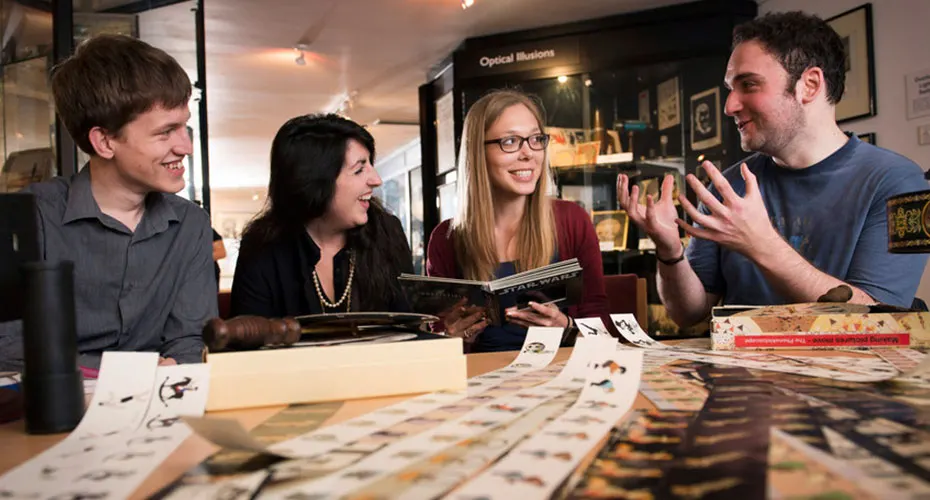
Students in the Bill Douglas Cinema Museum
We are exceptionally lucky to have some fantastic facilities and resources on the Streatham Campus.
Special Collections
We have Special Collections relating to writers such as Agatha Christie, Daphne du Maurier, and William Golding, and we integrate these into our teaching so students can share the excitement we have when discovering new insights from manuscripts, letters, and business papers.
The Bill Douglas Cinema Museum
Our unique film and popular culture resource, contains items going back hundreds of years. We regularly take students into its archives and think about the study of literature in relation to visual texts.
Digital Humanities Lab
Digital Humanities is increasingly important in all areas of humanities research, including history, archaeology, literatures and languages. This research space enables the examination, preservation and analysis of historical, literary and visual material. Facilities in the lab include:
- a flagship seminar room equipped with a 4.2-metre video wall, encouraging interactive engagement in a shared display space
- two state-of-the-art photography labs, including provision for the 2D digitisation of heritage material and primary sources
- an audio-visual lab with a recording studio and sound editing suite
- a MakerSpace equipped with 3D scanning and printing equipment
Your future
Employer-valued skills this course develops
An English degree puts you in a great position to succeed in a range of careers. Oral and written communication is at the heart of our programme and you will learn to present your ideas in a variety of formats. You will also develop strong research and analytical skills and the ability to problem solve and make informed decisions. Through a balance of independent study and teamwork you will learn to manage your time and workload effectively.
Professional experience
With practical modules on offer and opportunity to undertake professional placements, a degree in English will give you plenty of opportunity to develop your professional portfolio which will give you the skills and experience needed to be successful in your chosen career.
Career paths
Our students have progressed to a broad range of work sectors including education, arts management, publishing, journalism, marketing, finance and events management, working for companies such as:
Recent Graduates are now working as*:
- Actor
- Assistant Brand Manager
- Assistant Director
- Copywriter
- Data Analyst
- Journalist
- Policy Adviser
- Product Manager
- Radio Producer
- Youth Worker
Recent Graduates are now working for*:
- European Parliament
- Rolls Royce
- Oxford University Press
- Warp Films
- Oxfam
- Estee Lauder
Other recent graduates have progressed to postgraduate courses in:
- MA Cultural Heritage Management
- MA English Literary Studies
- PGCE English primary
- MA Magazine Journalism
- Postgraduate Certificate in Counselling Skills
* This information has been taken from the Destinations of Leavers from Higher Education (DLHE) Surveys 14/15, 15/16, 16/17 and 17/18. Please note that, due to data protection, the job titles and organisations are listed independently and do not necessarily correspond.