MSc Exploration and Mining Geology
| UCAS code | 1234 |
|---|---|
| Duration | 1 year full time |
| Entry year | 2027 |
| Campus | Penryn Campus |
| Typical offer | 2:2 Honours degree in Geology/Geosciences |
|---|---|
Why study MSc Exploration and Mining Geology at Exeter?
- Taught by the internationally established Camborne School of Mines (CSM), a combined mining school and geoscience department.
- Designed to provide advanced specialised training for earth science graduates, leading to excellent employment opportunities in the extractive industry.
- Attain a comprehensive understanding of the role of a geoscientist working in the mining industry, and learn new skills including geological and geotechnical mapping, mineral exploration, ore microscopy, and ore deposit modelling.
- Gain knowledge in mineral resource estimation and grade control, mineral extraction and management, and the environmental impact of mining.
- Undertake individual research projects throughout the summer period, often as industrial placements with a mining/exploration company.
- Progress into careers in the national and international exploration and mining sectors, and gain transferable skills used in the broader geotechnical, site investigation and environmental industries.
Fast Track (current Exeter students)
Mining and Geology postgraduate taught courses at the University of Exeter

Top 5 in the UK for Geology

Leading research facilities include a £3.5 million investment Critical Minerals Equipment Hub for minerals processing and analysis

Multidisciplinary expertise in mining and minerals engineering, geology and surveying

Based on our Penryn Campus in Cornwall, a beautiful and diverse county with amazing geosites on your doorstep
Accreditations
The MSc Exploration and Mining Geology programme is accredited by the Geological Society of London.
"In deciding to progress to postgraduate study, it was clear that Camborne School of Mines at the University of Exeter was the place to continue learning and push my understanding. They have a globally renowned reputation, industry connections, and rich history of mining in Cornwall, making it the obvious choice for me."
"There is a really friendly dynamic between students and lecturers here, making it easy to discuss questions or issues when they come up. With support from course directors and tutors, I feel confident and excited for what’s ahead. Paired with industry insight from the ‘Pint and Pasty’ events, my first term has been really fulfilling. It’s so refreshing to be studying a course that’s completely tailored towards my interests! I’m especially looking forward to the field trip to the Geevor mine this term, and then to Rwanda. I’m also excited to develop my connections within the mining industry – Camborne School of Mines is the place to be to build a good network before breaking into the industry.
After I graduate, I plan to start my career as an exploration geologist. I'm excited to see what the future has in store!"
Millan
MSc Exploration and Mining Geology

Entry requirements for 2027 entry
Applicants will be selected on the basis of being predicted or achieved a minimum 2:2 Honours degree in Geology/Geosciences. Consideration will also be given to appropriate equivalent professional qualifications and training on a case-by-case basis. Students applying with Turkish Government sponsorship/funding need to include their anticipated research project topic as part of the application and are encouraged to discuss this with the programme director in advance.
Please also see our guidance on essential documentation required for an initial decision on taught programme applications.
Entry requirements for international students
English language requirements
International students need to show they have the required level of English language to study this course.
The required IELTS test scores for this course fall under Profile B1.
Please visit our English language requirements page to view the required test scores and equivalencies from your country.
Course content and modules
This course is designed to provide advanced specialised training for earth science and geology graduates seeking employment in the mining industry. You will attain a comprehensive understanding of the role of a geoscientist working in mineral exploration, resource estimation, production geology and environmental aspects of mining and will be equipped with the knowledge and skills required in exploration target generation, testing and evaluation. You will learn new skills in GIS, database management, geochemical and geophysical targeting, technical report writing and spatial modelling as well as geological and geotechnical mapping, exploration techniques, ore microscopy, ore deposit modelling and geostatistics. This degree allows you to progress into careers in the national and international exploration and mining sectors, and gain transferable skills used in the broader geotechnical, site investigation and environmental industries.
You will study 180 credits to obtain an MSc and 120 credits for a PgDip.
This programme is modular and flexible, carrying 180 credits in total and offering flexibility in choice of modules studied.
The programme begins in October each year and the taught elements are concluded by May. The research project, under the personal supervision of an expert in the chosen area, will be carried out from April/ May to late August.
The modules that we outline here provide examples of what you can expect to learn on this degree course based on recent academic teaching. The precise modules available to you in future years may vary depending on staff availability and research interests, new topics of study, timetabling and student demand.
The modules below provide examples of what you can expect to learn on this degree course based on recent academic teaching. The precise modules available to you in future years may vary depending on staff availability and research interests, new topics of study, timetabling and student demand.
Please note that the module information displayed here is subject to change.
150 credits of compulsory modules, 30 credits of optional modules
You must select 15 credits form Optional Module group 1 and 15 credits from Optional Module group 2
| Code | Module | Credits |
|---|---|---|
| Compulsory 1 | ||
| Project and Dissertation | 60 | |
| Economics, Processing and Environment | 15 | |
| Exploration Targeting | 15 | |
| Exploration and Mining Geology | 15 | |
| Ore Deposit Geology | 15 | |
| Mineral Exploration Geophysics | 15 | |
| GIS for Mineral Explorationists and Geoenvironmental Engineers | 15 | |
| CSM Professionalism Year 4 and MSc | 0 | |
CSMM118: Project and Dissertation
This module gives you the chance to showcase the skills you have developed in previous modules by carrying out an independent research project.
You will collect, analyse (using previously acquired data and/or data collected as part of the project), interpret and discuss geological, exploration, mining or related environmental data, and come up with conclusions and recommendations.
The project must be of research value within an industrial or academic setting. The dissertation must also show an in-depth understanding of the background to the research topic.
The project will require you to put in at least 10 weeks of individual work, followed by a writing up period to compile a dissertation.
We will provide you with a handbook on planning and executing the research project and writing the dissertation. You must prepare a dissertation for submission by the end of August. You should aim to report in no more than 80 pages (for core text/diagrams from Introduction to Conclusions, i.e. excluding contents page, references etc.) and 20 pages additional appendices.
CSMM135: Economics, Processing and Environment
The module provides the opportunity for graduates from a range of disciplines to study important aspects of the mining cycle. These include mineral economics, processing of mineral ores to produce concentrates or metal and environmental impacts and remediation techniques. When linked to other specific modules, it forms part of the specialist training for the MSc in Mining Engineering, Exploration and Mining Geology, Minerals Processing, Geotechnical Engineering and Mine Environmental Management.
This module aims to provide you with a broad understanding of both the macro-economic and the industry specific economic environment in which mines and projects operate and are evaluated. It introduces you to financial analysis and explores how technical and operational parameters influence the revenue stream and cost structure at mines.
This module has been designed to develop a systematic understanding of the unit processes used in minerals engineering and an appreciation of how these unit processes are combined to produce an overall treatment system for a range of minerals and metals.
This module familiarises the student with the legal and regulatory framework within which companies explore, exploit and manage mineral resources. It highlights the key environmental and societal impacts and issues arising from mineral exploration and exploitation and introduces concepts of Social Licence To Operate and Corporate Social Responsibility.
CSMM193: Exploration Targeting
Provides the skillset to conduct modern mineral exploration targeting and desktop studies which is highly sought-after by the mining industry. You will have the chance to work on a world-class dataset from a frontier exploration district and to develop advanced data interpretation and synthesis skills by jointly interpreting geological, geochemical and geophysical data.
This highly practical module intends to develop exploration targeting skills by a combined provision of formal lectures, a residential field trip and a student coursework project. This will allow the you to interpret a range of available geoscientific data and synthesise the learnings in a targeting report. Guidance in the form of scheduled group meetings and drop-in sessions will be available to support the independent learning process.
CSMM194: Exploration and Mining Geology
This module provides an introduction to practical geological skills used by geologists in mineral exploration and mining. This includes how to initiate, run and organise exploration programmes and control grade at operating mines.
It builds on geological knowledge acquired at undergraduate level and CSMM195. The module introduces and develops key practical techniques and skills associated with the role of mining and exploration geologists. These include geological fieldwork techniques in mineralised areas including, surface mapping and working as a member of a team.
CSMM195: Ore Deposit Geology
This module provides you with an introduction to ore deposit geology, key mineral deposit types and styles of mineralisation. This is the base for modules CSMM110 Techniques in Mining Geology, CSMM429 Industrial Rocks and Minerals, CSMM425 Ore Genesis and CSMM193 Exploration Targeting. A short programme of local fieldwork and practicals is included.
The aim is to develop an understanding of the genesis, geological characteristics, mining and processing of the major types of metalliferous ore deposits. Major ore deposits relating to magmatic, hydrothermal, and surface processes are included. Both descriptive and genetic models of mineral deposits will be used to bring the topic to life. The selection of mineral deposits studied may vary depending current trends in exploration and commodity demand, but a broad base considered to reflect the main deposit types that geologists are likely to encounter will always be covered.
CSMM218: Mineral Exploration Geophysics
This module principally focuses on the application of airborne and ground geophysical survey techniques in regional and targeted mineral exploration programmes. Students will learn about commonly used geophysical surveys, such as magnetic, radiometric, electromagnetic, electric and seismic methods, along with relevant acquisition, processing and interpretation aspects. A focus will also be on the practical application of geophysical techniques in local Cornish mining and remediation aspects, and therefore support and maintain an interdisciplinary approach to geophysical surveying.
CSMM219: GIS for Mineral Explorationists and Geoenvironmental Engineers
Provides an introduction to basic and advanced GIS skills used by geologists, scientists and engineers in the mining and environmental industry. You will learn and familiarise with the most fundamental tools and software packages used to collect, analyse, manipulate and display spatial datasets.
Prerequisite modules for MSc cohort: Undergraduate module(s) in GIS.
The module introduces and develops advanced spatial visualisation and modelling skills associated with the daily work of an exploration geologist and environmental scientist. These include practical work on a number of spatial datasets and will guide the student from simple data visualisation to designing geodatabases and spatial modelling/ mineral potential mapping practicals. The module caters for the needs of senior undergraduate and postgraduate students and will therefore be split into the following components:
CSMM904: CSM Professionalism Year 4 and MSc
The aim of this module is to support students as they adapt to MSc study and prepare for industry and industry aligned research careers. This includes building an understanding of professional accreditation and bodies, and further support with successfully applying for graduate jobs. Additionally, it will foster a sense of academic belonging and community within the broader department.
| Code | Module | Credits |
|---|---|---|
| Optional 1 | ||
| Excavation and Geomechanics | 15 | |
| Ore Genesis | 15 | |
| Optional 2 | ||
| Industrial Rocks and Minerals | 15 | |
| Geometallurgy and Resource Modelling | 15 | |
CSMM130: Excavation and Geomechanics
In order to create an excavation, both surface and underground, it is important to understand the engineering characteristics of the material being excavated. The module provides an insight into excavation processes and how rock mass quality influences excavation methods, equipment selection, product technology and post-excavation stability. The module provides fundamental understanding of rock mechanics and soil mechanics principles related to excavation. The module provides a review of appropriate excavation techniques including selection of appropriate mining methods. The module also provides fundamental geotechnical knowledge that is a pre-requisite for subsequent design-related modules. The module is not recommended for interdisciplinary pathways.
The module provides an understanding of the mechanics of rock behaviour and its influence on excavation behavior, design and, importantly, stability. The module provides pre-requisite material for all subsequent geotechnical-related modules. It provides basic knowledge for assessment of material properties, evaluation of rock failure criteria and an awareness of their impact on design or use of materials. Where appropriate, case history information is used to emphasize important aspects associated with data variability and its influence on design.
CSMM425: Ore Genesis
This module builds on Ore Deposit Geology (CSM M195) to provide a more in depth understanding of the nature and formation of ore mineral deposits. You will critically evaluate models for the formation of ore deposits with reference to data from case examples. Your understanding will be enhanced through detailed studies of mineral assemblages and textures in hand specimens, thin section and polished blocks. The module will develop skills for the study of ore mineral assemblages by reflected light microscopy. The module is not suitable for non-specialist students or interdisciplinary pathways.
CSMM429: Industrial Rocks and Minerals
This module develops the knowledge of the economic formation, extraction and use of industrial minerals in our modern society. The module builds on the knowledge of geolocial processes equivalent to the syllabus of the second and third year of study of a typical geology programme. The module will deal with the formation, characteristics and extractive properties of industrial rock and mineral commodities, as well as develop knowledge of the industry standards for their economic processing, marketing and use.
The aim is to develop an in-depth understanding of the genesis, geological characteristics, extraction and processing of the major types of industrial minerals. The selection of commodities studied will vary depending upon lecturers’ research interests and areas of specialist knowledge, availability of guest lecturers, current trends in exploration, and commodity demands.
CSMM445: Geometallurgy and Resource Modelling
The module provides an in-depth introduction to geometallurgy, an evolving discipline whose significance is increasingly recognised by practitioners. Geometallurgy is an over-arching subject which aims to enhance characterisation of a resource to support more efficient and effective extraction.
The student is familiarised with modelling of the spatial distribution of properties to define an in situ resource. Relevant properties are those which impact the feasibility and viability of extracting the ore. A prominent characteristic is the chemical composition with, as headline, the grade of constituent commodities. The chemical composition is routinely measured in sections of drillcore and translated into block volumes. Techniques for orebody definition through interpretation of drillcore data will be discussed and their application is demonstrated with computer tutorials and exercises.
It is widely accepted that grade alone, and its spatial distribution, does not fully determine the extraction potential of ore. Local variation in mineralogy and texture can influence the ore throughput time and metallurgical recovery in the processing plant, as well as the generation of residual products.
Fees
UK fees per year:
£15,900 full-time
International fees per year:
£30,100 full-time
Scholarships
The University of Exeter offers a wide range of scholarships to support your education, with £8 million available for international students applying to study with us in the 2027/28 academic year, including our prestigious Exeter Excellence Scholarships. We also provide awards for sport, music and other achievements, as well as regional and partner scholarships with organisations such as Chevening, the Commonwealth Scholarship Commission and the British Council. For more information on scholarships and other financial support, please visit our scholarships and bursaries page.
University of Exeter Alumni Scholarship
We are pleased to offer the University of Exeter Alumni Scholarship, a scholarship for University of Exeter alumni beginning a standalone postgraduate programme in 2027/28 with us a scholarship worth 20% of the cost of your first year tuition fees.
Terms and conditions, including deadlines, apply.
Funding and scholarships
LME Scholarship
Two scholarships worth £26,500 each are available to students who have had an application accepted to one of the Camborne School of Mines MSc programmes for September 2026 entry. This scholarship programme is funded by a generous donation from London Metal Exchange (LME). As part of the scholarships the successful candidates will have the opportunity to undertake mentoring with LME staff and to work with LME on their dissertation project. Find out more.
The Richard Osman Memorial Fund Scholarship
These scholarships will enable up to two talented UK students studying on the MSc Exploration Geology programme to become distinguished Richard Osman Scholars. The successful candidates will receive a bursary covering their tuition fees in full, and a generous stipend of £8,100 toward living costs.
Fieldwork
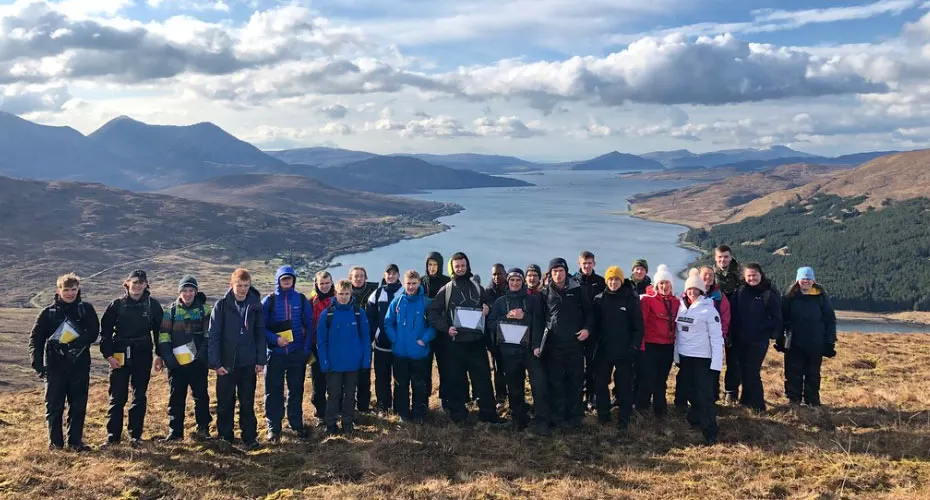
On the Exploration and Mining Geology MSc you will receive a great deal of practical experience of working within the minerals industry. The programme aims to produce high quality graduates who can enjoy high employment rates and easy transition into further PhD study. Emphasis remains on applied teaching and research relevant to careers in the earth resources and renewables sectors. Field visits and practical field-based assignments are used, where appropriate, to emphasise key areas within each module.
You will spend a proportion of your time in the field during the autumn term and over the Easter period and are required to participate in an international field trip to visit mines and exploration projects in a major mining region.
Your project runs from April/May until September. These projects can be located worldwide - previous students have undertaken projects on six continents, including countries such as Ireland, Greenland, Canada, Chile, Tanzania, Zambia, South Africa, Mongolia, Kazakhstan and Australia.
You will have the opportunity to work on a discrete problem for 4 months, which can include software projects, fieldwork and/ or laboratory studies. You will participate in designing your research project with a sponsor, who in turn provides you with help and support during the project.
Teaching and research
The programme is delivered through a mix of lectures, workshops, tutorials, practical activities, case studies, industry visits, computer simulations, project work and a dissertation. The taught part of the programme is structured into two semesters. Field visits and practical field-based assignments are used, where appropriate, to emphasise key areas within each module.
A research and practice-led culture
We believe every student benefits from being taught by experts active in research and practice. You will discuss the very latest ideas, research discoveries and new technologies in seminars and in the field and you will become actively involved in a research project yourself. All our academic staff are active in internationally-recognised scientific research across a wide range of topics. You will also be taught by leading industry practitioners.
Students are encouraged to undertake projects directly linked with industry, which may result in industrial placements for their project period.
In April/ May a field trip to examine the geology and visit a leading mining hub will provide you with an opportunity to put your acquired exploration skills into practice.
Extensive use is made of Camborne School of Mines' geochemistry and mineral processing laboratories, and the superb field geology and extractive industry operations in South West England.
Graduate School of Environment and Sustainability
You will become part of Exeter's Graduate School of Environment & Sustainability - a vibrant and supportive postgraduate community based here on our Penryn campus in Cornwall. The Graduate School brings together experts from across the spectrum of earth and life sciences, engineering, humanities, social sciences and business. You will interact with students from other MScs and have the opportunity to explore issues from a range of perspectives, benefiting from a truly interdisciplinary experience. All our programmes are designed with a focus on developing solutions to global challenges and creating a better future for our planet and its people.
Studying in Cornwall has been really good. The facilities are great, there are several different types of labs, a lot of space for learning and loads of learning resources. The lecturers are always really helpful, supportive and there when you need them.
The MSc Mining Geology programme has been really good as it covers all the aspects of all the different types of Geology. I’ve been able to learn a broad range of skills and the field trips have been great.
Omolara
MSc Mining Geology

Careers

Reputational and networking benefits
A unique benefit studying at Camborne School of Mines is the community and relations you will gain both during, and after your studies. Camborne School of Mines has a world-class reputation and excellent alumni network, allowing our graduates to prosper in their respective fields in all corners of the globe:
“I have worked in many places around the world and have yet to visit a country where I could not find at least one CSM graduate. In fact, there are normally several and they can often be found in influential positions.”
Tim Henderson, CSM Graduate and Mining Consultant
Graduate skills and destinations
In addition, a degree from Camborne School of Mines will teach the necessary technical skills and theoretical knowledge required, as well as additional complementary skills relating to communications, teamwork and problem solving. We have excellent rates of graduate employment, with many postgraduates working overseas.
Graduates of this programme have gone on to enjoy careers as mining and production geologists, exploration geologists, engineering and environmental geologists. Our graduates have gone to work for some exceptional companies such as Northern Star Resources, First Quantum Minerals, Rio Tinto, Fortescue Metals, and SRK Consulting.
Support and opportunities
The Career Zone (CAS) at our Cornwall Campus provides high-quality careers information and guidance to students of all disciplines. Our experienced careers team can give you individual support whilst you are at the University and after you have graduated.
Services include talks, confidential careers interviews and an extensive careers library of reference books, magazines and journals. A new computer suite is also available for accessing online careers information, vacancy services and specialist software on, for example, sources of funding for courses and worldwide volunteering.
The CAS can help you to identify attractive jobs, careers paths and employers and assist with your CV, interview technique and identifying work experience placements.
Find out more about studying at Exeter








Sign-up for more information about studying with us
If you're thinking about studying MSc Exploration and Mining Geology with us, signing up to our emails is the best way to discover if we’re the right university for you.