Acoustic, fluidic, and elastic metamaterials
We specialise in acoustic, fluidic, and elastic metamaterials—engineered structures that control sound, flow, and vibrations in ways natural materials cannot. Our work uncovers fundamental wave–material interactions and enables practical advances in noise control, signature reduction, sensing, and energy and flow management.
In this section

Our research
Acoustic metamaterials are composite materials, typically with small and closely placed resonant inclusions, which have been designed to control, direct, and manipulate sound.
Propagation of sound in materials is mostly dictated by the bulk modulus and mass density, which are analogies of the electromagnetic parameters, permittivity and permeability.
However, just like in the electromagnetic domain, there is a drive towards ever increased device performance and functionality, and metamaterials offer an opportunity to look beyond naturally-occurring materials since they can be engineered to have completely artificial behaviour.
Our research
Our work in acoustics is fundamental in nature, exploring the phenomena that are revealed through adopting metamaterial concepts. It focuses on sound propagation both in air, and underwater.
We investigate:
- the acoustic absorption achieved via structuring of materials,
- the selective transmission through apertures and phononic crystal structures,
- the emission of thermally generated sound,
- the coupling of sound to mechanical vibrations and fluid flow,
- the excitation of acoustic surface waves for the channelling of sound across surfaces.
Real-world applications
Our work continues to be of great relevance to end users, particularly those interested in signature control, thin absorbers, noise control, acoustic wave forming and imaging, and energy harvesting.
Linking together acoustic metamaterials with fluid flow is a natural extension for our research. For example, screening sound using a perforated metasurface that allows free-flow of air, has application to the design of windows in hot, noisy environments.
Yet there has been little work on more widely applying general metamaterial concepts to realistic fluid flow situations, despite the fact that this technology might have great potential - providing new avenues for the control of flow noise, energy harvesting, and the shielding of surface mounted instrumentation.
We have a number of ongoing projects to exploit this potential, exploring the fundamental physical mechanisms that come into play when metasurfaces, metamaterials, and driven mechanical elements are used within fluids.
These include using patterned metasurfaces or elastic resonators to reduce drag, harvest energy, or delay the onset of turbulence. We are also actively pursuing the study of magnetically actuated motors (or ‘swimmers’), and the potential of influencing microfluidics via collections of these meta-atoms.
The vector system of elasticity presents additional complications when compared to scalar acoustics, as in a solid there exists two body waves (shear and compression), that co-exist and travel with different wavespeeds; these wave types are inherently coupled and therefore resist independent manipulation. Surface Rayleigh waves also exist at traction-free interfaces.
These elastic waves are present all around us in the form of vibrations, across a large range of scales ranging from small-scale surface acoustic wave devices, ubiquitous in electronic circuitry present in mobile devices, to larger scales that we feel in our immediate environment, such as noisy domestic appliances, all the way up to ground-borne seismic vibrations caused by earthquakes. Elastic metamaterials offer a route to manipulate and control such vibrations over these length scales, offering applications in energy harvesting, vibration isolation and noise control.
Our research
Just as in our acoustics research, our work on elastic metamaterials is fundamental, investigating the manipulation of elastic waves through metamaterial techniques.
We investigate:
- the coupling of sound to elastic structures,
- noise control and vibration mitigation,
- elastic energy harvesting,
- phononic metamaterials for sensing and signal processing applications,
- mode conversion from surface to body waves,
- redirection and focusing phenomena,
- active mechanical metamaterials,
- time-varying mechanical material properties.
Facilities
We have experimental facilities that allow for the study of sound reflection, transmission, or absorption from test panels in air and underwater, either with pulses (time-domain) or via continuous wave excitation.
We have scanning stages to map pressure fields in three-dimensional space in air and inside the water tank, and a semi-anechoic chamber for airborne measurements.
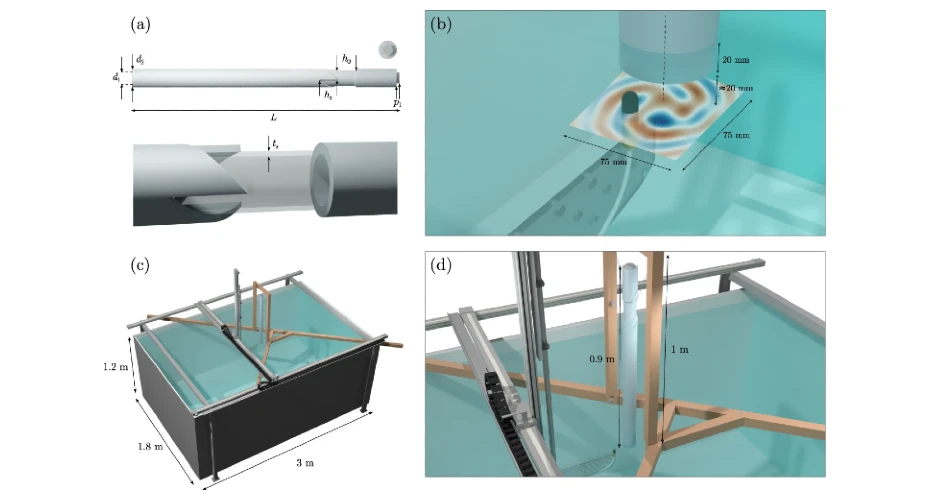
Flow tanks and particle image velocimetry apparatus are provided by our colleagues in the department of Engineering, and we are experienced users of commercial numerical modelling software (e.g. Comsol) and in-house developed analytical and semi-numerical methods.
- A collimated beam acoustic apparatus for measuring the air-borne far-field response of test samples to high frequencies, in the frequency and time domain.
- A hydro acoustics facility to similarly characterise the response of samples underwater in the time-domain.
- Each set-up includes a computer-controlled 3D scanner providing the ability for mapping local pressure fields.
- We have an semi-anechoic chamber for air-borne measurements and a 3 x 1.75 x 1.2 m (5000 litre) water tank for the hydroacoustics.
- Laser Doppler Vibrometer (LDV) and scanning head for time-and spatially resolved elastic field characterisation.
- We are advanced users of finite element software, such as Comsol Multiphysics, for numerical modelling of acoustic and elastic wave systems.
- Differential methods for predicting the response of multilayered corrugated surfaces (diffraction gratings) have been developed, together with modal matching analytical techniques for predicting the response of well-defined phononic structures.
- Our team have expertise in the development of finite difference time domain (FDTD) methods for predicting the response of advanced acoustic and elastic materials.
Our centre has access to facilities that include
- Additive Manufacturing
- Large Format, high temperature printing
- laser sintering systems (including metal printing)
- material extrusion
- Materials processing and manufacturing
- including injection / compression moulding and extrsuion
- Materials analysis, including
- thermal (Differential Scanning Calorimetry, Thermogravimetric analysis, Dynamic Mechanical Analyis)
- spectroscopy (FTIR, NIR. UV)
- microscopy
- rheology
- surface analysis
- Mechanical Testing, including drop towers and impact testers
- Vacuum Forming
- CAD/CAM software
Many of these facilities can be accessed via Exeter technologies Group.
People
Our academics in this area include:


Our Post Doctoral Researchers are:
| Tristan Lawrie | Philip Wong |
Our current PhD students are:
| Robyn Edge | Erica Paul |
| Philip Skelland | Simon Preston |
Metamaterial control of vibrations
Find out more