Metamaterials for Information and Communications Technologies
Digital infrastructure is expanding rapidly, creating demand for faster networks, greater bandwidth, lower latency, better coverage and reduced energy consumption. Metamaterials are well placed to contribute because they provide new ways to control electromagnetic and optical signals across radio, microwave, terahertz and photonic regimes.
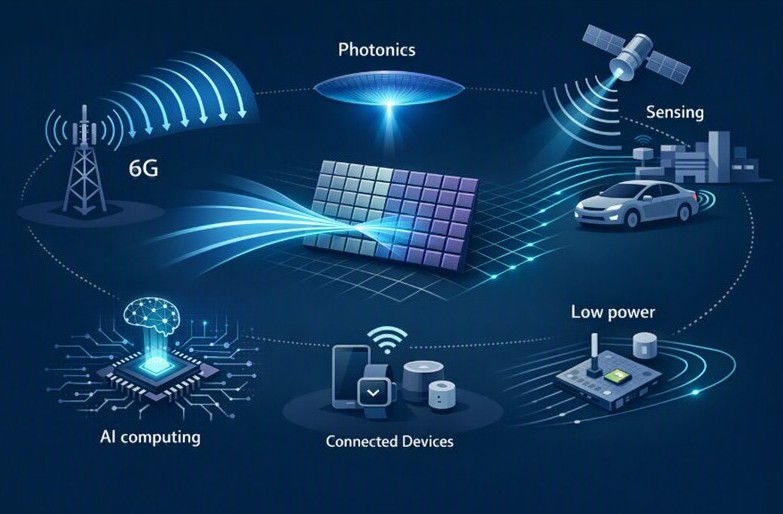
For future wireless systems, reconfigurable intelligent surfaces, compact antennas and beam-steering devices can improve how signals are shaped, routed and received. These technologies could support 6G, integrated terrestrial-satellite networks, smart buildings, autonomous systems and environments where communication and sensing are increasingly combined.
At optical frequencies, metasurfaces, metalenses and photonic metamaterials can shrink and simplify components used for imaging, LiDAR, free-space communication, switching, filtering and integrated photonic circuits. Their ability to manipulate light with compact, patterned structures creates opportunities for highly integrated platforms that combine sensing, communications and processing.
Metamaterials may also contribute to new computing approaches. Optical, analogue and wave-based information processing could help reduce the energy burden associated with AI, edge devices, communications networks and data centres. Rather than simply making existing electronics smaller, these approaches point towards different architectures for processing information more efficiently.
The strongest opportunities sit at the convergence of photonics, semiconductors, quantum technologies, telecommunications, sensing and AI. Progress will require close attention to integration, packaging, fabrication tolerances, reliability and compatibility with existing communications and computing ecosystems.
Relevant studies
- 2D metasurfaces and 3D metamaterials for electromagnetics (IR, visible, microwave) and acoustics, involving tunability and reconfigurability for some applications:
- to control energy or data propagation;
- to enhance the performance of detectors and antennas;
- to control field distribution and beam steering;
- for filtering and absorption;
- for imaging
- single-photon source development to generate, manipulate and measure light as the underpinning element of modern communication;
- magnetic and elastic waves generated in magnetic materials using designed electromagnetic and bias field transducers for signal transmission, storage and processing;
- spin waves (or magnons) offering the technology to carry and process both analog signals and digital data at low power, with magnetic reconfigurability and scalability to nanometre dimensions;
- development of RFID tags and gate systems, using electromagnetic and acousto-magnetic designs;
- novel acoustic sources, e.g. thermally generated sound;
- the coupling of sound to mechanical vibrations and fluid flow, and vice versa for wake control, noise reduction and energy harvesting;
- phase change materials for photonic memory and processing;
- flexible and optically transparent graphene-based electronics and electronic textiles;
- the control of surface acoustic waves (SAW) for RF communications, sensing, and wireless communications;
- harvesting of energy from the environment to power IoT devices.
People
| Prof Mustafa Aziz: Magnetic materials and transducers; magnetic materials; phase-change materials |
| Prof Monica Craciun: Optoelectronic materials and devices; quantum phenomena; nanoelectronics |
| Dr Jacopo Bertolotti: Wavefront shaping and imaging |
| Prof Alastair Hibbins: RF and microwave metamaterials; acoustic metamaterials |
| Dr David Horsell: Thermoacoustics; electrical conduction in nanostructures |
| Dr Simon Horsley: Theory of electromagnetic and acoustic materials; absorption |
| Prof Robert Hicken: Magnetic and spintronic materials |
| Dr Ian Hooper: RF and microwave metamaterials |
| Prof Volodymyr Kruglyak: Magnonics |
| Dr Isaac Luxmoore: Quantum nanophotonics |
| Prof Geoff Nash: Infrared sources; detectors and spectroscopy; surface acoustic wave devices |
| Prof Dave Phillips: Imaging; complex photonics; optical tweezers |
| Dr Dibin Zhu: Energy harvesting |
Case studies