BA English and History
| UCAS code | QV01 |
|---|---|
| Duration | 3 years |
| Entry year | 2027 |
| Campus | Streatham Campus |
| Typical offer | A-Level: AAB |
|---|---|
|
A-Level: BBB |
| UCAS code | QV02 |
|---|---|
| Duration | 4 years |
| Entry year | 2027 |
| Campus | Streatham Campus |
| Typical offer | A-Level: AAB |
|---|---|
|
A-Level: BBB |
| UCAS code | QV03 |
|---|---|
| Duration | 4 years |
| Entry year | 2027 |
| Campus | Streatham Campus |
| Typical offer | A-Level: AAB |
|---|---|
|
A-Level: BBB |
Why study English and History at Exeter?
- Immerse yourself in literature spanning from the Middle Ages to the 21st Century, whilst exploring the historical context in which texts were written.
- Delve into fascinating history from the Roman Empire to indigenous people in Latin America, or the Vikings, magic, and witchcraft in early modern Europe.
- Take advantage of our excellent facilities, such as our Special Collections relating to world-renowned writers, the Bill Douglas Cinema Museum, which is a unique film and popular culture resource, and our Digital Humanities Lab. Exeter has also recently been awarded UNESCO City of Literature status.
- Customise your BA English and History degree to your interests and career ambitions with an array of exciting modules spanning the breadth of both subjects.
- Boost your employability with sought-after, advanced skills in communication, critical thinking, developing ideas and arguments, and interpreting information.

Top 10 in the UK for English

Top 50 in the world for English Language and Literature
QS World University Subject Rankings 2026

Unique on-site resources: Exeter’s Special Collections archive and The Bill Douglas Cinema Museum

Top 100 in the world for History
QS World University Subject Rankings 2026
History has always been my favourite subject. The wide range of module choices has allowed me to study a range of very interesting time periods and topics, and I have been given the opportunity to learn a new language which I am thoroughly enjoying.
I would recommend Exeter to anyone who would like to be taken out of their comfort zone. I have learnt a lot about myself by attending this institution.
I have thoroughly enjoyed diving deeper into medieval periods that I was unable to cover at school. Unlike some other history courses, Exeter’s course is not Eurocentric, and there are many modules covering different areas of world history. For example, I am currently studying a module on Islamic history.
Hanife
BA History (Exeter)

Entry requirements for 2027 entry (typical offer)
| Qualification | Typical offer | Required subjects |
|---|---|---|
| A-Level | AAB | B in an accepted Humanities or Social Science subject* (see below) |
| IB | 34/665 | HL5 in an accepted Humanities or Social Science subject* (see below) |
| BTEC | DDD | Applicants studying a BTEC Extended Diploma will also require GCE A-Level grade B in an accepted Humanities or Social Science subject* (see below) |
| GCSE | C or 4 | English Language |
| Access to HE | 30 L3 Credits at Distinction Grade and 15 L3 credits at Merit Grade. | To include at least 12 L3 credits at Merit Grade in an accepted Humanities or Social Science subject* (see below) |
| T-Level | Distinction | Applicants studying a T-Level will also require GCE A-Level grade B in an accepted Humanities or Social Science subject* (see below) |
| Contextual Offer | A-Level: BBB |
Specific subject requirements must still be achieved where stated above. Find out more about contextual offers. |
| Other accepted qualifications | ||
| English language requirements |
International students need to show they have the required level of English language to study this course. The required test scores for this course fall under Profile B1. Please visit our English language requirements page to view the required test scores and equivalencies from your country. |
|
NB General Studies is not included in any offer.
Grades advertised on each programme webpage are the typical level at which our offers are made and provide information on any specific subjects an applicant will need to have studied in order to be considered for a place on the programme. However, if we receive a large number of applications for the programme we may not be able to make an offer to all those who are predicted to achieve/have achieved grades which are in line with our typical offer. For more information on how applications are assessed and when decisions are released, please see: After you apply
*Accepted Humanities and Social Science subjects:
- Anthropology
- Classics and Ancient History
- Drama
- English
- Geography
- Government and Politics
- History
- Law
- Media Studies
- Modern Languages
- Philosophy
- Politics
- Psychology
- Religious Studies
- Sociology
Course content and modules
Our BA in English and History explores the work of some of the giants of English literature and goes on an exciting journey across a diverse range of Anglophone literatures. You will read works of literature spanning the Middle Ages to the 21st century in their historical context, learning how and why certain literary forms emerged when they did. We will introduce you to traditional and emerging cultural forms from novels to digital culture and expose you to writers from across the globe.
Our history expertise covers areas such as migration and mobility, indigenous peoples in Latin America, the history of health and its politics, women in society, the Vikings, magic and witchcraft in early modern Europe, and histories of material things. In your final year you will have the opportunity to delve into a topic that interests you for your History Research Project.
You will have the flexibility to choose History and English modules that complement each other, enabling you to fully immerse yourself in the real world behind the story.
You may notice changes to some of our modules over the coming months. This is because we are making space for the following:
- Minors: Future Skills Pathways - Alongside your main degree you may be eligible (depending on your course) to choose modules from another subject to broaden your skills and interests.
- Skills to Thrive built into every degree - Essential skills for your future, including communication, problem-solving, teamwork and digital confidence.
- Increased innovation and wellbeing - More room for creative learning, real-world projects and a healthier study rhythm.
Please note that the module information displayed here is subject to change.
Students must take 45 credits of compulsory History modules, 30 credits of compulsory English modules, 15 credits of optional History modules, and 30 credits of optional English modules at Stage 1.
Compulsory Modules
Subject to choosing 120 credits for the stage overall, you must:
Take EAS1035 (30 credits) and HIH1137 from the Compulsory Group
From English Optional - select 30 credits from this list of optional English modules
From Compulsory Choice you must take HIH1421 OR HIH1422 (30 credits) + HIH1137 Becoming a Historian: Core (15 credits)
Select 15 credits from this list of optional History (HIH-coded) modules.
| Code | Module | Credits |
|---|---|---|
| Compulsory 1 | ||
| Beginnings: English Literature before 1800 | 30 | |
| Becoming a Historian: Core | 15 | |
| Compulsory Choice | ||
| Understanding Medieval and Early Modern History | 30 | |
| Understanding Modern History | 30 | |
EAS1035: Beginnings: English Literature before 1800
This module selects texts that represent some of the richest sources and most complex moments of English cultural history before 1800. These texts, and the cultural elements they combine, went on to have afterlives of great significance for English language, literature and other media. In other senses, they offered legacies that were not taken up, and what has been lost in cultural transformations will also be considered.
The module aims to
- introduce you to these major literary texts. In doing so, we aim to cultivate modes of reading and critical analysis broadly informed by an attention to history and context. Such analysis will include ideas of subjectivity, identity, conflict, community, myth, the transmission of stories, storytelling, translation, transformation, and influence. This module will emphasise essay-writing skills that are fundamental to research and communication in English literature.
HIH1137: Becoming a Historian: Core
Studying history at university is not only about increasing your knowledge of the past, but mastering particular ways of researching, processing information, and communicating arguments effectively. This module introduces you to the essential skills that will enable you to become a historian, and familiarises you with the innovative ways we teach and assess these skills at Exeter.
Part of the module will facilitate your transition to studying history at university by covering key practical skills, from conducting independent research to reading critically. The other part will introduce the key intellectual tools you will need, surveying the evolution of history writing over time and the important approaches and ideas that historians use to study the past. By the end of the module, you will acquire skills that will be developed further across your degree and in future careers, and that will enhance your development as an open-minded and internationally-engaged individual.
HIH1421: Understanding Medieval and Early Modern History
This module is designed to introduce you to histories of the world from antiquity, through the Middle Ages, and into what we traditionally the early modern period. Taking a thematic approach, it seeks to develop your understanding of politics, society, economy, and religion across different regions during these years. Key themes include rulership and government, power and resistance, religion, cultures of knowledge, trade and the environment, and encountering the 'other'. This is an introductory module and no prior knowledge is required.
HIH1422: Understanding Modern History
This is a module that introduces you to the key processes, ideas, and connections in modern history from the eighteenth century to the present. It covers themes such as colonialism and postcolonialism; states, ideologies and nationalism; gender, sexuality and the body; science and technology; race, class, religion, and disability; violence and conflict; and development and humanitarianism. The module traces these themes across multiple countries and regions around the world, highlighting connections and differences between them, and exploring the multiplicity of experiences and ideas that have produced numerous, and at times competing, conceptualisations of 'modernity'. This is an introductory module and no prior knowledge is required.
This module explores some of the most important historical developments from around the world from the eighteenth century to the present. It provides a taster of topics you can explore in greater detail in future years of study. The module is global in its scope, focusing on exploring a range of regions and nations whose histories have been foundational to the formation of the 'modern' world as we know it today. While introducing you to the key features that have led to the development of 'modern' states, societies, and cultures, it simultaneously challenges Eurocentric ideas of 'modernity', accepted historical chronologies, and dominant historical narratives.
| Code | Module | Credits |
|---|---|---|
| Combined Honours Optional 1 | ||
| Digital Cultures: Narrative, Creativity, Industry | 15 | |
| The Novel | 15 | |
| The Poem | 15 | |
| Academic English | 15 | |
| Rethinking Shakespeare | 15 | |
| Imagine This: Prompts for Creative Writing | 15 | |
| Optional Combined Honours 2 | ||
| Climate Emergency! An Introduction to Environmental Arts and Humanities | 15 | |
| Sources and Skills | ||
| Sources and Skills: Modern | 15 | |
| Sources and Skills: Early Modern | 15 | |
| Sources and Skills: Medieval | 15 | |
EAS1016: Digital Cultures: Narrative, Creativity, Industry
Digital technology has transformed almost every area of human life over the last sixty-five years, and the written word remains at the core of this ongoing transformation. This module will introduce you to some of these developments across literary cultures, and you will gain an understanding of how phenomena such as interactive storytelling, artificial intelligence and the Internet have come to influence literature's subject matter as well as its modes of publishing and production. Alongside critical readings and discussions, you will conduct practice-based research by learning to use some of the technologies and software that define modern literary cultures..
This module aims:
- To consider how digital technology makes itself apparent in modern literary, visual and creative cultures.
- To introduce you to a diverse range of authors, poets, artists, technologists, theorists and critics both commenting upon and using digital technologies to explore new possibilities in literature.
- To explore the historical relationship between literary cultures, visual cultures and emerging technologies, grounding students' understanding of current debates in this field.
- To enable you to create a diverse portfolio of creative and critical responses to the topics explored in class, including both traditional written outputs and digital prototypes.
EAS1037: The Novel
This module will introduce you to an exciting range of novels representative of diverse narrative styles drawn from different historical periods and national contexts. The module covers the development of this important genre from the birth of the novel in eighteenth-century England through the nineteenth-century and modernist periods into the present day. It provides an invaluable foundation for future study in a number of literary fields.
- To introduce students to an exciting range of novels representative of diverse narrative styles drawn from different historical periods and national contexts. The module covers the development of this important genre from the birth of the novel in eighteenth-century England through the nineteenth-century and modernist periods into the present day.
- To address the emergence and reception of the novel in relation to its historical and literary contexts and to its adoption, and adaptation, of particular voices and forms. Close readings of chosen novels will be supplemented by theoretical and critical analysis. Stylistic changes - such as the move from nineteenth-century realist fiction to modernist experimentation - will be explored alongside specific texts which illuminate the impact of cultural change on fictional form.
- In looking at a variety of examples of prose fiction, to examine the pleasures of the novel, as well as the historical conditions and textual strategies which underpin those pleasures.
EAS1038: The Poem
Despite its strong oral traditions and origins, poetry is the origin of all written literature. It is the base on which all that literature - drama, novels, non-fiction prose - is built. Many of its formal elements are used in common and rhetorical speech. This module is designed to introduce you to the mechanical aspects of poetry and to its history; in addition, it offers you insight into the history and influence of important poetic eras, as well as into how understanding of it may be enriched by literary theory. By the end of the module, you will have a firm grounding in the poem as a form and as a literary force.
The aim of the course is to cultivate skills of formal analysis which can be used in combination with other interpretive and creative techniques later in the degree. There will thus be a close focus in seminars on details of language in particular examples of poetry.
EAS1040: Academic English
Academic English introduces you to the techniques needed to write successful, university-level analytical essays on literary texts and topics. Using model essays and articles, seminar discussions, your own essay writing, and guided readings, you will learn how to write well structured, clearly argued persuasive analytical essays, with a focus on some of the fundamentals of writing: arguments/thesis statements, paragraphing, clarity of expression, essay formatting and accurate referencing. You will also learn how to locate, evaluate, and use secondary (critical) sources that support your essay's argument, as well as how to cite those sources correctly. There will also be attention to ways of analysing literature effectively.
EAS1041: Rethinking Shakespeare
This module explores Shakespeare's plays from a wide range of perspectives. You will study in depth some of the plays and examine the contexts of their production and reception; the plays' print history; early modern performance practices, and how other writers and film directors have adapted Shakespeare's plays. Through engaging with the sources and precursors to Shakespeare's plays, the intricacies of textual production and editorial history, as well as how these plays have been reimagined by other writers, you will be asked to rethink notions of textual stability in relation to the 'Shakespearean text' and encounter the nuances and richness available within Shakespeare Scholarship.
The module aims to explore the processes by which Shakespeare's plays came into existence, how they achieved their unique status in English literature and culture, and how Shakespeare's dominance has been and continues to be challenged. The module illuminates the role (and texts) of other writers involved in the legacy of Shakespeare's plays, from the Restoration to the twenty-first century, and encourages you to examine these often neglected influences within modern understandings of Shakespeare. Throughout, the module pays close attention to the particular possibilities of theatre as a mode of cultural production.
EAS1044: Imagine This: Prompts for Creative Writing
This module will ask you for a creative writing response to whatever 'prompt' is suggested - whether it's a newspaper headline, the Ted Hughes archive in The Old Library, or a geographical feature. It will invigorate your entrepreneurial spirit, and will include expressions written in both poetry, prose and dramatic forms. Working across a wide range of writing styles and genres, you will make literature that works for the ear and the body and the page. The assessment will be entirely creative, and in that sense the module complements the other term-2 compulsory module on the Combined Honours English and Creative Writing degree programme, 'Critical Reflections', for which the assessment will be wholly critical/academic.
This module has a clear set of learning strategies, offering you a series of stepping stones that navigate the creative process in different forms. You will develop learning strategies that will encourage self-starting intelligence and invention, an entrepreneurial spirit. It will explore the notion of the 'good idea' and its relationship with form - whether poetry, prose, or dramatic expression, as well as strategies for successful drafting/rewriting. The overall intention of the module is for you to develop an individual creative process that might be carried forward into a writing life.
HAS1003: Climate Emergency! An Introduction to Environmental Arts and Humanities
This module is an introduction to cultures, histories, and politics of environmental and climate change. Science has proven beyond doubt the global scale of human-natural engineering leading to the present climate emergency and environmental crisis; so what is the role of the arts and umanities in effecting positive change through understanding, interpreting, and finding meaning?In this module, you will learn about the specific issues facing the Earth today, about the implications of these global challenges facing all of us, and about the ways in which studying this can help us address problems in the present and the future. By placing current debates and dilemmas in cultural and historical contexts, the module allows you to explore how different disciplinary perspectives, and the different kinds of source material they use as evidence, enable us to understand more clearly why the world is facing an environmental and climate crisis, as well as how we might create a more just and equitable world. This module will provoke you to think with and through the relevant literary, historical, socio-cultural, philosophical, and political contexts, providing relevant skills for a wide range of arts, humanities and social sciences courses.
HIH1423: Sources and Skills: Modern
The module Modern Sources & Skills introduces source genres, themes, and approaches that are important in the study of modern history. The focus of the module is on exploring the possibilities and limitations of our extant sources in a wide variety of genres – from personal letters and diaries, political treatises and state papers, plays, novels, and creative arts, to scientific texts, social surveys, material culture, oral histories and more. Through these, you will learn about forms of knowledge, culture, and politics in modern societies. You will also become acquainted with the ways in which these sources and societies have been understood by scholars.
HIH1424: Sources and Skills: Early Modern
The module Early Modern Sources & Skills introduces source genres, themes, and approaches that are important in the study of early modern history. The focus of the module is on exploring the possibilities and limitations of our extant sources in a wide variety of genres – from personal letters and diaries, political treatises and travelogues, plays, ballads, and satirical prints to scientific texts, art and material culture. Through these, you will learn about forms of knowledge, culture, and politics in early modern societies. You will also become acquainted with the ways in which these sources and societies have been understood by later scholars. The content of your module will vary depending on which stand you will take within Early Modern Sources & Skills. Strands may vary year by year; examples are ‘Early Modern Venice: Representations and Myths’ and ‘The Body in Eighteenth Century Britain’.
MODULE AIMS – INTENTIONS OF THE MODULE
The primary aim of the module is to:
• Introduce you to a range of source genres available to historians of the early modern period and reflect on their uses
• Help you gain an understanding of key aspects of early modern societies
• Provide you with an insight into the various approaches scholars have brought to the study of early modern sources and societies
• Hone your critical reading skills and prepare you for academic writing, and allow you to practice presenting your ideas orally in a formative setting
HIH1619: Sources and Skills: Medieval
The module Medieval Sources & Skills introduces source genres, themes, and approaches that are important in the study of medieval history. The focus of the module is on exploring the possibilities and limitations of our extant sources in a wide variety of genres – from romance literatures and poetry, biographies, hagiographies, and chronicles, to sermons and philosophical writings, medical literature, legal records, art and architecture. Through these, you will learn about the religion, culture, and politics of medieval societies. You will also become acquainted with the ways in which these sources and societies have been understood by later scholars. The content of your module will vary depending on which stand you will take within Medieval Sources & Skills. Strands may vary year by year; examples are ‘The Viking Phenomenon’, ‘The First Crusade’, and ‘Gender and Sexualities in the Middle Ages’.The primary aims of the module are to:· Introduce you to a range of source genres availablePlease note that the module information displayed here is subject to change.
Subject to selecting 120 credits overall in the stage, you must:
Select 60 credits from a single History Route A, B, C or D. You must take HIH2237 Doing History in the Digital Age if you intend to select HIH3005 History Dissertation in the final stage.
Select 30-60 credits from this list of optional English modules. English modules in stage 2 are divided into three groups:
- Group 1, modules concerned with pre-1750 literature; Group 2, modules concerned with post-1750 literature; Group 3, modules not concerned with a particular historical period.
Combined Honours students may not take more than one module from each group.
History Route A - 2 History Option modules. English/Creative Writing/Collaborative Dissertation in final stage
History Route B - HIH2002 Uses of the Past + 1 other History option. English/Creative Writing/Collaborative Dissertation in final stage
History Route C - HIH2237 Doing History in the Digital Age + 1 other History option. History Dissertation in final stage
History Route D - HIH2237 Doing History in the Digital Age + HIH2002 Uses of the Past. History Dissertation in final stage
| Code | Module | Credits |
|---|---|---|
| Optional 1 Pre-1750 | ||
| Desire and Power: English Literature 1570-1640 | 30 | |
| Theatrical Cultures in Early Modern England | 30 | |
| Chaucer and His Contemporaries | 30 | |
| Renaissance and Revolution | 30 | |
| Satire and the City: English Literature 1660-1750 | 30 | |
| Optional 2 Post-1750 | ||
| Revolutions and Evolutions 19C Writings | 30 | |
| Modernism and Modernity: Literature 1900-1960 | 30 | |
| Romanticism | 30 | |
| Empire of Liberty: American Literature of the Long Nineteenth Century | 30 | |
| Optional 3 Neutral | ||
| Adaptations: Text, Image, Culture | 15 | |
| Creative Writing: Building a Story | 30 | |
| Creative Writing: Making a Poem | 30 | |
| British Cultures: The Exeter Seminar | 15 | |
| Comics Studies: Histories, Methodologies, Genres | 15 | |
| Creative Industries: Their Past, Our Future | 30 | |
| Humanities after the Human: Further Adventures in Critical Theory | 30 | |
| Culture, Crisis and Ecology in a Postcolonial World | 30 | |
| History (Combined Honours) Optional Route A | ||
| Adventures in Environmental Arts and Humanities | 30 | |
| Forgetting Fascism, Remembering Communism: Memory in Modern Europe | 30 | |
| Deviants and Dissenters in Early Modern England | 30 | |
| From Gallows to ASBOs: Crime, Punishment, and Society in Britain and Ireland | 30 | |
| Strategy and Success in the Second World War | 30 | |
| Vikings and Other Invaders: Europe under Siege in in the Tenth Century | 30 | |
| Beyond Bridgerton: A Peoples' History of Britain, 1688-1834 | 30 | |
| Creating an American Empire: From Westward Expansion to Colonial Empire | 30 | |
| Hunger Games: Poverty, Famine, and Environment | 30 | |
| Russia’s Empires: Societies, Peoples and Cultures | 30 | |
| Beyond the Tudors: Europe’s Worldview Transformed c.1500-1600 | 30 | |
| History (Combined Honours) Optional Route B | ||
| Adventures in Environmental Arts and Humanities | 30 | |
| Uses of the Past | 30 | |
| Forgetting Fascism, Remembering Communism: Memory in Modern Europe | 30 | |
| From Gallows to ASBOs: Crime, Punishment, and Society in Britain and Ireland | 30 | |
| Vikings and Other Invaders: Europe under Siege in in the Tenth Century | 30 | |
| Beyond Bridgerton: A Peoples' History of Britain, 1688-1834 | 30 | |
| Hunger Games: Poverty, Famine, and Environment | 30 | |
| Beyond the Tudors: Europe’s Worldview Transformed c.1500-1600 | 30 | |
| History (Combined Honours) Optional Route C | ||
| Deviants and Dissenters in Early Modern England | 30 | |
| Doing History in the Digital Age | 30 | |
| Strategy and Success in the Second World War | 30 | |
| Creating an American Empire: From Westward Expansion to Colonial Empire | 30 | |
| Russia’s Empires: Societies, Peoples and Cultures | 30 | |
| History (Combined Honours) Optional Route D | ||
| Uses of the Past | 30 | |
| Doing History in the Digital Age | 30 | |
EAS2026: Desire and Power: English Literature 1570-1640
This module introduces you to a wide range of literature written during a crucial turning point in the English Renaissance, when society was undergoing enormous change and upheaval at every level. It covers the work of dramatists, such as Shakespeare, Marlowe, and Webster; poets, including Queen Elizabeth I, Mary Wroth, Spenser, Sidney, and Donne; and inventive prose writers like Thomas Nashe and John Stow. It deals with constructions of race, sexuality, and disability; explores issues of cultural contact and migration; examines the role of literature in upholding and subverting authority; and investigates the representation and meanings of violence.
The module aims to familiarise you with the breadth and depth of the literature of the English Renaissance, its fascinating contexts, complexities, and contradictions. You will engage with the ways in which Renaissance writers address eroti-cism, religion, race, class, authorship, social change, and anxiety about the power of the monarchy. You will learn about theoretical and critical landmarks in Renaissance Studies, as well as recent, cutting-edge critical perspectives on the Re-naissance, its cultural discourses and current resonances.
EAS2036: Theatrical Cultures in Early Modern England
Theatrical Cultures in Early Modern England focuses on the 'golden age' of English drama from the Elizabethan period through to the Civil War which produced the works of Shakespeare and other playwrights who continue to influence our understanding of this period and its drama today. Each week, you will explore a new performance environment, so that over the course of the term you will acquire a nuanced understanding of the performance culture that shaped the work of Shakespeare, Jonson, Middleton, Cary and their fellow playwrights.
Through the prism of theatre history, the module explores how gender, sexual, national and racial identities were constructed not just through the written texts but also through theatrical conventions and technologies such as cross-dressing, blackface performance and the use of stage space, lighting and costuming. The study of both texts and their performance contexts will shed light on how popular and elite culture responded to immigration and the beginnings of colonial expansion and the slave trade.
The module's texts furthermore illuminate how increasing opportunities for women's participation in theatrical culture, foreign policy under Elizabeth I and James I and the growth of a mercantile middle class are related to the development of English drama.
EAS2071: Chaucer and His Contemporaries
This module introduces you to late medieval English literature. You will have the chance to explore some exceptionally inclusive poetic imaginations and a world of devotion, brutality, exclusion, chivalry, urbanity, misogyny, piety, courtly sophistication, sharp minds and some very bodily bodies.
We will look at religious and secular, and courtly and popular traditions, and themes such as 'courtly love', that adores women and puts them on a pedestal, arguably the better to ignore them; the constructions of femininity and masculinity in a Christian chivalric culture; the ways in which a tension-riven society went about presenting a harmonious vision of itself; and a Christianity that approached its God with a mixture of familiarity and awe. The module is split more or less equally between the works of Chaucer and the anonymous literature of the late Middle Ages.
The module aims to provide an introduction to the literature of the late Middle Ages in England.
The syllabus is split more or less equally between the works of Chaucer and the anonymous literature of the late Middle Ages. You will also consider the particular nuances of Middle English as a vehicle for literary expression and explore late-medieval culture.
EAS2080: Renaissance and Revolution
This module introduces English literature written during the most violent and turbulent period of English history: the seventeenth century. The module traces literature from Shakespeare to Milton, exploring literary culture at the courts of the Stuart kings James I, Charles I, and Charles II, as well as literary reactions to the civil war, the execution of the king, and the rule of Oliver Cromwell. It includes drama, poetry, and prose, and studies major male and female writers within their wider literary and historical landscape.
EAS2102: Satire and the City: English Literature 1660-1750
The period 1660 to 1750 was politically and culturally tumultuous. The Stuart dynasty was restored to the throne, and then deposed again. London expanded massively, becoming the largest city in Europe and a centre for financial and criminal activity. The theatres - closed during the civil war and interregnum - reopened, and actresses appeared on the English stage for the first time. The spread of literacy and growth of the press led to the emergence of many new literary genres - above all the periodical and the novel - and of the first professional authors, many of whom were women. Satire and polemical writing flourished in the period, as writers reacted against (or celebrated) these seismic shifts. This module offers an in-depth look at the writing of this period.
The long eighteenth century is a key period in British history and literature, when many of the cultural productions that inform our contemporary modernity - the novel, the periodical, the marketplace for a new, expanded print culture - emerged and started to take shape. You will read a broad range of texts, drawn equally from the poetry, prose and drama of the period, and learn to identify how these relate to the revolutionary times in which they were written.
EAS2029: Revolutions and Evolutions 19C Writings
Revolutions and Evolutions explores a wide range of literature written during the Victorian period. You will study literary texts by writers such as Charles Dickens, Charlotte Brontë, and Thomas Hardy in relation to central historical, social, and cultural developments in the nineteenth century. The texts on this module are thematically arranged in order to illuminate a number of the important and exciting conceptual developments of the nineteenth century including industrialisation and progress; class consciousness and democracy; globalisation and colonialism; developing notions of the self and subjectivity; and conceptions of nature , ecology and evolution.
As well as studying a selection of major Victorian texts in depth, to consider these texts in their historical, social, and cultural contexts. The use of a course reader will introduce you to a range of texts beyond the core reading that will give you a broad understanding of the major themes that influence the literary production of the period. Such themes include imperialism, industrialisation and urbanisation; gender and identity, religion, secularism and the rise of science; liberalism; the emergence of the mass market; and the development of new literary forms such as the short story
EAS2103: Modernism and Modernity: Literature 1900-1960
Modernism and Modernity explores a wide range of British, American and Irish authors from the first half of the twentieth century (1900-1960). In different ways, these authors sought to challenge established ways of using language and reinvent literature itself. You will study the texts in relation to their political, aesthetic and critical contexts. Particular attention is paid to innovation and experimentation, to the emergence and development of literary and cultural movements and to literatures' perceived responsibility in a time of change. You will learn skills in contextual and historical analysis, and independent research.
- As well as studying literary texts in depth, this module aims to strengthen your skills in contextual and historical analysis and research. Lectures and seminars will introduce key concepts and provide advice on further independent research. Study group meetings and prepared seminar presentations will give you the opportunity to develop your own approaches to the syllabus texts and other materials.
EAS2106: Romanticism
The Romantic movement of the late 18th and early 19th centuries transformed European culture, and had profound implications for a modern understanding of the self, nature, feeling, gender, imagination, the sublime, freedom and the role of the artist as an interpreter of all these. This module introduces some of the key canonical texts of British Romanticism produced during the years 1780-1830, in order to understand the phenomenon of Romanticism, its relation to historical, political, and aesthetic developments, and its legacy in today's world. The module is essential study for an understanding of literary history as a whole, and prepares you for more in-depth study of Romantic topics in Year 3 and beyond.
In addition to the primary literature, we will pay close attention to the central concepts and concerns of the era; the visual arts; Romantic experimentation with poetic forms; and the intertextual literary circles that formed between key Romantic figures. The early weeks of the module will introduce key Romantic concerns. At the centre of the module will be an exploration of writings by leading authors of the period, including Blake, Wordsworth, Coleridge, Mary Wollstonecraft, John Keats, Lord Byron, and Charlotte Smith.
EAS2116: Empire of Liberty: American Literature of the Long Nineteenth Century
This module explores key literary texts of the United States during the long nineteenth century. You will study a broad range of major contributions - including poetry, the novel, the short story, slave narratives, and autobiography - as well as the intersections of literature with broader contextual issues, such as literary nationalism, the literature of enslavement and the American Civil War, and the Gilded Age.
You will learn how the turbulent social and political development of the US during this time is reflected through literature, considering contexts such as the constitution of the democratic state, the fraught history of ethnic and race relations, the changing gender politics of US society, and how transnational models of culture have affected our understanding of the US literary canon.
Module aims:
- To consider major artistic forms and styles such as the American gothic, poetry, the tale and the short story, the autobiography, the slave narrative, and the American novel
EAF2520: Adaptations: Text, Image, Culture
The process of adapting material between media, including literary forms, such as scripts, short stories, novels and plays and visual forms, including film, television, graphic novels, webtoons, and games is one of the oldest, most dominant and most ubiquitous strategies in the creative industries. By analysing a wide range of adaptations in different forms you will be able to understand the rich and complex relationships between textual and visual media at distinct historical moments and in specific cultural contexts. This module introduces key issues in transmedia studies and offers you the opportunity to understand adaptation as a creative process and adaptations as cultural products.
EAS2031: Creative Writing: Building a Story
The module develops a toolbox of writing techniques and approaches for contemporary short fiction. It will prepare you for the contemporary writing world by focusing on the kinds of writing that are being published at the present time, while examining the production of literary texts within their traditions and lineages. Through practical exercises and seminar discussions, you will explore a variety of techniques, styles and content and build towards a portfolio of short stories and an accompanying critical essay that will show how you have reflected on and implemented the concepts and techniques taught on the course.
The course comprises a fortnightly lecture on key aspects of short story writing, as well as technical material on the set texts; a weekly 2-hour seminar that helps you develop the techniques introduced in the lectures, and fortnightly 'Workshops' to further develop and give and receive critical feedback on creative work and critical reading in progress. These approaches are designed to enhance the understanding of the practice, as well as the historical, social and critical contexts that produce short story writing and writers.
Only B.A. English and Creative Writing students and Creative Writing majors on the Liberal Arts programme are permitted to take BOTH EAS2031 AND EAS2032: Making a Poem.
EAS2032: Creative Writing: Making a Poem
The module develops a toolbox of writing techniques and approaches for writing contemporary poetry. It will prepare you for the contemporary poetry world by focusing on the kinds of 'page poetry' that are being written and published at the present time, while examining the production of literary texts within their traditions and lineages. Through practical exercises and seminar discussions, you will explore a variety of textual form and content.
The course comprises lectures on key aspects of poetry writing technique, as well as material on the set texts; seminars that help you develop the techniques introduced in the lectures, and workshops to receive and give detailed criticism and feedback on works in progress. These approaches are designed to enhance the understanding of the practice, as well as the historical, social and critical contexts that produce poetry and poets.
Only students enrolled on the B.A. English and Creative Writing programme and who are Creative Writing majors on the Liberal Arts programme may take BOTH this module and EAS2031: Building a Story.
EAS2033: British Cultures: The Exeter Seminar
This module is especially designed for inbound study abroad students and will enhance your experience of visiting Britain by providing you with a critical introduction to British Culture from the medieval period through to the present day. The module covers a variety of cultural forms (including literature and film) and genres (including drama, fiction and poetry) and encourages you to reflect on the processes by which - sometimes competing - ideas about national identity have been created, disseminated and interpreted in Britain. Teaching is by regular seminars and assessment is by a reflective learning log, a presentation, and an independent study.
This module aims to provide inbound study abroad students with a distinctive critical introduction to British Cultures, including national legends, icons, beliefs and values. It will provide you with the opportunity to study some familiar texts in depth and will introduce you to some that you might not yet have encountered. The aim is to equip you with skills that will enable you to interpret examples of British Culture in relation to their contexts. The module is taught by a convenor with frequent guest contributions from specialists in the department who have research interests in this area.
EAS2037: Comics Studies: Histories, Methodologies, Genres
This module will introduce you to the academic analysis of the medium of comics, including graphic novels, periodicals (‘comic books’), and webcomics, examining comics from the US, Franco-Belgian, and British industries. Comics Studies moves from the origins of comics in the nineteenth century all the way through to the digital present, and will equip students for further intellectual adventures into the study of sequential art.This module engages with the various methods that comics scholars deploy, from close-reading texts to sociological accounts of fandom, from studying sales figures to the history of censorship. After encountering multiple methodologies, students are encouraged to make connections between different weeks and to pursue interdisciplinary approaches to Comics Studies.As well as online resources such as the Underground and Independent Comics database, students benefit from the material held in the Bill Douglas Cinema Museum. Seminar teaching draws upon these archivesEAS2089: Creative Industries: Their Past, Our Future
Creative Industries: Their Past, Our Future tracks the profound changes that the creative industries have gone through during the 20th and early 21st centuries. The module, which focuses on the publishing industry, museums, film and theatre, looks at how each of these industries has become increasingly focused on 'users', tracking how the industries have worked with emergent technologies, including social media and AI, to shape new forms of engagement; how they have widened participation and redefined access; reinvented values (aesthetic, economic, social); and dealt with generational and social divides.
You will learn about how the creative industries operate as organisations; how they design their relationships to readerships, visitors and audiences; how they use a range of technologies to reach out to different communities; how they produce novel forms of aesthetic, social, and economic value; and how they usually operate through shrinking budgets.
The module requires no prior knowledge or skills and is open to anyone with an interest in the current and future developments of the creative industries.
EAS2090: Humanities after the Human: Further Adventures in Critical Theory
Humanities After the Human considers how critical theory - a constellation of writing that includes philosophy, sociology, political manifesto, and cultural commentary - has decentred the (white, heterosexual, able-bodied, cisgender, male) human subject as the privileged site of meaning, knowledge, and creativity. In so doing, this course tries to imagine those yet-to-be-enumerated possibilities of being and relating to others and the world around us that models of subjectivity in late consumer capitalism tend to foreclose. You will build on concepts introduced in Approaches to Criticism and reflect on the challenges that critical theory poses for the study of literature, the limits of the self, possibilities of kinship, and the organisation of social life. It is advantageous for you to be familiar with the material in Approaches , although it is not a prerequisite.
On this module we will interrogate the assumptions bound up with white Euro-American neoliberal subjectivity, such as interiority, individualism, private property, and naturalised partitions. How have critics deterritorialised the received coordinates of self and world, public and private, mind and body, man and woman, human and non-human? What happens when familiar myths of being are left behind in favour of new utopian communalities, queer and trans futures, and rhizomatic connections? And what does this mean for how we read literature and other cultural texts?
EAS2113: Culture, Crisis and Ecology in a Postcolonial World
This module offers an introduction to World Literatures and film focused on Africa, the Caribbean, Middle East and South Asia, assessing how texts inscribe the social, historical and environmental impact of colonialism and new and adapted forms of imperialism. Focussing on issues such as development and disaster, conservation and animal rights, resource exploitation, and the effects of neoliberalism and global tourism, the module will introduce you to a range of texts - essays, films, novels, poems, and short stories - to investigate the cultural representation of the consequences of global crisis. While considering stylistic and thematic features, the module will map the convergences and divergences of postcolonial and environmental perspectives. This focus enables you to explore the deep connections between imperial power relations and contemporary issues of globalization.
HAS2011: Adventures in Environmental Arts and Humanities
The climate crisis is not only a matter of earth-system failures, carbon footprints, biodiversity loss, and tipping points; it is also a crisis of our ability to imagine alternative worlds and develop creative ways of moving towards them. It is equally the result of our short-sightedness in learning from the past and in rendering these lessons meaningful for the future.In this module, we will bring these two seemingly separate worlds together: the creative and artistic, and the historically informed. By doing so, we will explore the potential of the environmental arts and humanities to address concrete environmental issues around us and beyond the classroom, in the real world. Together, we will get our hands “dirty” both with the “debris” of the material and natural environments that surround us and with the “dust” of the archives. This way, we will develop historically grounded, creative, artistic, and conceptual tools to engage with the past, present, and future of our immediate enviHIH2011A: Forgetting Fascism, Remembering Communism: Memory in Modern Europe
This module will examine the ways in which European memory has been constructed since the Second World War. It will partly focus on countries, from Spain to Germany to Russia, which have attempted to 'come to terms' with their experience of Fascism and/ or Communism. It will examine the way in which histories are remembered, remoulded or forgotten when one regime collapses and another takes its place. It will address how the memory of the past is constructed at many levels: through transnational advocacy, state commemorations, trials and funerals; through novels, films, buildings, statues and everyday objects. It will also place European memory politics in global context, exploring both the differences from, but also connections to, other ways of remembering difficult or violent pasts across the world.
For the most part we will use focussed (and often national) case studies, to a) historicise this process: to understand how Europeans came to believe it necessary to remember their 'difficult pasts' and b) to explore the competition and contestation over which 'difficult pasts' were the most important, how these should be remembered, and - in some cases - whether these pasts should be remembered at all.
HIH2186A: Deviants and Dissenters in Early Modern England
How societies define and create deviants and dissenters can tell us a great deal about those societies: what they value and seek to promote and encourage is inevitably also revealed through what they seek to discourage or stamp out. This module explores who were the people, and groups of people, who deviated in some way from the 'norms' of early modern society, or who disagreed with its political, religious, legal, economic, and medical institutions and tenets, and why. It will further examine what it meant to be defined or categorised in this way. What kinds of ideas and beliefs might place a person or people on the margins of early modern English society and culture? What were the consequences of espousing such ideas or beliefs, or of acting on them? But deviance could also be experienced through the body: what bodily appearances, practices and behaviours might similarly place you on the margins of early modern society? These are the kinds of questions you will explore in this module, using a wide range of primary sources, which will provide a foundation for thinking about those you might examine in your dissertation research next year. You will also have the opportunity to develop your debating skills, and to synthesise and substantiate arguments as you build your own ideas about these often contested areas of historical study.
This module aims to:
HIH2245: From Gallows to ASBOs: Crime, Punishment, and Society in Britain and Ireland
It’s often said that “a society gets the criminals it deserves”. Likewise, the ways in which a society polices, prosecutes, and punishes lawbreakers reveals much about that society. Through stories of arsonists and muggers, executions and ASBOs (Anti-Social Behaviour Orders), this module explores key themes in the relationship between crime, punishment, and society in Britain and Ireland in the early modern and/or modern periods (the precise chronological focus may vary from year to year). For instance, was crime the product of an “underworld” or “criminal class”, separate from “mainstream” society? Can the mass media be held responsible for creating “moral panics” about crime? Were the elite able to use the criminal law to maintain their authority over the poor and to suppress political dissent? Has policing always been as much about controlling morality as controlling crime? And did prisons replace hangings, brandings, and birchings because people became more rational and humane? TheHIH2248: Strategy and Success in the Second World War
The starting point for this Optional module is a question: Why should we still study the Second World War? In response, in this module you will reassess, using up to date new scholarship, the causes, conduct and enduring impact of the Second World War through the lens of successful strategies. It posits the conflict as the second ‘30yrs War’ from the Treaty of Versailles in 1919 to the end of the Chinese Civil War and the creation of NATO in 1949. As well as rethinking the chronology of the war (traditional thought of as 1939-1945) you will assess the war from a global perspective rebalancing the war in Europe with other theatres and experiences of conflict in Africa and Asia/Pacific. This will ensure that you possess the general knowledge of key aspects of the conflict alongside assessing how new scholarship has allowed us to rethink many aspects of this global struggle. The module will ask you to compare and contrast different contexts, themes and dimensions across the theatres of coHIH2249: Vikings and Other Invaders: Europe under Siege in in the Tenth Century
The years 900–1000 were viewed by Christian writers at the time as ones of turmoil and decay characterised by the destruction wrought by raiding bands of Vikings, Hungarians, and Muslims, political fragmentation, religious decline and intellectual stagnation. For modern scholars, it is instead a crucial period of transition in European history. Out of the wreckage of the ninth-century Carolingian empire emerged new kingdoms, identities and political constellations. In this module, we investigate how far either of these alternative interpretations holds. Focussing on the nature and impact of the ‘invaders’ on western Europe, we examine the evidence for vitality and dynamism alongside uncertainty and degeneration. By the end you will be able to reach your own conclusions about whether these years constitute foundational years for the history of western Europe.You will need effective communication and analytical skills, oral and written, to complete many of your modules and in a job aftHIH2251: Beyond Bridgerton: A Peoples' History of Britain, 1688-1834
The popular image of eighteenth-century Britain is one of high society and country houses, teeming with aristocrats and landed gentry, inspired by countless Jane Austen adaptations and Regency romances like Bridgerton. But who made up the bulk of Britain’s population, and what was the daily reality of life beyond the ballroom? This module challenges you to take a fresh look at this crucial phase of British history and consider the lived experience of diverse social communities during the tumultuous ‘long’ eighteenth century. This was an era marked by the shock of industrialisation, imperialist expansion, and near-constant warfare. Beyond Bridgerton: A Peoples’ History of Britain considers how ‘ordinary’ people both shaped, and were shaped by, these changes, and how we can recover these marginalised voices. It also invites you to reflect on our contemporary obsession with the eighteenth-century’s social elite: what does this tell us about Britain today?
The module aims to:-
- Develop your understanding of how diverse communities navigated, and shaped, the changing social, political, and economic structures of Britain in the ‘long’ eighteenth century.
- Develop your ability to critically evaluate the historiographical approaches, and primary sources, relating to the subject.
- Develop you critical awareness of how and why the history of Britain in the long eighteenth century has been portrayed in modern popular culture.
HIH2253: Creating an American Empire: From Westward Expansion to Colonial Empire
This module explores the history of United States’ territorial expansionism and the controversial rise of a U.S. empire across the long nineteenth century (c. 1783-1902). That period saw the United States develop into a continental and colonial empire that extended across the American West and then claimed insular possessions such as the Hawaiian Islands and the Philippines. In this module, you will explore how historians have approached U.S. expansion and the drivers and debates surrounding the American empire, from the Revolutionary era to the Spanish-American War.
Topics will likely include concepts of the “frontier” and of “borderlands”; slavery and free-land expansionism; Native Americans, Indian Removal and resistance, and federal Indian policy; the Mexican American War and the U.S. annexation of Texas and California; the incorporation and settlement of the West through farming, homesteading, speculation, mining, and railroad development; transpacific trade, immigration, and diplomacy; and the mythology of the frontier in US popular culture. Towards the end of the nineteenth century, the U.S. expansionist gaze turned increasingly towards "frontiers" in Latin America and Asia-Pacific, leading to new and troubling questions surrounding the formal or informal imperialism of the United States.
HIH2595: Hunger Games: Poverty, Famine, and Environment
This module isn’t just about famines in modern history. It’s about how the threat of famines and food poverty shaped the modern state, family size and sexuality, our eating habits, our food systems and our attitudes towards the environment and the climate crisis. Case studies will cover some topics from Ireland and the British Isles, the Indian sub-continent, and the Ottoman Empire, and will focus on the modern period (roughly 1750 onwards). The subject matter is serious but the seminars will have you playing survival games at subsistence farming and engaging with everything from economic theory to collective memory to try and understand how famine has—until now—evaded every human effort to eradicate it. This module reintroduces you to modernity—its hungry side. No prior knowledge of famine history or environmental history is required to take the module, but coming to the module with an openness to reading a variety of sources from testimonies and lived experiences to economic analyses is encouraged.
HIH2596: Russia’s Empires: Societies, Peoples and Cultures
Over the course of the last four centuries, Russia has formed the central part of a series of states that can be categorised as empires in various ways, from the rapid geographical expansion seen during the imperial period, to the formation of the multinational USSR, to the present-day Russian Federation. This module will focus on various parts of this long period to explore the enduring questions of what empire has meant to these states and the varying nature of their imperial projects; what the experience of empire has meant to those peoples living within it and how this has changed over time; and how empire has shaped the society and culture of Russia over the centuries. The content of this module will be determined by staff expertise so may focus entirely on the imperial period, straddle the revolutionary divide of 1917, or explore the dynamics of the Soviet Union and its influence in the post-Soviet world.
HIH2597: Beyond the Tudors: Europe’s Worldview Transformed c.1500-1600
Summary
The Tudor period is quite rightly seen as a crucial one in English history, but it wasn’t only England that was transformed at this time. Indeed, English history can only be fully understood in the context of great changes that swept across all of western Europe in the sixteenth century. Dismissing the medieval period as a ‘dark age’ full of ignorance and savagery, Europeans saw their own time as one of light and learning, when the errors of the past were rejected and knowledge, belief, art and culture were made anew. Rather than focusing narrowly on the better-known Tudors in isolation, this module therefore situates England within broader European society, charting how existing worldviews were challenged, reformed and reconstructed at this time.
This module introduces you to transformations in the ways that sixteenth-century Europeans understood themselves, their bodies, their history and their religion. We also consider how novelties such as the printing press facilitated the spread of new ideas, and how European ‘discoveries’ of new parts of the globe were absorbed into western worldviews. If you have studied the Tudors before the module will bring new depth and perspectives to your understanding; alternatively, if you are new to the period, the module gives an excellent insight into what made both England and this wider world tick.
HIH2002: Uses of the Past
In this module you will explore how people in the past used history to explain their present, and how people today use history. You will look at the ways in which the past has been constructed, including the roles people have played, the impact of different cultures, and how things have changed over time. You will explore the authority that different cultures have given to the past, what makes a past 'authentic' and 'powerful', how notions of good or bad history have changed over time, and you will assess why people have turned to the past in order to make sense of their worlds. You will compare past and present uses of history across different cultures, and the way in which history is used by different states and rulers, and in education, entertainment, and public commemoration. You will also look at how groups have attempted to make sense of their past using a range of sources: for example, chronicles, paintings, films, genealogies, statues, and memorials.
This module aims to:
HIH2237: Doing History in the Digital Age
This module will enable you to develop independent learning skills, an understanding of the value and use of primary sources in history, knowledge of historiography, and critical and presentational skills. It is a progression from the Year 1 core modules in History, and from Sources and Skills. It will also help to prepare you for writing a dissertation in your final year.
The module is compulsory for Single Honours History students. It is optional for Combined Honours History students, but a prerequisite for students wishing to undertake a dissertation in History in their final year. The module is also available to students on other programmes as an optional module.
This module builds on work done in Year 1 in the core modules in History, and in Sources and Skills modules. It is a guided independent study module, which aims to develop your independent learning, understanding of the value and use of primary sources in history, knowledge of collections, archives, and databases, and critical and presentational skills. It also serves as part of the preparation for the final element of independent study in history programmes in the final year, in the form of the Dissertation or Research Project Dissertation.
Please note that the module information displayed here is subject to change.
Typically, any placement year will take place in Year 3. If you are not taking a placement year please see the Final Year modules for year 3.
With Study Abroad
Student must take 120 credits of compulsory placement module.
| Code | Module | Credits |
|---|---|---|
| Compulsory 1 | ||
| Study Abroad | 120 | |
HAS3999: Study Abroad
The Study Abroad programme enables you to undertake a year-long study placement at a partner university outside of the UK, as part of your degree programme.
This module serves as the administrative mechanism for recording the Study Abroad assessment results of students within the Faculty of Humanities, Arts, and Social Sciences (HASS). Students participating in the Study Abroad programme and based in a HASS department (except for the Law School, the Institute of Arab and Islamic Studies, Modern Languages, and the School of Education) will be registered on this module during their Study Abroad placement year.
The Study Abroad programme widens the range of modules available to you during Stage 3 of your degree programme; enables you to broaden your academic horizons by studying in a different learning culture and (where relevant and appropriate) in languages other than English; and aims to promote resilience, independence, cultural awareness, and communication skills.
With Employment Experience
Student must take 120 credits of compulsory placement module.
| Code | Module | Credits |
|---|---|---|
| Compulsory 2 | ||
| Employment Experience | 120 | |
HAS3998: Employment Experience
This module allows you to undertake and to learn from an extended work placement during the third year of a four year “with Employment Experience” programme. You will use one or more work placements to gain skills that equip you to work in the employment market and to improve your knowledge of the work environment. You are encouraged to think about the intercultural competence and the employability skills that you acquire during your year.
To progress to this module, you will have secured a suitable placement for a minimum of 26 weeks.
Having developed the skills necessary to find relevant roles and apply for roles in the graduate labour market, this is an invaluable opportunity to develop work-related skills and experience that will further enhance your success in the graduate labour market and support your future career choices.
During your placement year you will be supported by the Module Convenor and Placement Team.
The module assessment structure provides opportunity and support for you to evaluate your skills and achievements using personal development techniques. You will also write an Employer Report to showpiece the culmination of your academic and business skills.
This module aims to:
Please note that the module information displayed here is subject to change.
History Route A or B taken in Stage 2: Select one 30 Credit English/Creative Writing optional module. Select a History Special Subject for 60 credits.
History Route C or D taken in stage 2: You must select 30 credits from History Concepts Modules, or 30 credits of optional modules from outside History via modularity. Select 60 credits of English/Creative Writing optional modules.
If choosing optional modules outside your named subjects, you must make sure that your total for both History and English is 90 credits each over the second and final year. This is to ensure you meet the requirements needed for the degree title.
| Code | Module | Credits |
|---|---|---|
| Compulsory Choice | ||
| Dissertation | 30 | |
| Creative Writing Dissertation | 30 | |
| Dissertation by Collaborative Project | 30 | |
| General Third-Year Dissertation | 30 | |
EAS3003: Dissertation
The dissertation is an independent research project, which enables you to operate autonomously and responsibly, and take a positive and active role in your learning. You will plan and produce a sustained piece of critical work that highlights the skills you have learnt over the course of your degree programme, incorporating a range of research methods and methodologies.
You will receive guidance from a supervisor and receive support through a series of workshops and lectures. The dissertation module teaches you time management skills and gives you the flexibility to devise and follow your own research questions, extending your knowledge in a specialism which you have particularly enjoyed.
- To enable you to operate independently and responsibly, and take a positive and active role in your learning, in the service of the production of a sustained piece of critical work. It allows you to devise your own research questions and to pursue these lines of inquiry. You will work under the guidance of an academic supervisor, with extra support provided by occasional workshops and lectures to develop key skills for researching a chosen subject and preparing a finished manuscript.
EAS3122: Creative Writing Dissertation
This module gives the opportunity to pursue a sustained piece of original writing of your choosing. You will have the chance to develop both your imaginative and critical abilities through the completion of a portfolio of creative work and reflective commentary. Possible project forms include an extract from a novel, a sequence of short stories, a collection of poetry, a combination of poetry and prose or a screenplay.
You will choose your project in consultation with academic staff and then write the dissertation, along with a related self-reflexive essay, under appropriate academic supervision.
The dissertation provides the opportunity to gain skills in active learning, research and writing.
- This module aims to provide the opportunity, at the end of your BA programme, to pursue a sustained piece of creative writing. A project is chosen by you, in consultation with an academic member of staff, and thereafter you write the dissertation, along with a related self-reflexive essay, under appropriate academic supervision. The module therefore develops qualities of independence, active learning, research and writing.
EAS3510: Dissertation by Collaborative Project
This module gives you the opportunity to share your university English learning with a non-academic audience by creating a project in collaboration with an external partner. Sample external partners include but are not limited to: the creative industries (e.g. a publisher); heritage organisations (e.g. a museum); a school; a library; an archive; a charity. The format of the project output is flexible: for example, it could be a website, series of blog posts, set of podcasts or video essays, set of lesson plans, online exhibition, edition, translation with introduction, edited collection of poetry, interactive guided walk. It will be based on scholarly research and it will communicate a topic that falls generally into the remit of English and Creative Writing. If you want to hone your employability skills and create a piece of work that will be read and used by a specific non-academic audience, this module is for you.
HIH3005: General Third-Year Dissertation
The History Dissertation module gives you the opportunity to undertake independent source-based research on a topic of your choice. Over the course of your final year, you will research and write an extended essay based on the analysis of primary sources. Although the onus is on you to identify and research your own chosen area, you are assigned a supervisor from the Department to advise and guide you through the process. The dissertation allows you to put into practice the key skills of source analysis, argumentation and independent study that you have learnt at levels 1 and 2, and represents the culmination of your training as a historian. The dissertation is your chance to pursue original research, to offer a contribution to the field and to add your voice to the debate!
The dissertation is compulsory for all final-year Single Honours History students and may be opted for by final-year Combined Honours History students, provided that they have taken HIH2001 Doing History at level 2, as the dissertation builds on this module.
This module allows you to:
| Code | Module | Credits |
|---|---|---|
| Optional 1 | ||
| Queering British Screens | 15 | |
| Hardy and Women Who Did: the Coming of Modernity | 30 | |
| Writing the Short Film | 30 | |
| Heroes and Exiles: English Poetry of the Age of Beowulf | 30 | |
| James Joyce's Ulysses | 30 | |
| Life and Death in Early Modern Literature | 30 | |
| Visual and Literary Cultures of Realism | 30 | |
| Encountering the Other in Medieval Literature | 30 | |
| Writing for Children and Young Adults | 30 | |
| Resource Fictions: Oil, Water and Conflict in the World-System | 30 | |
| Acts of Writing: From Decolonisation to Globalisation | 30 | |
| The Death of the Novel | 30 | |
| Virginia Woolf: Fiction, Feeling, Form | 30 | |
| "Reader, I Married Him": The Evolution of Romance Fiction from 1740 to the Present | 30 | |
| Romance from Chaucer to Shakespeare | 30 | |
| Citizens of the World | 30 | |
| The Rise of Science | 30 | |
| Harlem and After: African American Literature 1925-present | 30 | |
| Food, Environment and Literature in Early Modern England | 30 | |
| The Poetry of Place | 30 | |
| Poetry and Politics | 30 | |
| Ghosts, Witches and Demons: the Renaissance Supernatural | 30 | |
| Jane Austen: In and Out of Context | 30 | |
| The Development of British Children's Literature | 30 | |
| Art, Industry and the Modern, 1840-1900 | 15 | |
| American Counterculture in Literature | 30 | |
| Migration, Literature and Culture | 30 | |
| Surrealism and its Legacies | 30 | |
| "Mad": Cultures, Histories, Phantasies, Imaginaries of Mental Distress | 30 | |
| Concepts Optional Modules | ||
| Truth | 30 | |
| Disease | 30 | |
| War | 30 | |
| Violence | 30 | |
| Revolution | 30 | |
| Sexualities | 30 | |
| Optional | ||
| The Legend of King Arthur | 30 | |
| Special Subject Optional Modules | ||
| The Yes, Minister Files: Perspectives on British Government since 1914 | 60 | |
| The Russian Revolution | 60 | |
| Magic in the Middle Ages | 60 | |
| Governing the World: A History of Internationalism from WW1 to the Present | 60 | |
| Health and its Politics in the 20th Century | 60 | |
| From the Grand Tour to Gladiator: Modern Encounters with the Ancient World | 60 | |
| The Body in Early Modern England | 60 | |
| Britons Abroad: The Experience of Travel, c. 1650-1900 | 60 | |
| The Celtic Frontier | 60 | |
| Borders and Mobilities in Postcolonial South Asia | 60 | |
HIH3330: Truth
Everything is relative! Nothing is real! Perhaps scepticism about truth in science, morality, and religion once belonged to radical fringes—but today’s global politics and culture seem to be overwhelmed with competing and contradictory beliefs about everything from the shape of the earth to whether Chat GPT has a soul. In disciplines such as History, there are still deeper questions lurking. Does the practice of history help us to identify the truth about past events, or does history play a role in encouraging scepticism and uncertainty over the ‘truth-makers’ of our society? In this module, your convenors and seminar leaders will take you through some core readings on knowledge, the history of science, and readings on the production of social truths concerning (potentially) gender, morality, politics, and alternative belief systems and cults: but from there you will be working to develop your own projects, developing case studies on key themes (a few are recommended in the video introduction). There will be scope to delve deeper into the philosophical questions lurking in any historical study of ‘truth’—and if those don’t appeal, there will also be room here to explore the social and cultural practices that make the truth—whatever it might contain!-- so irresistible to those living within a particular culture and time.
HIH3333: Disease
This module explores the concepts of sickness and health. While these might appear to be universal human conditions, this module invites you to think about how the conceptualisation, management, and experience of sickness and health has varied significantly across time and space. From definitions produced by the World Health Organisation for the entire globe to the individual's subjective experience of bodily, mental, and emotional suffering and wellbeing, what it means to be well and unwell is never detached from historical context. Through case studies drawn from across geographies, chronologies, and scales, you will be encouraged to reflect on how disease categories, treatment regimens, and illness narratives have been historically constructed. This module will also highlight what we can learn about a given political, social, and cultural context by putting sickness and health under the microscope. Both concepts have been central to the definition of the normal and the pathological, whether in relation to disability, sexuality, or race, as well as to the representation of the 'other'.
HIH3334: War
War is an ancient and contested concept. The Greek philosopher Heraclitus called it 'the father of all' around 500 BCE while the Bible lists 'conquest' and 'war' as two of the four horsemen of the apocalypse. Wars were proclaimed to be 'just' or 'holy', but many people reject it on philosophical or religious grounds. The concept of 'total war' developed in tandem with efforts to codify the laws of war and mitigate its impact. War was praised as antidote to modern materialism, but the 'military-industrial complex' (Dwight D. Eisenhower) creates ever more sophisticated high-tech weapons. War is the subject of countless games but defined by cruelty. It was, for a long time, regarded as the ultimate test of manhood but is now increasingly conducted by drones, robots, or in cyberspace. It was once just waged against enemy armies but is now also fought against drugs, smoking, or obesity. In this module, you will explore and discuss different concepts of war and its impact on thought, society, culture, and people.
HIH3335: Violence
This module explores the social and cultural histories of collective violence, focusing on the act of violence itself. Engaging with the extensive theorisation of violence offered by different social sciences, the module will examine why violence has taken particular forms and rituals, what it has meant to perpetrators and victims, and the limits placed on violence by formal and informal rules and practices. The module will explore the roles of religion, ethnicity, group dynamics, and gender, phenomena ranging from riots and massacres to the duel, as well as the halting of violence through surrender or negotiation.
This 'Concepts' module requires you to engage with historical ideas and theories relating to violence that are applicable across time and space. You will be encouraged to think beyond the detail of your Special Subjects and Dissertations, using a range of illustrative case studies to examine broader ideas. You will have to consider how ideas and concepts about violence vary, develop, or manifest consistently in different time periods and places, and why they are constructed as they are. What can this tell us about past peoples and societies, and what are the implications for the world in which we now live?
HIH3336: Revolution
Along with major wars, with which they are often associated, revolutionary struggles have formed some of the most dramatic turning points in the development of human societies and their governments. At times the threat and promise of revolution has been an all-consuming preoccupation, epitomised by 'classic' revolutions such as those in France in 1789 and Russia in 1917, but also encompassing many other examples of both successful and failed attempts at revolutionary change right up to the present day. On this module you will take an inter-disciplinary approach to the global phenomenon of revolutionary change, starting before 1789 when revolution tended to be a word ascribed to significant events after they had occurred before moving to the post-1789 period when the idea of revolution changed and people became consciously involved in attempts to reshape their governments and societies in the hope for a better future, even if the end result was often very different.
HIH3455: Sexualities
This module explores the conceptual frameworks that shape approaches to the history of sexuality. While sexuality might appear to be a universal human (even biological) element of our personalities and identities, this module introduces you to the claim, central to much recent historians' work, that the thinking about ourselves as having a sexual identity is peculiar to some twentieth century cultures. As a result, the history of sexuality invites us to explore the different ways bodies and desires have been conceptualised in different times and places. What concepts have been deployed to make sense of human sexual experiences? What shifting categories (gender, race, nature, age) have been critical to the ways in which societies organise sexual behaviours, or demarcate the moral from the immoral, the pathological from the unhealthy, the normal from the abnormal, the legal from the illegal or the appropriate from the distasteful? Drawing upon case-studies drawn from across geographies, chronologies and scales you will be encouraged to reflect on how sexual categories and modes of regulation reflect different political, social and cultural contexts shedding light and offering new perspectives on our own worlds.
HAS3006: The Legend of King Arthur
The deeds of King Arthur and his court are imprinted on the landscape, embedded in (pseudo-)historical texts, and have been repeatedly re-invented in romances, novels, film and television programmes. This interdisciplinary module asks you to investigate the appeal of the 'once and future king' from the Middle Ages to the twenty-first century, including the ways in which his legend has been adapted and extended over time. The Southwest has unique links to the Arthurian myth, and this module allows you to explore the manuscript and archaeological resources that distinguish this region.
No prior knowledge, skills or experience are required: this module is suitable for all students at this level.
NB This module is also listed as an MA option: undergraduate and postgraduate students will be taught together in mixed classes. An undergraduate student who has taken this as a Stage 3 module cannot then take it as a masters module.
HIH3417: The Yes, Minister Files: Perspectives on British Government since 1914
This module uses the hit BBC comedies Yes, Minister and Yes, Prime Minister as a window on to the world of British government. The programmes were based to a considerable extent on insider information, and the course will explore some of the real life counterparts to things that happened in the series. The module will also show how Yes, Minister relates to other fictional representations of British politics. If you want to understand how Britain has been governed over the last century, this is the course for you.
Possession of a sense of humour is recommended but is not essential.
Sir Humphrey Appleby: Bernard, if the right people don't have power, do you know what happens? The wrong people get it: politicians, councillors, ordinary voters!
Bernard Woolley : But aren't they supposed to, in a democracy?
Sir Humphrey : This is a British democracy, Bernard!
HIH3418: The Russian Revolution
The Russian Revolution was one of the greatest events of the twentieth century, heralding the emergence of the first communist regime and providing the inspiration for subsequent revolutions across the world. This module examines the revolutionary period from 1914 to 1922, exploring how and why revolution emerged, the progress of events during the crucial year of 1917, and how the Bolsheviks seized and held on to power during a tumultuous civil war. As well as examining political developments, it seeks to explore the fluctuating aspirations of ordinary people and the emergence of a revolutionary culture, while contrasting Bolshevik aspirations to build a pioneering new state and society with the reality of the foundation of the Soviet Union.
This module studies the revolutionary period in Russian history (1914-22) through the wide range of sources available, including memoirs, diaries, letters, political manifestos, official documents and correspondence, newspapers reports, photographs, and film. It encourages you to analyse and evaluate the reliability and value of these sources, place them in the broader context in which they were produced, and relate them to the subsequent arguments of historians.
HIH3421: Magic in the Middle Ages
This course explores how medieval people thought about magic and the magical practices that they used. It takes a long chronological sweep, from the period of conversion to Christianity in the early Middle Ages to the development of new ideas about witchcraft in the fifteenth century.
The course will examine the key changes which took place during the period, including the Church's efforts to Christianise popular practices; the impact of new magical texts which circulated in Europe from the twelfth century onwards; intellectual debates about what magic was and how it worked; and the rising number of trials of magical practitioners. It will also examine how these factors contributed to the invention of a new crime, witchcraft, and the first witch trials.
This module will bring together a wide range of evidence, including religious treatises, academic theology, magical texts, works of literature and trial records to examine both the reality of medieval magic and perceptions of it. It will place this evidence in its social and cultural context, and analyse the key debates in modern historiography.
HIH3424: Governing the World: A History of Internationalism from WW1 to the Present
Since the 19th century individuals and states sought to promote national interests in various international fora and to find ways to ‘govern the world’ for the greater good of mankind. This module will introduce students to the rich and complex history of internationalism and the evolution of iconic organisations such as the United Nations from diverse perspectives, engaging with leading as well as lesser known twentieth-century thinkers, policy makers, activists and transnational groupings both within and beyond the Western world. It will examine critically internationalism’s role in the shaping of the modern world, including contemporary critiques and acts of retreat from multilateralism and global cooperation.
The module focuses on internationalism’s dynamic relationship with nationalism and the dialectic between ideals and power politics that had defined visions of global cooperation throughout the 20th century. You will develop skills in researching, interpreting, and analysing both primary and secondary material related to the history of internationalism and international institutions. Drawing on archival, published and translated sources, as well as on a growing number of online digital archives, the module will use official institutional sources, as well as oral histories, letters, post-war memoirs, photographs and video material.
HIH3426: Health and its Politics in the 20th Century
Who has a right to health, and who is responsible for maintaining it? Who should pay for it and who should provide it? Questions around access to health and medical management have been central to how international order, state formations and political systems have been imagined and organised in the 20th century. We will explore relationships among social and political structures and health in local, national and global contexts, moving in space, time and thematic approach throughout the course. We will focus on intersections of medical technologies and scientific knowledge; social movements and political ideologies, such as empires and the bacteriological revolution; reproductive rights and women's health movements; socialist ideas of health and decolonisation; and the rise of global health and the neoliberal world order.
The module aims to:
- Introduce you to the entangled histories of health, society and politics in the 20 thcentury through analyses on local, national and global registers.
- Drawing on published and translated source collections as well as a growing number of online digital archives,
The module will make use of sources ranging from governmental records, medical literature, news media, oral history interviews, public health campaign materials, advertisements, personal letters, photographs, conference proceedings, memoirs.
HIH3430: From the Grand Tour to Gladiator: Modern Encounters with the Ancient World
The classical world is all around us. We encounter the classical world in museums, buildings, gardens, films, poems and video games. We find classical references in political, economic, social and cultural debates on topics such as education, democracy, slavery, sexuality or imperialism. In this module, we will examine why the cultures of Greece and Rome still matter to global societies.
Covering roughly the period from 1750 to the present day we will excavate the ways the ancient world has shaped the modern. We will explore the centrality of Greece and Rome to concepts of civilization, national identities, political ideology, race and sexuality. Why is the ancient world so prominent in narratives of Western triumphalism, marshalled in support of white supremacy and imperial politics, harnessed to legitimate dictatorships or wielded to promote liberal democracies? How is ancient history relevant to movements for sexual liberation or deemed illustrative of the dangers of pornography? How and why are ancient cultures appropriated to shore up racialised, classed and gendered structures of oppression?
HIH3434: The Body in Early Modern England
This module will provide a detailed analysis of both the history of the body in early modern England and historical sources available for the subject. Seminars will focus on exploring key issues and questions in the study of the body and its historiography. Topics covered may include: anatomy; sex and gender; sex, reproduction, and sexuality; medicine and midwifery; life-stages from conception to old age; illness and disease; death and dissection; regulating the body (including morality, size, behaviour); deformed, disabled, foreign, monstrous bodies.
If you have not previously studied the period you will be expected to do some general reading to familiarise yourself with the early modern world.
You will require at least 90 credits of History at level 1 and/or level 2 to complete this module.
- To analyse the history of the body in early modern England
- To analyse the historical sources available for the subject
HIH3441: Britons Abroad: The Experience of Travel, c. 1650-1900
Travel today is commonplace, familiar to us all, and often routine; but it hasn't always been so. From the early modern period in Britain, domestic and international travel increased markedly, driven by socio-cultural phenomena such as the Grand Tour, commercial expansion and the Atlantic economy, as well as developments in transport and travel infrastructure. By the twentieth century travel had been 'democratised', opening up mass tourism. For the first time in history, large numbers of travellers were beginning to explore the globe, encountering new countries, environments and peoples. But the history of travel isn't just about journeys and destinations...it encompasses a huge range of historical factors including gender, health, sexuality, race, transport, the body, risk and vulnerability. This module enables you to explore the experience of travel over the course of three centuries. Alongside broader narratives of the development of tourism, transport and material culture, and drawing on a wide variety of source materials, including travel literature, personal narratives, advertising, art and literature, it focusses on the profound changes to individuals of encountering 'new' peoples and places, and their experiences of journeys in the past.
HIH3446: The Celtic Frontier
The events of 1066 brought radical and permanent change not just to England but to Wales, Scotland and Ireland which, over the next century, became targets for Norman ambition. In This module you will examine the processes, voluntary and involuntary, by which these countries were brought into line with continental norms.
You will focus on studying all aspects of the impact of the Normans on the British Isles between 1066 and 1215. A variety of primary sources will be used to examine the processes of conquest and assimilation. Writings of both conquerors and conquered are used and will include correspondence, ethnography, satire, chronicle, poetry, prophecy, and charters. Texts may be from Latin, French, English, Welsh and Irish origin.
We welcome students from other disciplines; however you will require at least 90 credits in History at level 1 and/or level 2.
The events of 1066 brought radical and permanent change not just to England but to Wales, Scotland and Ireland which, over the next century, became targets for Norman ambition. This course examines the processes, voluntary and involuntary, by which these countries were brought into line with continental norms.
HIH3451: Borders and Mobilities in Postcolonial South Asia
Tracing contested borders and frontiers cleaved by Empire, this module examines histories of war, peace, and resistance in postcolonial South Asia. Drawing on the intertwined histories of India, Pakistan, Bangladesh, Afghanistan, and Sri Lanka, we will study the cartographic anxieties and boundary-making practices that enumerate identity and shape mobilities in the region. We will adopt an intersectional approach that foregrounds caste, gender, race, religion and class and unsettles the nation-state's rigid, exclusionary borders. Spanning a range of topics including ethnic conflict, diplomacy and disputed territories, statelessness and citizenship, this module explores the postcolonial states and societies of South Asia.
The module will enable students to utilise interdisciplinary frameworks in postcolonial studies, diplomatic history, migration and borderland studies to better understand South Asia. You will be introduced to scholarship that challenges methodological nationalism and top-down approaches by putting forward a nuanced, intersectional agenda. Drawing on diverse sources including archival documents, diplomatic memoirs, biographies, fiction, translated works, and cinema, you will also be equipped to work with primary sources effectively and innovatively.
Course variants
BA English and History with Study Abroad
UCAS code: QV02
Our four-year ‘with Study Abroad’ degree offers you the possibility of spending your third year abroad, studying with one of our many partner universities.
Why study abroad?
Living and studying in a different country is an exciting experience that broadens your academic and cultural horizons, as well as giving you the opportunity to widen your circle of friends. Students who have studied abroad demonstrate initiative, independence, motivation and, depending on where they stay, may also have gained a working knowledge of another language – all key qualities that employers are looking for in today’s competitive employment environment.
Where can I study abroad?
We have partnership arrangements with many prestigious institutions across the globe. Exactly where you can apply to study will depend on the subjects you are studying at Exeter. For a full list please visit the Study Abroad website.
Does it count towards my degree?
Credit for academic work during your year abroad is arranged by agreement between the University of Exeter and the host institution. These marks are then translated back into your degree at Exeter. If you are studying abroad for a semester or full year, your time abroad will count toward your final degree. Please refer to your Study Abroad co-ordinator for further details.
How does it affect my tuition fee and funding?
For the year that you spend studying abroad you will pay a significantly reduced tuition fee to Exeter, but nothing to your host university – for more information visit our fees pages. If you were previously eligible, you will continue to receive a maintenance loan whilst on your Study Abroad year.
BA English and History with Employment Experience
UCAS code: QV03
Our four-year ‘with Employment Experience’ degree offers you the option of spending your third year carrying out a graduate-level work placement or placements, within the UK or abroad, as part of your degree.
Why choose to include Employment Experience?
Undertaking graduate-level work during your degree unlocks a world of experience that allows you to develop essential employability and interpersonal skills that relate to your degree and future career.
A work placement will dramatically boost your confidence, enhance your CV and develop graduate-level skills and competencies that employers are looking for.
Where will I do my work placement?
The sector and country you choose to work in is very much your choice, as you will be responsible for finding and organising your placement.
We will provide plenty of guidance and support during your first and second years which will prepare you to research and apply for placements. Ultimately, the university will give final approval to your placement to make sure you have a valuable experience.
How does it affect my tuition fees and funding?
For your ‘Year In Industry’ you will pay a significantly reduced tuition fee to Exeter – for more information visit our fees pages. If you were previously eligible, you will continue to receive a maintenance loan whilst on your year of work placement/s.
Is the placement paid?
You will be paid in accordance with the rules of the country you work in and there may be visa restrictions or requirements which you need to consider when applying.
Find out more
Fees
Tuition fees for 2027 entry
UK students: £10,050 per year
International students: £25,700 per year
Scholarships
The University of Exeter offers a wide range of scholarships to support your education, with £8 million available for international students applying to study with us in the 2027/28 academic year, including our prestigious Exeter Excellence Scholarships*. We also provide scholarships for sport, music and other achievements, alongside regional and partner awards such as The Beacon Trust. Financial support is available for students from disadvantaged backgrounds, lower income households and other under-represented groups to help them access, succeed and progress through higher education.
For more information on scholarships and other financial support, please visit our scholarships and bursaries page.
* Terms and conditions, including deadlines, apply. See our website for details.
Learning and teaching
How will I learn?
As well as lectures, seminars and tutorials led by internationally respected academics at the forefront of research, you'll engage in group tasks and independent study: reading or viewing module material, writing essays or preparing for seminars and presentations.
We encourage presentation work and written coursework, because it involves you actively in the teaching and learning process and develops important transferable skills such as good verbal and visual communication, as well as effective interaction with other people. You will also develop a range of professional skills, such as time management and team working, plus valuable critical and analytical skills.
Modules
Our history modules encourage you to think about long-term developments and processes of historical change, and to make comparisons between countries and cultures. We emphasise historical questions that require you to identify patterns across time or between countries, and to isolate common or competing trends, instead of concentrating on short-term or single explanations.
Likewise our English modules enable you to deeply investigate the work of some of the giants of English literature, as well as discovering more unusual works from the past and engaging literary and cultural works from the contemporary moment.
Teaching hours
You’ll have on average 1-3 teaching hours per module per week, and will need to allow for up to nine additional hours of private study. You should expect your total workload to average about 40 hours per week during term time.
As well as attending lectures and writing essays and assignments, you’ll be expected to make presentations in seminars or tutorials. We encourage your presentation work, because it involves you actively in the teaching and learning process and develops important life skills, such as good verbal and visual communication and effective interaction with other people.
Personal tutor
You'll have a personal tutor as well as tutors in individual subjects and they will work with you to monitor your progress, as well as offering pastoral support and other help. You will have a chance to make your mark on the programmes through regular student evaluations and participation in the Student-Staff Liaison Committees and relevant subject societies on both campuses.
How will I be assessed?
All our degrees have assessments and examinations each year. Although formal examinations are important tests of skill, up to 50% of your marks will come from other forms of assessment, including coursework essays, projects, dissertations and measures of your skill in presentation and oral work. The exact balance will depend on the modules you choose, and you’ll be informed of the methods of assessment before making your choices.
Progression
You must pass your first-year assessment in order to progress to the second year, but the results do not count towards your degree classification. For three-year courses, the assessments in the second and third years contribute to your final degree classification. For four-year courses, the assessments in the second, third and fourth years all contribute to your final degree classification.
Optional modules outside of this course
Each year, if you have optional modules available, you can take up to 30 credits in a subject outside of your course. This can increase your employability and widen your intellectual horizons.
Minors: Future Skills Pathways
You can study a Future Skills Pathway alongside your main degree by choosing up to 30 credits of modules from a different subject area in your second and final years.
Facilities
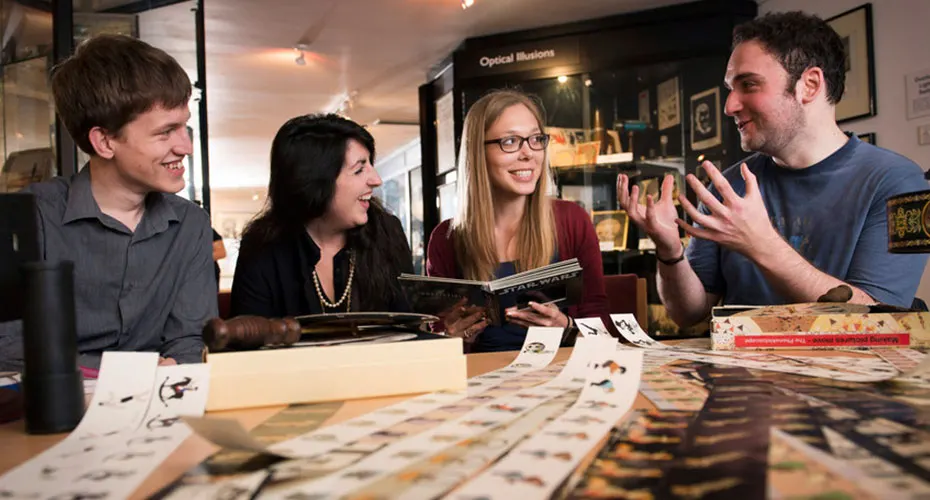
Students in the Bill Douglas Cinema Museum
We are exceptionally lucky to have some fantastic facilities and resources on the Streatham Campus.
Special Collections
We have Special Collections relating to writers such as Agatha Christie, Daphne du Maurier, and William Golding, and we integrate these into our teaching so students can share the excitement we have when discovering new insights from manuscripts, letters, and business papers.
The Bill Douglas Cinema Museum
Our unique film and popular culture resource, contains items going back hundreds of years. We regularly take students into its archives and think about the study of literature in relation to visual texts.
Digital Humanities Lab
Digital Humanities is increasingly important in all areas of humanities research, including history, archaeology, literatures and languages. This research space enables the examination, preservation and analysis of historical, literary and visual material. Facilities in the lab include:
- a flagship seminar room equipped with a 4.2-metre video wall, encouraging interactive engagement in a shared display space
- two state-of-the-art photography labs, including provision for the 2D digitisation of heritage material and primary sources
- an audio-visual lab with a recording studio and sound editing suite
- a MakerSpace equipped with 3D scanning and printing equipment
Whilst my studies here at the University of Exeter have been incredible (I cannot speak highly enough of my English course), my time at Exeter has been defined by what I do away from the books.
I have taken managerial roles within societies, broadening my circle of peers and allowing me to develop my leadership skills. Not only have I been involved in voluntary positions, the University’s broad internship programme has allowed me to take paid work in the Digital Humanities Labs, assisting academics on world leading research and pioneering and fostering new relationships between the University and the rest of the world.
This internship has let me interact with texts like the first edition of William Golding’s ‘Lord of the Flies’ (with the rarely seen first chapter) and even taken me to Canada, all of which is incredible experience, and will stand me in good stead for further study. I chose the study abroad option at Deakin University in Melbourne, Australia, as I believe that having international experience is key to success as work between countries continues to become more globally significant and the world is becoming smaller through communication and travel,’
Connor
BA English with Study Abroad (Deakin University, Melbourne, Australia)

Your future with a degree in English and History
Employer-valued skills this course develops
Our BA in English and History equips you with a range of complementary skills that will put you in a great position to succeed in a range of careers. Alongside in-depth knowledge of both subjects, you will develop highly transferable skills in:
- researching;
- analysing and assessing primary and secondary sources;
- written and verbal communication;
- managing and interpreting information;
- developing ideas and arguments;
- teamwork;
- problem solving;
- and the ability to make informed decisions.
Through a balance of independent study and teamwork you will learn to manage your time and workload effectively.
Employer visits
We have a dedicated Careers Service, ensuring you have access to careers advisors, mentors and the tools you need to succeed in finding employment in your chosen field on graduation. We offer the Exeter Award and the Exeter Leaders Award which include employability-related workshops, skills events, volunteering and employment which will contribute to your career decision-making skills and success in the employment market.
Our graduates compete very successfully in the employment market, with many employers targeting the University when recruiting new graduates. For further information please visit our Careers Service pages.
Career paths
You will be equipped with skills that are attractive to employers and relevant for a wide range of careers, including graduate-level roles in the heritage and arts sectors as well as other fields of work, including education, retail management, recruitment, charities, finance and accounting, and journalism.
Example careers include:
- Account Manager
- Archivist and/or Librarian
- Business Analyst
- Civil Servant
- Digital Marketing and Events Executive
- Event Project Manager
- Global Market
- Researcher
- Historian/teacher of History and/or English
- Parliamentary Researcher
- TV Researcher
Further study
A degree in English and History will put you in an excellent position to pursue postgraduate study after you have graduated. We offer several Masters degrees suited to enhancing your employability or relevant to your interests, such as:
Find out more about studying at Exeter







Sign-up for more information about studying with us
If you're thinking about studying BA English and History with us, signing up to our emails is the best way to discover if we’re the right university for you.