BA History and International Relations
| UCAS code | VLF2 |
|---|---|
| Duration | 3 years |
| Entry year | 2027 |
| Campus | Penryn Campus |
| Typical offer | A-Level: AAB-ABB |
|---|---|
|
A-Level: BBB-BBC |
| UCAS code | VLF3 |
|---|---|
| Duration | 4 years |
| Entry year | 2027 |
| Campus | Penryn Campus |
| Typical offer | A-Level: AAB-ABB |
|---|---|
|
A-Level: BBB-BBC |
| UCAS code | VLF4 |
|---|---|
| Duration | 4 years |
| Entry year | 2027 |
| Campus | Penryn Campus |
| Typical offer | A-Level: AAB-ABB |
|---|---|
|
A-Level: BBB-BBC |
Why study History and International Relations at Exeter?
- Study international, economic, cultural and social history and many geographical areas including the Americas, parts of Asia, Britain and Europe.
- Our broad range of optional modules in your second and third years gives you the flexibility to tailor your degree to your interests and career ambitions.
- Prepare for your future career by developing a range of skills valued by a wide range of employers from the media to teaching and the public, private and charity sectors.

Top 100 in the world for History
QS World University Subject Rankings 2026
Top 100 in the world for Politics
QS World University Subject Rankings 2026

Top 15 in the UK for Politics

We are 6th in the UK for research in History
Based on our GPA in REF 2021
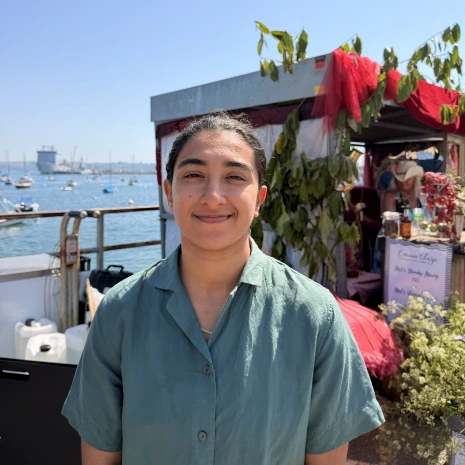
"At first I wasn't sure about the interdisciplinary approach, but I've come to really value it; it means I'm able to engage with different subjects that genuinely connect to each other."
Studying areas like environmental humanities and politics has shown me why looking at issues from more than one angle matters. This was brought to life by opportunities like visiting the Hypatia Archive in Penzance, which was a genuinely eye opening experience, and collaborating with Falmouth photography students, working across disciplines like that has added real nuance to how I think and approach my work. I also appreciate not being limited to history, because it gives me space to explore and work out where my interests lie. The flexible assessments are a real benefit too, since they push me to think originally.
I chose to be here because it has such close knit family style community, which creates the loving support system I need to help focus on my interests. You encounter people from all walks of life, and the interactions feel more real and considered than I’d anticipated. Theres an authenticity to the community here that’s hard to put into words.
Zainab
BA History and International Relations
Entry requirements for 2027 entry (typical offer)
| Qualification | Typical offer | Required subjects |
|---|---|---|
| A-Level | AAB-ABB | n/a |
| IB | 34/665-32/655 | n/a |
| BTEC | DDD-DDM | n/a |
| GCSE | C or 4 | English Language |
| Access to HE | 24 L3 credits at Distinction Grade and 21 L3 credits at Merit Grade | N/A |
| T-Level | Distinction | N/A |
| Contextual Offer | A-Level: BBB-BBC |
Specific subject requirements must still be achieved where stated above. Find out more about contextual offers. |
| Other accepted qualifications | ||
| English language requirements |
International students need to show they have the required level of English language to study this course. The required test scores for this course fall under Profile B1. Please visit our English language requirements page to view the required test scores and equivalencies from your country. |
|
NB General Studies is not included in any offer.
Grades advertised on each programme webpage are the typical level at which our offers are made and provide information on any specific subjects an applicant will need to have studied in order to be considered for a place on the programme. However, if we receive a large number of applications for the programme we may not be able to make an offer to all those who are predicted to achieve/have achieved grades which are in line with our typical offer. For more information on how applications are assessed and when decisions are released, please see: After you apply
Course content and modules
The History and International Relations degree programme is made up of compulsory (core) and optional modules, which are worth 15 or 30 credits each. Full-time undergraduate students need to complete modules worth a total of 120 credits each year.
Depending on your programme you can take up to 30 credits each year in another subject, for instance a language or business module, to develop career-related skills or just widen your intellectual horizons.
You may notice changes to some of our modules over the coming months. This is because we are making space for the following:
- Minors: Future Skills Pathways - Alongside your main degree you may be eligible (depending on your course) to choose modules from another subject to broaden your skills and interests.
- Skills to Thrive built into every degree - Essential skills for your future, including communication, problem-solving, teamwork and digital confidence.
- Increased innovation and wellbeing - More room for creative learning, real-world projects and a healthier study rhythm.
The modules below provide examples of what you can expect to learn on this degree course based on recent academic teaching. The precise modules available to you in future years may vary depending on staff availability and research interests, new topics of study, timetabling and student demand.
Please note that the module information displayed here is subject to change.
75 credits of compulsory modules, 45 credits of optional modules (including 30 credits of History optional modules and 15 credits of Politics and International Relations optional modules)
| Code | Module | Credits |
|---|---|---|
| Compulsory 1 | ||
| New Approaches to History | 15 | |
| Key Concepts in Politics and International Relations | 15 | |
| Political Communication | 30 | |
| Generative AI and Sustainable Futures: Ethics, Society, and Scholarship | 15 | |
HIC1604: New Approaches to History
This module will provide you with the key skills necessary to identify the intellectual and historiographical perspectives from which different histories have developed. You will examine how historians study the past and how they engage with each other’s work. You will consider how even historians studying the same topic can have differing perspectives. Over the course of the module, you will develop your understanding of the ideas that have underpinned historical research and writing, and how different theories and assumptions shape the ways history is written. At its core, the module highlights the importance of historiography and reading critically by analysing and evaluating the author’s argument. You will consider new directions and approaches for the study of history in dialogue with other disciplines. You will be encouraged to read closely, process reflectively, and develop critical thinking skills. You will be introduced to the working methodologies and interests of the academic staff in Cornwall and the variety of possible approaches to history that you can look forward to exploring during the rest of your degree.
POC1021: Key Concepts in Politics and International Relations
How and when did China, Russia, North Korea or Cuba become the 'bad guys' in mainstream popular culture and the news? Why does mainstream news prioritize the US' foreign policies over Brazil's, for instance? What do we mean by realist, constructivist or idealist approaches in IR? Are such 'old school' concepts still relevant in an increasingly globalized world where borders appear to be blurred? What other approaches has IR, as a discipline, shied away from and why is it important that we centre our analysis around them? Our global world, some would argue, is at an important historical juncture: the environment, sexual rights and space exploration have become major debates alongside increasingly populist states. How do we make sense of this variety? Who has the power to implement such analyses? Our module attempts to make sense of our world by drawing together classic and contemporary analysis in IR. We will draw on scholarly works whilst examining them in tandem with historical and current events.
No prior knowledge skills or experience are required to take this module and it is suitable for specialist and non-specialist students. The module is suitable for students studying Politics, History or International Relations.
POC1033: Political Communication
Is communication ever not political? Since power and decision-making is central to the study of politics, many forms of communication have political dimensions. Informal, personal interactions can reflect or challenge power dynamics. Communication does not need to be explicitly ‘political’, to reinforce or disrupt existing structures and norms in ways that shape public debate. We will examine forms of political communication, such as incivility in social and political life, rhetorical speeches, opinion pieces, state apologies, debate, citizens assembly deliberation, referendum campaigns, responses to controversial statues and comedy. We will also explore the skills needed to engage in effective and inclusive political communication. You will therefore develop your own capacities as an effective and inclusive communicator through practice-based learning in both a group and an individual project.
POC1036: Generative AI and Sustainable Futures: Ethics, Society, and Scholarship
Artificial Intelligence is reshaping the production, communication and evaluation of knowledge across higher education, professional environments and society. This module provides you with the foundational understanding and practical competencies to become AI‑literate within their degree programmes. It equips you with a clear grasp of how Generative AI operates, develops your ability to use AI tools effectively and ethically, and encourages critical engagement with the opportunities and challenges AI presents for the Humanities, Social Sciences and Law. You will examine the technical principles underlying large language models and related systems, gaining insight into their capabilities, constraints and modes of operation. This technical grounding is complemented by structured opportunities to apply AI tools to academic research tasks, including project planning, source interrogation, argument development and the communication of ideas. Throughout, the module emphasises the importance of evaluative judgement: you will learn how to assess the quality, accuracy, reliability and biases of AI‑generated materials, and to make informed decisions about appropriate use. A distinctive feature of the module is its sustained engagement with the broader implications of AI for sustainability, social and environmental justice, legal processes and political life. You will explore how debates within your own disciplines intersect with the development and deployment of AI technologies, enabling you to situate your learning within wider scholarly and societal conversations. The module also incorporates personal skills auditing and guided professional development, supporting you in building responsible, reflective and future‑facing approaches to AI use. It prepares you not merely to use AI tools, but to understand, question and evaluate them as emerging and influential components of academic practice and contemporary society.
| Code | Module | Credits |
|---|---|---|
| History Optional | ||
| Foundations of Environmental Humanities | 15 | |
| Historical Sources and Skills: Microhistory and History from Below | 15 | |
| Public History | 15 | |
| European History: Politics and Society | 15 | |
| An Introduction to Histories of Science and Environment | 15 | |
| Global History: Twentieth Century Transformations | 15 | |
| International Relations Optional | ||
| British Government and Politics | 15 | |
| Violence in World Politics | 15 | |
| Power, Inequality and Global Justice | 15 | |
HIC1010: Foundations of Environmental Humanities
This module introduces you to the insights provided by a range of humanities disciplines dealing with urgent issues of climate and environmental change. You will be introduced to key concepts and ideas and will track the emergence of Environmental Humanities as a new interdisciplinary field. You will get to learn about cultural, ethical, historical, social, political, legal and literary perspectives representing environmental humanities inquiry. You will study an array of theories, themes, issues, questions, and debates within the humanities in dialogue with the sciences. We will address issues associated with knowledge, meaning, justice, crisis, and sustainability.
The module aims to introduce you to the main themes, theories and discussion in current Environmental Humanities research, by focusing on cross-disciplinary and interdisciplinary perspectives and approaches. You will develop a broad understanding of the relationship of nature, culture, history, science, technology, politics and economy in the context of today's climate and environmental crises. You will develop knowledge of the multi-layered and historically contingent relationship of nature, culture, politics, economy and science. We will discuss different perspectives on environmental, social and multi-species justice.
HIC1012: Historical Sources and Skills: Microhistory and History from Below
While engaging with grand narratives is an important first step in histories studies, the research projects which you will undertake in your studies will require you to speak to larger historical debates by identifying specific case studies and microhistories which can speak to larger issues. This also means you will need to be able to use an analyse a wide array of primary sources. This module will equip you with the skills needed for success in your future research projects, including your final dissertation, by focusing on the art of primary source analysis and identifying appropriate case studies. Rather than looking purely at top-down history, this module will also provide perspectives from the "history from below" and help you identify microhistories which can speak to broader historical issues and debates.
Primary source are enormously varied, ranging from private diaries and newspapers to oral history recordings, material cultural and paintings to manuscripts. Each variety poses different possibilities and problems to the historian, all of which we will explore. By focusing on a different source genre each week, you will develop the ability to tackle historical research at a more sophisticated level. We will employ the sources examined to shed light on a range of histories, with a focus on the history of social relations, working-class politics, popular protest, the history of gender and sexuality, immigration, and the lives of non-elite people.
HIC1603: Public History
Public History is an optional module on the level one History programme, which will introduce you to the theory and practice of public history. You will analyse the power, politics and practicalities of (re)presenting history in the public sphere. You will gain insight into public responses to the past and the importance of understanding diversity and inclusivity in current approaches. From heritage sites and museums, to film, fiction and virtual reality; the course explores key concepts and contextualises them within national and international debates. You will have the opportunity to analyse museum exhibits, conduct practice oral history interviews, critically analyse concepts relating to protest and social activism in cultural heritage settings, and examine why it matters to challenge accepted narratives (as well as those under threat) in the current political landscape.
This module aims to give you a core theoretical understanding of the key issues and debates in Public History. You will have the opportunity to put theory into practice through in-class discussions and assignments , which will help you to critically review and engage with current debates in the field. It also aims to give you competency in several transferable skills, including experience in undertaking basic oral history interviews, understanding different viewpoints through structured debate, and in critical analysis.
HIC1605: European History: Politics and Society
This introductory module explores themes, ideas, and developments in history and historiography that are fundamental to understanding the past and its study. It does so through a chronological framework that maps onto key points in British and European history and scholarship. We consider the emergence and development of key concepts in European history including nationalism, democracy, and revolution, among others. We will also address questions and debates about periodization throughout European history. Within this framework, you will analyse key ideas, events, and individuals, as well as debate approaches taken by other scholars, past and present.
This module aims to introduce you to some of the foundational concepts, key events, and important individuals in European history. Mirroring the long chronologies of other core modules, you will gain insight into developments in European society and culture, while also attaining a foundational understanding of the general overview of European history. You will gain the ability to make connections between the core modules at first-year. This general understanding will give you a good grounding to look in greater detail at some of these and later events in the rest of your degree.
HIC1610: An Introduction to Histories of Science and Environment
This module introduces you to the history of scientific and other systematic approaches to non-human nature in different parts of the globe from 1500 to the present day. You will develop a broad knowledge and critical understanding of the way historians, sociologists and other scholars have studied the complex and changing relationship between humans and the non-human environment. These will enrich your ability to understand how interdisciplinary approaches within the humanities and social sciences can yield powerful insights into the roots of our environmental crises and dilemmas.
This module aims to give you a broad understanding of the ways in which human cultures have interpreted and exploited their non-natural environments from 1500 to the present. These include Western scientific, non-Western and indigenous processes for making and applying knowledges. You will acquire a broad understanding of connections between, on the one hand, beliefs and practices concerning 'nature' and sustainability, and on the other. the wider contexts of politics, economics, imperialism, industrialisation, gender, race, conflict, religion and spirituality. The module will give you the ability to challenge assumptions made about such fundamental concepts as nature, environment, science and knowledge. It aims to enrich your ability to apply interdisciplinary approaches to critically understand a range of environmental issues that have become global crises.
HIC1611: Global History: Twentieth Century Transformations
This module introduces key social, cultural, economic, and political themes in modern global history, with a particular focus on the twentieth century. Moving from colonialism and world wars through nationalism, migration and race, global governance, decolonisation, the Cold War, environmentalism and globalisation, it traces both global interconnectedness and moments of rupture. You will work closely with primary sources alongside secondary readings to engage with historians’ interpretations and develop your own evidence-based arguments.
This module aims:
· to develop your understanding of major patterns of global historical change in the modern period, approached from comparative international and cultural perspectives;
· to build your understanding of how global processes and micro-historical experiences inform one another, using case studies drawn from across the module;
· to strengthen your skills in historical enquiry, particularly in analysing primary sources for themed portfolio assessments, relating them to wider historiographical debates, and presenting your arguments clearly in written and oral form.
POC1003: British Government and Politics
This module will use the question of how pluralist British Politics is, to take students on a journey through under-examined aspects of British histories, cultures, and politics. In many respects it tackles the themes of traditional British Politics courses, but will provide a fresh new set of perspectives which begins from some of the inequalities which ripple through contemporary Britain. Our aim is that by exploring different positionalities and perspectives, some of the long-standing fracture lines in British society and politics can become better understood. Further, the module presents a version of politics in which power is dispersed throughout civil society, rather than held centrally in Westminster. We will explore the idea that the body politic is something that we all have the capacity to shape, and that we are all a part of, rather than something that is remote and inaccessible.
POC1022: Violence in World Politics
This module will help you to understand the different conceptual approaches that enable a critique of violence in the contemporary international system.
Violence is an ever-present feature of international politics. Violence can be a direct and physical act, such as war and terrorism. Violence can also be a non-physical and anonymous act of neglect or abuse, such deprivation and abandonment. Violence can also be performed through culture and institutions. In this module we will examine a series of questions: What is violence? Where and how does it happen in world politics? What causes it? When is it justifiable? Is violence inevitable, or can violence be reduced, and even eliminated? By studying violence, we will examine some of the greatest challenges and issues in international politics today: war and terrorism; economic inequality; religious and secular justifications for violence; environmental, cultural and urban destruction; borders; sexual violence; and new technologies. Through the lens of International Relations scholarship, you will research, engage with, and critique different ways of conceptualising both the root causes of violence and the possibilities for change.
There are no pre-requisite or co-requisite modules required in order to take this module.
The aim of this module is to:
POC1026: Power, Inequality and Global Justice
This module will help you to ask critical questions about the assumptions behind contemporary practices of power in the contemporary international system.
You will understand what it means to ask critical questions by exposing and deconstructing a range of empirical practices in world politics. Through this critical questioning, we will explore the issues and possibilities for global justice in the contemporary international system. In this module we will examine a series of questions: How can we think critically? How do we find out what is going on in the world? Why do we obey? Why is the world divided territorially? Do colonialism and slavery belong in the past? Why are some people better off than others? What makes the world dangerous? What can we do to change the world? Who do we think we are? How can we end poverty? You will be exposed to a variety of approaches or 'framings' of world politics and encouraged to develop your own perspectives and reasoned arguments about them.
There are no pre-requisite or co-requisite modules required in order to take this module. This module is particularly recommended for students who intend to pursue modules in International Relations at levels 2 and 3.
The aims of this module are to:
Please note that the module information displayed here is subject to change.
30 credits of compulsory modules, 90 credits of optional modules.
You will select either Pathway A or B.
Pathway A, you will take the 30-credit compulsory module HIC2039 The Practice of History
Pathway B, you will take the 15-credit compulsory modules POC2124 Political Analysis and POC2087 Security Studies.
| Code | Module | Credits |
|---|---|---|
| Pathway A | ||
| The Practice of History | 30 | |
| Pathway B | ||
| Security Studies | 15 | |
| Political Analysis | 15 | |
HIC2039: The Practice of History
This module is a major step in your development as a professional historian and preparing for your dissertation next year. It is a guided independent study, with the freedom to explore one of two pathways depending on your interests and future career ambitions. Students must choose either:
- Libraries, archives and special collections, or;
- Public understanding of the past
Every student is required to design and deliver - with the support of a supervisor - a project that stems from their historical and professional interests, the expertise of staff, and the availability of resources. You will practice the collection and application of a critical analysis to primary and secondary sources, and real-world historical practice to interrogate our knowledge of the past and its uses in the present.
This module is a guided independent study module, which aims to develop your transferable skills in self-motivated study, project management, communication, problem-solving, source analysis, archival skills, critical engagement with scholarly debates, and producing an excellent standard of final output. Unlike many core modules, students enrolled in The Practice of History will have the choice to follow one of two professional pathways:
- Libraries, archives and special collections: This pathway models the work of a traditional historian and is centred around the dialogue between primary and secondary sources. Students following this pathway will have the opportunity to construct their own research project, beginning with the development of a specific research question. They will use a range of primary and secondary sources to produce a critically reflective research essay based on 4-5 primary sources. This option constitutes an individual project, which will be fully supported through frequent meetings with supervisors.
- Public understanding of the past: In this pathway, students will be matched with a local cultural heritage organisation to research one of their key priorities for public engagement. Students will work with a range of sources and, under the guidance of the organisation and supervisor, will deliver a pre-determined output, which might include a museum exhibition, educational resource, short documentary, film consultation, podcast, discovery day, or research papers at conference, amongst others. This pathway has the potential for group work, with no more than three students per project. This project involves working with sponsors on pre-defined projects, which will require independent outputs for the sponsor that while not formally assessed are used as the basis for the assessments for this pathway.
It is important to note that both pathways will require students to participate in employability activities, specifically tailored for their cohort as part of this module.
POC2087: Security Studies
This module will introduce you to the field of Security Studies, allowing you to critically engage with a range of contemporary practices in the current international system that are performed in the name of security. Popular and official discourse in contemporary international relations is littered with references to a need to protect and improve 'security'? But what does that mean? How does an actor practice 'security'? Does seeking more security make us less insecure? And is there a tension between securities and liberties? In this module, we will examine different theoretical and conceptual understandings of security and of security practices in international relations. You will have the opportunity to examine a range of issues, including: the politics and ethics of nuclear deterrence; the strategy of warfare; the ethics of torture and human rights, security and race; security and gender; the role of technology and the pre-emptive security practices of the War on Terror.
No prior knowledge skills or experience are required to take this module and it is suitable for specialist and non-specialist students.
This module will:
POC2124: Political Analysis
This module will introduce you to political analysis in order to prepare you for your dissertation in third year. You will engage with a range of theories and approaches to the study of Politics and International Relations. You will be challenged to reflect on the assumptions that underpin various analytical lenses, which in turn shape the questions that can be asked and answered. As experts in their field, staff will offer political issues to be analysed and work through a number of different approaches and methods, using real world examples of research on that issue. Through the module you will be guided on choosing a suitable topic for your dissertation, conducting a literature review, generating your own focussed research questions, and designing an independent research project.
| Code | Module | Credits |
|---|---|---|
| History Optional | ||
| Apocalyptic Narratives: Disaster Writing | 15 | |
| Ecology and Empire | 15 | |
| Art and Archaeology in Post-Colonial Nations | 15 | |
| Stolen Histories: Colonialism, Looting, and the Illicit Trade of Cultural Heritage | 15 | |
| Critical Elements of Environmental Humanities: Cultures of Earth and Water | 15 | |
| The Occult in Victorian Britain | 15 | |
| Germany 1500-Present: Cultural and Political Histories | 15 | |
| Humanities in the Workplace (Penryn) | 15 | |
| Enlightenment and the Age of Reason: Philosophy, Politics, Society | 15 | |
| Revolution and Abolition: History and Legacies of the Atlantic Slave Trade | 15 | |
| International Relations Optional | ||
| American Politics | 15 | |
| National and Community Identity | 15 | |
| The Political Psychology of Elites | 15 | |
| Imagining the Good Life: From Agora to the American Dream | 15 | |
| Introduction to Postcolonialism | 15 | |
| Political Geographies: Local to Global | 15 | |
| Politics of the Middle East | 15 | |
| Global Authoritarianism | 15 | |
| Politics of Gender, Sex and Sexuality | 15 | |
| Politics, Policy and Economy | 15 | |
HIC2007: Apocalyptic Narratives: Disaster Writing
In this module, you will study a range of literary, historical and scientific narratives of global natural disasters (for example, hurricanes, landslides, drought, explosions, volcanic eruptions, exposure to nuclear warfare agents or chemical accidents), as well as texts on apocalypses. You will explore the ways in which such disasters and apocalypses have been imagined as the result of human actions—or portrayed as part of a 'natural' order. Further investigations include the ways in which multinational corporations often benefit by disasters, and the ways in which science writing and humanities writing can be integral to both the understanding and the mitigation of sometimes avoidable events. As part of the applied discipline of this module, you will be expected to engage in weekly writing practices of your own.
HIC2009: Ecology and Empire
This module examines how colonialism has shaped both the environment we inhabit and the ways we imagine our relationship to it. Through the lens of environmental history, it traces the ecological consequences of imperialism, the colonial formation of environmental knowledge, and the entanglement of globalisation, land politics, and sovereignty. Students will explore how anticolonial and environmental movements have contested these legacies and consider what it means to think beyond them.
You will engage with a range of historical sources—including archives, letters, photographs, and maps—and develop skills in interpreting them through postcolonial and settler‑colonial perspectives. By situating imperial and global histories within environmental frameworks, the module addresses questions such as:
- What is imperialism, and how has it shaped the world around us?
- How does an environmental history lens change our understanding of colonisation and decolonisation?
- In what ways has colonialism organised knowledge about the natural world, and how might we move beyond those frameworks?
HIC2028: Art and Archaeology in Post-Colonial Nations
In this module you will study indigenous art and archaeology, as well as the ways in which European colonizers and indigenous populations interacted, in southern Africa, Australia, and North America from deep time up until the present day. You will look at cultural and societal transformations using historical, archaeological, and art historical evidence, from the point of view of European settlers and indigenous groups. You will critically engage with the emergence of the themes of socialised landscape, environmental history, material culture, migration, and cognitive archaeology, as well as the ideological implication of these concepts. You will investigate the origins of indigenous art and culture as well as the consequences of pre- and post-colonial efforts to manage and interact with the land. This module will enable you to demonstrate how useful a critical historical perspective is to understanding and addressing the roots of contemporary issues concerning social and cultural identity, indigenous worldviews, and reconciliation.
HIC2040: Stolen Histories: Colonialism, Looting, and the Illicit Trade of Cultural Heritage
How did West African material culture like the Benin Bronzes end up in European museums? Why does their journey matter? What do objects and artworks such as these mean to us now, in the 21st century, as we live with the legacy of empire? What do they tell us about culture, power, and the links between finance and politics? To whom do these artefacts belong? This module will explore the complexities of decolonising spaces and disentangling repatriation claims using an interdisciplinary approach integrating perspectives from history, anthropology, art history, and museum studies.
This module will be of interest to students who want to explore the historical context of stolen objects to understand how and why they were taken. You will have the opportunity to explore the world of fake objects and forged artworks, shipwreck looting, the illicit trade in antiquities, war zone collecting, and debates surrounding contemporary 3D reproduction printing. We will examine how museums respond to issues surrounding the sale of objects, the politics of museum closures, and the disposal of collections across different geographical regions. You will develop skills in analysing material culture, using objects as primary sources.
HIC2041: Critical Elements of Environmental Humanities: Cultures of Earth and Water
How can the humanities help us understand and respond to the ecological and climate emergency? How do these emergencies challenge traditional approaches to the study of human culture and ‘nature’? This module approaches these urgent questions through the study of landscapes and waterscapes as both a physical and ideological entity. Every landscape and waterscape is shaped by the often unintended consequences of its human and nonhuman histories. On this module you will investigate landscapes and waterscapes (from oceans to rivers and lakes) shaped by a range of connected processes such as mining and extraction, farming, energy production, conservation and recreation, pollution and waste. We will examine the multiple, often competing meanings that landscapes and waterscapes hold across societies and cultures, both locally and globally. We will engage critically with the visible and invisible legacies of colonialism and extractivism. We will also seek out possibilities for hope in acts of and in the regeneration of ruined landscapes and waterscapes.
HIC2316: The Occult in Victorian Britain
Far fewer Britons believe in ghosts now than they did in the nineteenth century. Why were the Victorians so fascinated by the occult and what we now call the 'paranormal'? In this module you'll be exploring the origins, growth (and in some cases demise) of many key occult/esoteric 'currents' of the period, including animal magnetism and Swedenborgianism, Modern Spiritualism, Modern Theosophy, psychical research and ritual magic. You'll be exploring the ways that historians have interpreted these currents as responses to a host of wider issues, including the growing authority of the sciences, the fragmentation and privatisation of religious practices, secularisation, democratisation, industrialisation and urbanisation. For this reason, this module is as much a history of Victorian culture, broadly defined, as specific occult and esoteric currents. Indeed, you'll learn how useful these currents are as lenses for better understanding the Victorians.
But this module isn't just about the British: most of the occult and esoteric movements originated in other countries (e.g. Modern Spiritualism was 'born' in the US in 1848) and their ongoing development overseas impacted on the British scenes.
HIC2338: Germany 1500-Present: Cultural and Political Histories
This module will examine the cultural and political history of Germany and its regions within a longue durée framework. It will particularly look at how attempts to define the 'who,' 'what' and 'where' of local and national communities shaped the unfolding of German history. Different answer to these questions often made the difference between war and peace, life and death, and democracy and dictatorship. The module will begin in the early modern period with the earliest attempts to imagine the nation on the map and will proceed to an era of modern nationalism—examining the failure of liberal ideas of nation of 1848, political unification under Bismarck, and popular ideas of Germany as a 'nation of regions.' Moving from the Second Empire to the Weimar Republic and the mass violence of the Third Reich, we will conclude by examining attempts after 1945 to rethink local and national communities within a new federalist democracy and a unified Europe.
- The module will introduce you to the shaping of local, regional and national communities in German history across the longue durée.
- It will examine the ideologically variant contexts in which ideas of community were formed and the tools used in their shaping. Notions of Germany as a 'nation of regions' will represent a particular focal point.
- Over the course of module, you will be asked to reflect critically on how, within the context of German history, differing ideas about community had broader social, cultural and geopolitical ramifications.
HUC2001: Humanities in the Workplace (Penryn)
No prior knowledge skills or experience are required to take this module and it is suitable for specialist and non-specialist students.
For this module you will complete 35 hours of voluntary work experience with an employer of your choice. The aim of this module is for you to gain employment experience, skills for finding and securing the perfect job, and to see how your academic learning translates into a post-university environment.
We will have a series of workshop sessions to help you with the skills required for finding/ securing your work placement, including CV writing, and practical sessions talking about day-to-day issues within your placements.
You may arrange your placements yourselves using the assistance of the Employability resources on campus, and may undertake your placement at any point up until the end of April. This will allow you to undertake placements in other parts of the UK/ world if you so choose.
This module will help you to gain experience in a graduate level working environment, building contacts, skills, and knowledges to help you start out on your career post university, or try out a field that you think that you might be interested in but need to understand more.
HUC2013: Enlightenment and the Age of Reason: Philosophy, Politics, Society
Today we take for granted that scientific rationality, individual autonomy, universal human rights, and notions of 'progress' are key features of the modern world, but how did this happen? This module explores the social, cultural, and political conditions in Britain, Europe, and the wider world in the period c. 1650-1800 within the context of the birth of the 'modern world'. Each week you will examine key works, people, and institutions that contributed to the intellectual, cultural and social discourses of this crucial period of flux, which has had long-lasting and world-wide consequences, some of which you will explore during the course of the module.
This module aims to give you in-depth knowledge of a crucial period in history and to engage you in critical reading and thinking. Primary source texts and secondary literature will present you with ample material to develop critical and analytical skills, as well as hone your discursive and communication skills in the seminar discussions which will be a key component of this module. Lectures will provide key background information, especially biographical and historical context and introduce key themes and questions for discussion. You will have the opportunity to undertake independent research and to present their work in a supportive environment.
HUC2015: Revolution and Abolition: History and Legacies of the Atlantic Slave Trade
The late-Eighteenth century saw intense debates about the evils of slavery, the limits of political liberty, and the link between imaginative literature and historical agency. This module introduces you to some of the key texts written in the incredibly tumultuous period between the 1780s and 1820 when Britain was involved in a transatlantic slave trade, a global war with Revolutionary and Napoleonic France, and wracked at home by often violent political agitation. The module looks both at the historical conditions that led to abolition and slave rebellions in the Atlantic world, while also considering imaginative literature that contributed to political debates. The module will also consider contemporary issues in heritage, commemoration, and reparation relating to the Transatlantic slave trade and its legacy.
You will be introduced to a range of historical and theoretical perspectives for looking at issues surrounding the movement towards abolition of the slave trade and slavery in the British Empire. You will examine primary sources including polemical prose, poetry, parliamentary oratory, and life-writing that played a role in the movement for abolition. You will consider some of the debates in contemporary historiography of the Black Atlantic, and consider the legacies of the slave trade in literature and heritage in the present day.
POC2005: American Politics
Students of Politics need to understand different political systems around the world. While the United States is very familiar to us it has a political system that is fundamentally unlike that of Britain or most countries in Europe. Indeed, the way it elects its president, for example, is unique. This module provides an introduction to American democracy, from its foundations in the Constitution and federalism, to its political culture, institutions and processes, and the policies that emerge from it all. It examines the design and rationale for the American political system and the implications it has for governing and the policy making process. We will also examine how reforms to governmental institutions and processes might influence the way citizens interact with government. Throughout the module we will make comparisons between the American system and other democracies around the world.
No prior knowledge skills or experience are required to take this module and it is suitable for specialist and non-specialist students.
This module comprehensively examines the political system of the United States, from its foundations with the Declaration of Independence and Constitution, through the way its institutions work, to contemporary debates about gun control and health care. We will use theories and findings from the study of US Politics to understand politics in each of the domains we study. We will survey classic and contemporary work in these fields.
POC2018: National and Community Identity
Identity politics is a topic which infuses all levels of political debate, from big questions around ethnicity and race, to smaller, and more subtle questions, such as what can I absorb into my identity? This latter puzzle carries enormous implications that reverberate throughout both domestic and global politics. In this module you will explore how identities function both within communities and groups, but also regarding an individuals sense of self, and what problems and possibilities this opens.
The first part of the module develops a range of theoretical tools, which later are applied to specific and topical case studies, encouraging students to think critically around some 'taken for granted' issues.
Whilst prior studies of politics would be an advantage (particularly around political analysis, international studies and policy), interdisciplinary students would also find this a satisfying topic within which to engage.
This module explores the politics of identity, through the concepts of memory, belonging, otherness and difference.
POC2041: The Political Psychology of Elites
When we study the decisions of political leaders, we often think about them in terms of the power relations between states. Or we look at leaders as rational actors determined to maximize benefits and minimize costs. In other words, we ignore what is often referred to as the 'black box', or the psychological processes and dynamics that lie behind decisions. Political psychology focuses explicitly on the 'black box.' In this module, you will examine psychological explanations of elite policy decision-making, focusing mostly on foreign policy cases such as the Vietnam War and the war in Iraq. Political psychology is a relatively new subfield of Politics that has provided a wealth of new insights and approaches to the study of politics, many of which you will encounter in this module.
No prior knowledge skills or experience are required to take this module and it is suitable for specialist and non-specialist students.
POC2085: Imagining the Good Life: From Agora to the American Dream
In this module we will work together to think critically about the core political question that has exercised theorists for over two millennia. What is a Good Life and how can society be organised to achieve it, for who or what? What role should the state have in conceptualising and creating a good life for its citizens and others? What function should a vision of The Good Life play in organising society? These questions are still relevant, if not crucial, as taken for granted systems and world orders are becoming increasingly unstable. What social imaginaries should create a new vision for the future, one that perhaps should extend beyond old ideas of 'the social'? In this module we will engage with some key theories of The Good Life from ancient to modern times, covering the different concepts of human and planetary flourishing. What roles should virtue, resilience, happiness, pleasure, justice and liberty. How could we think about duty to other humans, species and entities in relation to our own good lives? We will assess the continuing relevance of those ideas in relation to national and global governance and pressing contemporary issues.
POC2103: Introduction to Postcolonialism
In this course you will examine postcolonialism as a field of study that is intrinsic to understanding world politics and International Relations, by focussing on the ways in which the contemporary global order is constituted by the experience and practice of colonialism. The course also revisits some of the lingering impasses encountered in classic postcolonial debates by placing them in conversation with futurity studies in order to ponder alternative possibility/ies and modes of knowledge production. As such, questions related to cultural production, the environment, and aesthetics are integral to it.
POC2108: Political Geographies: Local to Global
Our political identities, communities, debates, and activities both take place and make place . The conditions we live in, and our sense of alternatives, are shaped by the specifics of the places in which we are located. And how we navigate these conditions and pursue these alternatives - how we engage in politics - give material and symbolic shape to the world we inhabit. Drawing on critical feminist and decolonial contributions, this module engages the politics of how we position ourselves in the world, in our research and in everyday life. This module begins by introducing debates about the language of local and global space, place and politics. Similarly, it introduces interdisciplinary 'methods' by examining the politics of knowledge: how we define, feel, understand, and communicate politics, space and place, not only through writing but also through aesthetics and images, sensory encounters, and outdoor activities. The module then examines the dominant modern political geography of the state, from which we get specific versions of individual, local, regional and international space. Finally, we will use current political issues - such as (but not bound to) decolonization movements, urban development battles, refugee claims, climate emergency and Indigenous sovereignty claims - to assess how contemporary political life might generate different forms of space and place. We will read across disciplines of politics and IR, geography and geopolitics, and environmental, feminist, Indigenous, and postcolonial political geographies. By the end of the module, you will be able to describe and critically engage different accounts of political space and place, and the forms of political subjectivity, political community, and political analysis that emerge from these accounts.
POC2123: Politics of the Middle East
Famous satirist Karl reMarks remarks that God created the MENA region for the specific and noble purpose of permanently supplying global audiences with 'Breaking News.' Have you ever wondered how and why a region as vast and heterogeneous as the Middle East has become strictly associated with authoritarianism, women and LGBT population's oppression, and permanent wars? This module is an exciting opportunity to rethink politics - broadly speaking - in the Middle East. It unpacks the complexities of state-society relationships by examining them at the domestic, regional and global levels and by drawing on an array of scholarly and popular sources. What emerges is a complex region that seriously pushes us to re-assess our understanding of democracy, resistance, agency and modernity. The module adopts a largely decolonial approach that downgrade state-centric analysis and asks questions relevant to minorities and racial inequalities in the region.
No prior knowledge skills or experience are required to take this module. Although the module is suitable for specialist and non-specialist students, some degree of interest in the region is expected on the part of the student. The module is suitable for students studying Politics, Comparative Politics, History or International Relations.
POC2128: Global Authoritarianism
Authoritarianism is on the rise around the world, whether in the form of growing hostility to Western democracy promotion, the roll-back of democratic governance in countries thought to have ‘transitioned’ to democracy or the growing popularity of populist politics within established democracies. Increasingly, democratic governance seems to be revealing itself as an historical anomaly, rather than a consolidating trend. But what is authoritarianism? How can we trace it? What drives it?
This module aims to help you answer these questions, and more, by exploring the international and domestic factors that sustain authoritarian politics. It will introduce you to the range of theoretical approaches, as well as the conceptual and methodological challenges in the study of authoritarianism, which will be explored through a variety of case studies, from the ‘classical’ authoritarian regimes to those considered ‘democratic’.
POC2133: Politics of Gender, Sex and Sexuality
This module explores key ideas on gender, sex, and sexuality, providing a critical grounding in feminist and queer theory. It applies a decolonial feminist lens to women's movements and feminist theories in the West and beyond. It also examines intersectionality, analyzing how marginalized identities—such as gender, sexuality, race, disability, and religion—intersect with gender. While the focus is on gender rather than women, we will primarily discuss women's rights and also consider masculinity and men's movements.
The aims of this module are to:
POC2136: Politics, Policy and Economy
Drawing on insights from public policy and international political economy, this module examines how different actors, institutions and organisations wield power in the ‘polycrisis’: a period combining environmental collapse, financial instability, technological change, social contestation, populist upheaval and geopolitical conflict. You will examine how political parties, governments, businesses, activists and others help develop policies to command and control the political and economic conflicts and contradictions that underpin the polycrisis, and the ideas that inform these strategies. Inspired by the cutting-edge contributions of contemporary interdisciplinary scholarship, you will take a critical perspective on the past, present and future of power and governance, drawing from across the humanities and social sciences. The module will equip you with an understanding of how ideas about power inform the strategies policymakers from across the ideological spectrum take to govern anPlease note that the module information displayed here is subject to change.
Find out more about study abroad or employment experience under Course variants.
With Study Abroad
120 credit compulsory placement module
| Code | Module | Credits |
|---|---|---|
| Compulsory 1 | ||
| Study Abroad | 120 | |
HAS3999: Study Abroad
The Study Abroad programme enables you to undertake a year-long study placement at a partner university outside of the UK, as part of your degree programme.
This module serves as the administrative mechanism for recording the Study Abroad assessment results of students within the Faculty of Humanities, Arts, and Social Sciences (HASS). Students participating in the Study Abroad programme and based in a HASS department (except for the Law School, the Institute of Arab and Islamic Studies, Modern Languages, and the School of Education) will be registered on this module during their Study Abroad placement year.
The Study Abroad programme widens the range of modules available to you during Stage 3 of your degree programme; enables you to broaden your academic horizons by studying in a different learning culture and (where relevant and appropriate) in languages other than English; and aims to promote resilience, independence, cultural awareness, and communication skills.
With Employment Experience
120 credit compulsory placement module
| Code | Module | Credits |
|---|---|---|
| Compulsory | ||
| Work Placement Year | 120 | |
HAP3906: Work Placement Year
This third-year module forms part of the 4 Year 'with work placement' programmes offered by HaSS, Cornwall to include the Law and Business Programmes with Professional/Industrial Placement, the Politics Programmes with Employment Experience (EE) or Employment Experience Abroad (EEA) and the Humanities Programmes with EE/EEA.
On this module you will work in the UK or abroad for the whole academic year (a minimum of 28 weeks). You will use one or two placements to gain skills that equip you to work in the global jobs market and to improve your knowledge of the work environment. You are encouraged to deepen your understanding of the workplace and the employability skills that you acquire during the year.
Placement durations are as follows:
- for a single placement, a minimum of 28 weeks, excluding statutory and other holidays;
- for two placements, a minimum of 14 weeks per placement, excluding statutory and other holidays.
Prerequisites: to have studied HAP2906
This module cannot be combined with any study year abroad module.
The aims of this module are to provide you with opportunities to:
Please note that the module information displayed here is subject to change.
30 credits of compulsory Dissertation, 90 credits of optional modules
You can weight your modules primarily in one discipline at stage 2 but if you choose to do more History than International Relations at stage 2 you must do the reverse in the final stage (and vice versa) so that across your degree you will have an equal number of credits from History and International Relations.
| Code | Module | Credits |
|---|---|---|
| Compulsory 1 | ||
| Dissertation | 30 | |
HAP3000: Dissertation
The dissertation module equips you with ability to design and carry out independent research on a specific research topic in History and/or Politics and International Relations - with the support from an academic supervisor - resulting in a dissertation.
Each dissertation is a unique research project shaped by your own research interests and ideas and compliant with the standards or rigour and validity of academic research. Hence, there is art and skill to competing a dissertation. It helps developing deep discipline-specific knowledge and valuable transferable skills, including project and time management, engaging with feedback, research, data analysis, critical thinking and communication skills.
This module aims to equip you with necessary knowledge and skills to conduct your own dissertation research in History and/or Politics and International Relations using a series of dissertation lectures and workshops, as well as supervision meetings with a supervisor. These sessions will cover the research process and basics of research design, and other topics essential for your dissertation project. Overall, the module will enable you to conduct your independent research to address a research question of your choice in a rigorous, ethical and competent manner, thus, making you an expert in this research topic.
| Code | Module | Credits |
|---|---|---|
| History Optional | ||
| Environmental Humanities: Futures | 15 | |
| Irish Stories: History and Culture from 1800 to Now | 15 | |
| Writing Nature | 15 | |
| Caribbean Histories: Colonialism, Resistance and Environmental Crisis | 15 | |
| Boffins: Scientists, War, Politics and Culture in the Twentieth Century | 15 | |
| Gender, Power and Identity in Early Modern Britain | 15 | |
| Pacific Histories: Environment, People, and Politics | 15 | |
| The Power of Place: Home, Locality, and Region in Modern History | 15 | |
| Early Modern Britain: Power, Authority and Social Unrest | 15 | |
| Myth in the Modern World: From the Classics to Conspiracies | 15 | |
| International Relations Optional | ||
| Entangled Life: Radical Democracy in Theory | 15 | |
| The Resource Paradox: Blessing or Curse? | 15 | |
| Negotiating Postcoloniality: History and Politics of Independent India | 15 | |
| The Politics of Climate Change | 15 | |
| Controversies in American Politics | 15 | |
| Chinese Politics and Society | 15 | |
| The Politics of Knowledge and Ignorance | 15 | |
| Displacement and Migration in the Middle East | 15 | |
| Social and Islamist Armed Movements | 15 | |
| Gender and Politics in Africa | 15 | |
| Party Politics, Voters and Elections in Britain | 15 | |
| Parliamentary Studies | 15 | |
HAP3001: Environmental Humanities: Futures
This module explores how environmental humanities can help us imagine different futures in the face of climate and ecological crisis. Focusing on the themes of hope, sustainability and stewardship, we examine story-telling and community activism, landscape histories, the rise and critique of sustainable development, and practices such as commons-based governance. We then turn to historical and contemporary ideas of stewardship, from pre-industrial Britain to energy futures, degrowth, green colonialism and relationships with more-than-human worlds, culminating in a reflection on what it might mean to be a 'good ancestor'.
You will engage with historical case studies, theoretical texts and creative work to investigate how narratives of time, progress and crisis shape environmental futures. Through critical and reflective assessments, you will analyse the limits of dominant (often Western and extractive) models of sustainability, engage with anti-colonial and anti-extractivist perspectives, and experiment with alternative imaginaries of care, responsibility and collective action on a damaged planet.
This module aims:
HAP3003: Irish Stories: History and Culture from 1800 to Now
This module takes an interdisciplinary approach to the study of Irish history, culture, and society. It will provide a historical background to issues surrounding Irish nationalism and unionism. You will encounter the rich cultural heritage of Ireland through fiction, poetry, and drama. You will study both the history of Ireland and contemporary issues in Irish society surrounding race, lgbtq rights, feminism, and commemoration. The module will use literary texts and other varied primary sources to study larger theoretical issues involving the relationship between tradition and modernity, individual identity and community, and political and imaginative literature. The module encourages both close imaginative reading of literary texts and awareness of wider historical and theoretical contexts for thinking about the literature, heritage, and politics of Ireland.HAP3004: Writing Nature
In this module, you will develop your own approach to nature writing. You will research and discuss published fiction and creative nonfiction (including memoir, biography and literary journalism) to uncover historical and recent advances to our literary understanding of nature. Experimental (hybrid) forms of ecocriticism will be encouraged through writing exercises and workshopping each other’s creative writing in a supportive manner. Topics/themes will range from climate change to the metaphoric role of animals in literature. Your individual writing skills—including narrative structure, voice, character and thematic meaning—will lead to the creation of emerging hybrid forms within the context of the Humanities. This module involves ten weeks of 3-hour seminars to help guide and direct your independent study. Teaching sessions take the form of ‘workshops’ in which your written work is shared in a supportive and constructive peer review format. During discussion of published work and onHIC3038: Caribbean Histories: Colonialism, Resistance and Environmental Crisis
This interdisciplinary module focuses on the Caribbean region as a case study for exploring twenty-first century modes of imagining climate change and environmental catastrophe in the (post) colonial context to investigate the relationship between Caribbean histories of colonisation and exploitation, concomitant narratives and theories of climate change, climate crisis, resilience, and response. Through engaging with histories, stories, and practices of resistance across the Caribbean, you will uncover and examine the ways in which alternative imagined futures, to those of the dominant Anglo-American climate change discourse, empower communities impacted by climate change in the present.
Keywords: Caribbean history; culture; colonialism; environmental crisis; resistance; imagined futures.
HIC3044: Boffins: Scientists, War, Politics and Culture in the Twentieth Century
This module explores the complex and changing roles of scientists in the twentieth century. Focusing primarily on Britain, France, Germany, the Soviet Union and USA from the 1920s-60s, you will study the significant impacts of war, political and economic changes, and other factors on the scale, funding, professional status, public profile and content of the sciences. You will analyse the dramatic growth of scientists in government, industry, the military and in higher education, as well as their roles as popularisers, historians, philosophers and science fiction writers. You’ll be studying the ways in which the sciences transformed and were transformed by the political, economic, military, bureaucratic and other objectives of the state, and how these transformations continued and challenged ideas of the scientist’s vocation and profession.HIC3048: Gender, Power and Identity in Early Modern Britain
This module will provide you with a unique opportunity to investigate the meanings and construction of gender in historical context: not just biological difference but also the social meanings attached to that difference. You will engage with the most recent research on queer theory, gender and sexuality, homosexuality, and the cultural origins of the male/female binary . Throughout the module you will discover how contemporaries expressed their sexual identities in often unexpected and surprising ways. We are concerned with contrasting the myths about gender relations in this period with a close understanding of the documented experiences of the lives of men and women, both rich and poor, from childhood to old age. You will explore the ways historical lines of enquiry have developed over time and how old assumptions are modified in light of new theoretical and methodological developments. Overall this module will advance your understanding of the importance of gender as a key component of early modern history and the extent to which gender offers a 'useful category of analysis' in the study of all periods of History.
HIC3050: Pacific Histories: Environment, People, and Politics
This module introduces the Pacific as a vibrant region of mobility, exchange, protest and activism, challenging older portrayals of it as an empty space without history or culture. Focusing on the modern period, you will examine Pacific histories of migration and colonisation, decolonisation and indigenous rights, environmental justice and global environmental politics. You will also explore how Pacific peoples have participated in regional and international forums of governance, and reflect critically on how knowledge about the Pacific is produced, silenced and contested.
This module aims:
- to deepen your understanding of key historical and theoretical approaches to Pacific histories, drawing on global, transnational and interdisciplinary perspectives, including Pacific Studies and Environmental Humanities;
- to develop your skills in analysing a wide range of sources—such as maps, photographs, oral histories, protest literature, music, material culture, petitions and archival records—to interpret Pacific pasts and their wider significance;
- to support you in designing and communicating independent historical work for different audiences, through both a creative piece with reflective commentary and a research essay.
HIC3318: The Power of Place: Home, Locality, and Region in Modern History
Attachments to place and home have represented deeply powerful forces throughout history. They have played a key role in community and identity formation, and represent sites filled with personal and collective memories. Loss of such attachments, whether through forced uprootedness, exclusion, destruction in warfare, or processes of globalization, has historically generated deep preoccupation with the category of home. Given the intense emotions associated with place and home, it is not surprising that political groups across the spectrum have developed their own ideas and discourses about home and place. But what is the relationship of politics and place attachment? Have hometown sentiments always been a source of regressive, nationalist, or exclusionary projects, or can we also find democratic, inclusive, and cosmopolitan sides of home in history? How exactly have different political movements and historical actors sought to shape ideas about home, locality, and region throughout history? This module will examine these questions by looking at the radical transformations of place in modern history. Histories which we will examine include the emergence of nationalism and efforts to nest local identities within new national ones, the history of modern state building, nationalist contestation of ethnically diverse border regions, and the radical transformation of place during the wave of mass urbanization at the end of the late nineteenth century.
HIC3322: Early Modern Britain: Power, Authority and Social Unrest
This module seeks to provide you with a firm grounding in the social, cultural and political history of early modern Britain. It will provide you with a clear and accessible introduction to key events, themes and debates including state formation, religious reformation, national and local governance, the law courts, attitudes towards poverty and the poor, popular politics and social unrest, and how people dealt with crisis such as plague and food shortages. You will also study the politics of identity in relation to class, race and gender and contemporary attitudes towards crime and social deviancy. The module adopts a comparative approach to the study of the nature and scope of the sixteenth- and seventeenth century state and the lives of people – both rich and poor – who lived within it.
HIC3514: Myth in the Modern World: From the Classics to Conspiracies
From ancient Babylon to classical Greece to twenty-first-century Europe, myth, legend, tradition, and folklore have been present in every culture. This is true of the present-day, where rumours, memes, 'post-truths', and 'alternative facts' are all around us. But why are humans so susceptible to mythic thinking? This module explores the seductive power of myth in human societies through the eyes of a diverse range of thinkers, scholars, and historical actors. From a range of disciplinary perspectives, we will examine how and why myth, traditions, and unprovable beliefs persist. You will examine a diverse topics such as the Enlightenment science of 'mythography'; the rise of anthropology and the 'human sciences'; the study of contemporary folklore and urban legend; the 'science' of UFOlogy and modern conspiracy theories; the reinterpretation of ancient cultures in the modern world; and the impact of myths on popular culture. We will end by asking whether digital technology has led to a new age of myth.
POC3023: Entangled Life: Radical Democracy in Theory
This is an innovative module which uses New Materialisms thinking around political/ecological complex adaptive systems to explore how our environments shape human societies and politics. Drawing on research in Appalachia (USA), you will explore the ways that human community, political and economic lives are entangled with the environments that we are a part of. As we introduce new concepts, we explore what they add to our understanding of our Appalachian case study, and analyse what this means for our emerging (re) conception of ecological politics.
The module asks questions such as, 'can we understand political culture and institutions without understanding how we have been shaped by nature?' 'Do entangled perspectives help us to better understand rural America?' 'Does this mean that all politics is really a politics of the environment?' 'If so, should the environment be given political agency in decision-making processes?' To do this, we address how power operates within the social political and ecological system; explore ontological questions such as how we know what we know; raise questions about time, and consider if this improves our understanding of the world around us.
No prior knowledge skills or experience are required to take this module and it is suitable for specialist and non-specialist students.
POC3103: The Resource Paradox: Blessing or Curse?
To meet global targets of decarbonisation and reach Net 0, there will need to be a significant expansion of mining. In this interdisciplinary module you will look at some of the social, economic and political ramifications of resource extraction around the world, with a focus on critical minerals. This module seeks to situate extraction within a broader nexus of security and development to go beyond dichotomous discussion about if these industries promote or impede 'development' and instead question how varied practices around the world challenge and complicate our understanding of what development is, how it happens and what it means in the first place. Natural resources drive the economies and technologies of the developed world but they also have a huge impact on developing societies. The challenges associated with extractive industries have different manifestations and complexities in different locations, and across local, national and global scales. The international community is deeply implicated in the complex political crises that can emerge not only because it drives extractive industries but also because of the global governance mechanisms through which a wide range of actors engage in local contexts.
No specialist knowledge, skills or experience are required to take this module. It is suitable for specialist and non-specialist students. The module is suitable for students studying Politics, Geography, FCH and History.
POC3105: Negotiating Postcoloniality: History and Politics of Independent India
The module provides you with an in-depth understanding of modern India, tracing its journey from colonisation to a rising power. Regarded as the world's largest democracy, India has faced several challenges on many fronts: social, cultural, political and economic. The module follows those challenges through scholarly debates, visual representations and empirical material to engender critical inquiry into understanding India as a postcolonial nation-state. Topics include Independence and the trauma of Partition, democracy and diversity, secularism, casteism and communalism, social movements and insurgencies, foreign relations and diaspora, cricket and cultural productions.
The module encourages you to look critically at the processes of state and nation building in India since it achieved Independence in 1947. Through everyday experiences of different groups and within the many socio-cultural, political and economic contexts, the module introduces you to the deep diversities (ethnic, caste, linguistic and religious) within the Indian model of democracy and secularism. Studying specific events shaping identities, hierarchies and resistance, the module will attempt to go beyond the official and dominant historiography to raise critical questions regarding security and militarisation, representation and inequality, economic liberalisation and exploitation, development and displacement.
POC3117: The Politics of Climate Change
This module aims to introduce you to the political and governance challenges presented by climate change. In taking this module you will learn that producing effective climate policy is an inherently complex activity because of: the politicisation of climate science; issues surrounding intra and intergenerational equity; the interconnectedness of climate change and sustainable development; the cross-sectoral and multi-actor dynamics of climate issues; and the interaction between different governance scales. For successful completion of the module you will need to have a strong background in politics, international relations or human geography.
This module aims to help you examine why the issue of climate change is so difficult to address. While being rooted in concepts from political science, it aims to provide you with a platform through which the climate change problematique can be analysed from different disciplinary and theoretical perspectives. Through a mixture of activities your learning will be organised around key aspects of climate change governance, namely: adaptation and mitigation governance, the politicisation of climate change, climate justice, use of climate science, energy transitions and the multiple levels of climate politics.
POC3130: Controversies in American Politics
Students of Politics need to understand different political systems around the world. While the United States is very familiar to us it has a political system that is fundamentally unlike that of Britain or most countries in Europe. This module provides a survey of contemporary controversies in American politics, from questions of constitutional reform and America's place in the world to issues of public policy such as abortion and gun control. It examines their history, key arguments for and against change, as well as academic research on the influences on public opinion surrounding these issues.
No prior knowledge skills or experience are required to take this module and it is suitable for specialist and non-specialist students.
This module provides a survey of the major contemporary controversies in American politics, from constitutional reform, through polarization in public opinion, to areas of public policy. We will use theories and findings from the study of US Politics to understand and analyze each of the controversies we study. We will examine classic and contemporary work in these fields.
POC3133: Chinese Politics and Society
Arguably a new global superpower, China has become one of the most important actors in world affairs in the last decade. It is the most populous country in the world and has the world's second largest economy. An understanding of the processes and principles that drive the behaviour of this significant and compelling state is therefore essential for students of politics and international relations in the 21st Century. Divided into two parts, this course will give an overview of 20th Century Chinese political history before introducing you to the central themes and concepts of Chinese domestic politics, social trends and foreign policy. No prior knowledge of the region is assumed; however, students will be expected to have an understanding of the basic categories of politics and international relations.
POC3137: The Politics of Knowledge and Ignorance
When we consider the idea of knowledge what do we mean? Facts, truth, evidence, learnt behaviour, experience, wisdom, sensing information, emotion? What is the relationship between knowledge, power and justice? Evidence and truth? What do we need to unlearn? What knowledge is held in emotion? Who is responsible for our ignorance? Is knowing only about cognition? This highly interactive module provides a critical introduction to theories of knowledge and power applied to contemporary issues such as: epistemicide (and associated libricide, linguicide, scholasticide); curating difficult knowledge; epistemic injustice in society; the exploitation of indigenous knowledge; decolonising the neoliberal university. Most political issues often have some form of knowledge controversy at the core or are contingent on the legitimation of certain knowledge. In our contemporary world knowledge is increasingly commodified, explicitly challenged and politicised, and 'smoothed', manipulated or obscured to hide 'inconvenient truths'. All students will come to this from different places and everyone's contribution will be respected. You will be guided to develop your own interests, leading to your assessment, an original 'knowledge project' based on a contemporary issue of concern to you.
To introduce students to key theories of knowledge and how they relate to core political concepts, approaches and debates in the contemporary world.
POC3141: Displacement and Migration in the Middle East
Displacement is a prevalent phenomenon in conflict-affected populations, driven by fear of violence or death. This module explores how migration and displacement have shaped Middle Eastern states and societies over the last 150 years and remain critical to the region today. It examines theoretical debates, historical contexts, and contemporary cases of internal and external displacement and dispossession. Readings span history, sociology, political science, economics, anthropology, and human rights advocacy, providing an interdisciplinary perspective. The module requires no prior skills and is recommended for interdisciplinary pathways, enriching students' academic curricula.
POC3142: Social and Islamist Armed Movements
Social and Armed Movements created considerable consternation among international observers. They become an incubator for fighting and Jihadism, and an object of regional and international concerns. Social and Armed Movements stand at a crossroads, and the international powers are confronted by a series of conundrums, with no clear idea of how to proceed. This module aims to provide you with an understanding of the complex relationships between Islamism and various types of political violence including insurgency and terrorism. It will guide you around the regional and international interventions occurring. The module covers the major Jihadist groups and armed Islamist movements in the Middle East, North Africa, and other regions. It is an essential module for understanding armed Islamist movements' behaviour, structures and ideologies, and this module is recommended for interdisciplinary pathways.
POC3144: Gender and Politics in Africa
In this module we will examine how the fundamental functions of politics and governance, such as war and militarism, peace and reconciliation, social reproductive labour, empowerment and development, both construct and are sustained by masculinities and femininities. By exploring feminist theoretical interventions of normative understandings of politics and governance, the connections between feminist knowledge production, policy influencing, and social praxis will be articulated. Through interactive seminars, students will have a critical engagement with gender and politics through an examination of emerging approaches to thinking about politics and governance by feminist movements in Africa.
The aim of the course is to serve as an introduction to some major themes and debates around politics and governance via African feminist approaches. It encourages students to move on to more detailed work, thematically and regionally, and signposts them towards literature that will enable them to develop their own interests. This is an introductory module for students seeking to develop a critical perspective on gender, politics and African feminist interventions.
POC3146: Party Politics, Voters and Elections in Britain
Elections and political parties sit at the heart of our democracy. They shape public debate and are pivotal to the decisions we take about which issues should be prioritised and how to solve social problems. At the same time, British party politics and the relationships between them and their voters are changing - making elections less predictable and making room for insurgents to challenge the parties that have dominated the political system.
This module will equip you with the knowledge, conceptual tools and skills to observe, analyse and explain electoral politics in Britain. You will learn about the British party system and how it is changing, theories and tools (such as polling) used to explain voter behaviour and party campaigns, and the electoral systems used in the UK. You will also be taught how to analyse constituency level election data and survey data, allowing you to develop original analyses of recent election results, and develop strategies to advise political parties and/or campaigners for the future.
POC3151: Parliamentary Studies
The Parliamentary Studies module - co-delivered with the UK Parliament and supported by the Parliamentary Outreach Trust - enables you to examine the workings of the UK Parliament and the legislative processes in the context of the British party system and political culture, and the broader system of inter-parliamentary relations between the UK's legislatures.
This module is suitable for non-specialist students interested in British politics. It does not have pre-requisites nor assumes prior knowledge and skills in this subject area. It is, however, specifically focused on the UK Parliament, and would not be the best fit for those on interdisciplinary pathways.
This module aims to foster your understanding of the logic and facets of Parliament - from the structure, functions and internal working of parliamentary bodies to inter-parliamentary relations between the UK Parliament and devolved legislatures.
In addition to the institutional set-up, it aims to examine parliamentary politics by focusing on behaviours and legislative roles of parliamentarians, as well as their relationships with constituents, political parties and the British public using lectures and seminars, as well as interactive activities, guest talks and a field trip to Parliament.
Course variants
BA History and International Relations with Study Abroad
UCAS code: VLF3
Our four-year ‘with Study Abroad’ degree offers you the possibility of spending your third year abroad, studying with one of our many partner universities.
Why study abroad?
Living and studying in a different country is an exciting experience that broadens your academic and cultural horizons, as well as giving you the opportunity to widen your circle of friends. Students who have studied abroad demonstrate initiative, independence, motivation and, depending on where they stay, may also have gained a working knowledge of another language – all key qualities that employers are looking for in today’s competitive employment environment.
Where can I study abroad?
We have partnership arrangements with many prestigious institutions across the globe. Exactly where you can apply to study will depend on the subjects you are studying at Exeter. For a full list please visit the Study Abroad website.
Are there any academic requirements to study abroad?
Yes. If you wish to study abroad as part of this degree course, you must achieve an overall grade of at least 60% (a 2:1) for your first year of study. This applies to all students, even if you are registered on the 'with Study Abroad' variant from the start of your degree.
Does it count towards my degree?
Credit for academic work during your year abroad is arranged by agreement between the University of Exeter and the host institution. These marks are then translated back into your degree at Exeter. If you are studying abroad for a semester or full year, your time abroad will count toward your final degree. Please refer to your Study Abroad co-ordinator for further details.
How does it affect my tuition fee and funding?
For the year that you spend studying abroad you will pay a significantly reduced tuition fee to Exeter, but nothing to your host university – for more information visit our fees pages. If you were previously eligible, you will continue to receive a maintenance loan whilst on your Study Abroad year.
BA History and International Relations with Employment Experience
UCAS code: VLF4
Our four-year ‘with Employment Experience’ degree offers you the option of spending your third year carrying out a graduate-level work placement or placements, within the UK or abroad, as part of your degree.
Why choose to include Employment Experience?
Undertaking graduate-level work during your degree unlocks a world of experience that allows you to develop essential employability and interpersonal skills that relate to your degree and future career.
A work placement will dramatically boost your confidence, enhance your CV and develop graduate-level skills and competencies that employers are looking for.
Where will I do my work placement?
The sector and country you choose to work in is very much your choice, as you will be responsible for finding and organising your placement.
We will provide plenty of guidance and support during your first and second years which will prepare you to research and apply for placements. Ultimately, the university will give final approval to your placement to make sure you have a valuable experience.
How does it affect my tuition fees and funding?
For your ‘Year In Industry’ you will pay a significantly reduced tuition fee to Exeter – for more information visit our fees pages. If you were previously eligible, you will continue to receive a maintenance loan whilst on your year of work placement/s.
Is the placement paid?
You will be paid in accordance with the rules of the country you work in and there may be visa restrictions or requirements which you need to consider when applying.
Find out more
Fees
Tuition fees for 2027 entry
UK students: £10,050 per year
International students: £25,700 per year
Scholarships
The University of Exeter offers a wide range of scholarships to support your education, with £8 million available for international students applying to study with us in the 2027/28 academic year, including our prestigious Exeter Excellence Scholarships*. We also provide scholarships for sport, music and other achievements, alongside regional and partner awards such as The Beacon Trust. Financial support is available for students from disadvantaged backgrounds, lower income households and other under-represented groups to help them access, succeed and progress through higher education.
For more information on scholarships and other financial support, please visit our scholarships and bursaries page.
* Terms and conditions, including deadlines, apply. See our website for details.
Learning and teaching
How will I learn?
Throughout the History programmes stress is laid on the need to analyse, discuss and deploy historical evidence in a variety of settings and not simply on the ability to memorise. You will learn through lectures, tutorials and seminars, with a growing emphasis at each successive level on student-led learning.
International Relations
We use a wide range of teaching methods as well as encouraging independent study with an increasing emphasis on seminar discussion and project work in your second and third years
- Lectures
- Seminars
- Tutorials
- Practical exercises, project and group work
- Independent study
- Modules
Modules are designed to encourage you to think about long-term developments and processes of historical change, and to make comparisons between countries and cultures. This helps you progress from the more tightly defined topics studied at A level. Modules are also designed to encourage you to think and write analytically about these broad subjects. They emphasise historical questions that require you to identify patterns across time, or between countries, and to isolate common or competing trends, instead of concentrating on short-term or single explanations.
Teaching hours
Modules are taught through a combination of lectures, seminars and/or tutorials. Our teaching methods are chosen to encourage you to become an increasingly independent learner as you progress through the years.
Personal tutor
You'll have a personal tutor as well as tutors in individual subjects and they will work with you to monitor your progress, as well as offering pastoral support and other help. You will have a chance to make your mark on the programmes through regular student evaluations and participation in the Student-Staff Liaison Committees and the student History Societies on both campuses.
How will I be assessed?
- Essays and projects
- Practical assignments
- Oral language tasks
- Field work notebooks
You must pass your first-year modules in order to proceed but your performance at this level does not count towards your final degree classification.
Progression
You must pass your first-year assessment in order to progress to the second year, but the results do not count towards your degree classification. For three-year programmes, the assessments in the second and third years contribute to your final degree classification. For four-year programmes the assessments in the second, third and fourth years all contribute to your final degree classification.
Optional modules outside of this course
Each year, if you have optional modules available, you can take up to 30 credits in a subject outside of your course. This can increase your employability and widen your intellectual horizons.
Minors: Future Skills Pathways
You can study a Future Skills Pathway alongside your main degree by choosing up to 30 credits of modules from a different subject area in your second and final years.
Your future with a BA in History and International Relations
History graduates from the University of Exeter have an excellent reputation with graduate recruiters and compete very successfully in the employment market. Alongside in-depth subject knowledge you’ll develop highly transferable skills in researching; analysing and assessing sources; written and verbal communication; managing and interpreting information; developing ideas and arguments; teamwork; and problem solving.
Combining International Relations with History will not only develop your understanding of complex political and cultural issues, but you will also graduate with language skills that are particularly valued in a wide range of employers within finance, law, the media as well as the business and public sectors. Alongside this you will gain a range of academic and professional skills including:
- Analytical, critical and independent thinking
- Independent research
- Discussion and group work
- Written and verbal communication
- Articulating ideas and arguments
- Organising, planning and time management
- Assertiveness and enterprise
- Commercial awareness
- Communication and leadership
Employer visits
We have a dedicated, award-winning Careers Service, with offices at our Exeter and Penryn campuses, ensuring you have access to careers advisors, mentors and the tools you need to succeed in finding employment in your chosen field on graduation. We offer the Exeter Award and the Exeter Leaders Award which include employability-related workshops, skills events, volunteering and employment which will contribute to your career decision-making skills and success in the employment market. Our graduates compete very successfully in the employment market, with many employers targeting the University when recruiting new graduates. For further information please visit our Careers Service.
Career paths
You will be equipped with skills that are attractive to employers and relevant for a wide range of careers, including graduate-level roles in the heritage and arts sectors as well as other fields of work, including education, retail management, recruitment, charities, finance and accounting, and journalism.
Example careers
- Account Manager
- Archivist
- Business Analyst
- Civil Servant
- Digital Marketing and
- Events Executive
- Event Project Manager
- Global Market
- Researcher
- Historian
- Parliamentary Researcher
- TV Researcher
Further study
A degree in History and International Relations may also lead to further study or research and recent graduates have progressed to postgraduate courses in:
Find out more about studying at Exeter








Sign-up for more information about studying with us
If you're thinking about studying BA History and International Relations (Cornwall) with us, signing up to our emails is the best way to discover if we’re the right university for you.