BA Media and Communications
| UCAS code | P304 |
|---|---|
| Duration | 3 years |
| Entry year | 2027 |
| Campus | Streatham Campus |
| Typical offer | A-Level: ABB |
|---|---|
|
A-Level: BBC |
| UCAS code | P305 |
|---|---|
| Duration | 4 years |
| Entry year | 2027 |
| Campus | Streatham Campus |
| Typical offer | A-Level: ABB |
|---|---|
|
A-Level: BBC |
| UCAS code | P306 |
|---|---|
| Duration | 4 years |
| Entry year | 2027 |
| Campus | Streatham Campus |
| Typical offer | A-Level: ABB |
|---|---|
|
A-Level: BBC |
Why study BA Media and Communications at Exeter?
- You will hone practical and professional skills, equipping you to work across the creative industries or anywhere requiring people who understand how media and communications work.
- Study a range of contexts and applications, gaining a thorough grounding in the field.
- Opportunity to experience different ways of learning, with specialist modules that cover everything from the history of communications and professional writing, to language and social interaction, media, and global communications.
- Excellent facilities on campus include our Special Collections relating to world-renowned writers, The Bill Douglas Cinema Museum which is a unique film and popular culture resource and our Digital Humanities Lab. Exeter has also recently been awarded UNESCO City of Literature status.
- Participate in events involving internationally acclaimed authors, actors and filmmakers.
- Opportunity to combine Media and Communications with other subjects as part of our Combined Honours courses.

Top 10 in the UK for Communication and Media Studies

Multi-faceted degree drawing on strengths in Drama, English, Film & Television Studies and Modern Languages and Cultures

Unique on-site resources: Exeter’s Special Collections archive and The Bill Douglas Cinema Museum

Top 10 in the Russell Group for student satisfaction in four out of seven themes
National Student Survey 2026: Communications Studies
Entry requirements for 2027 entry (typical offer)
| Qualification | Typical offer | Required subjects |
|---|---|---|
| A-Level | ABB | n/a |
| IB | 32/655 | n/a |
| BTEC | DDM | n/a |
| GCSE | C or 4 | English Language |
| Access to HE | 24 L3 Credits at Distinction Grade and 21 L3 credits at Merit Grade. | N/A |
| T-Level | Distinction | n/a |
| Contextual Offer | A-Level: BBC |
Specific subject requirements must still be achieved where stated above. Find out more about contextual offers. |
| Other accepted qualifications | ||
| English language requirements |
International students need to show they have the required level of English language to study this course. The required test scores for this course fall under Profile B1. Please visit our English language requirements page to view the required test scores and equivalencies from your country. |
|
NB General Studies is not included in any offer.
Grades advertised on each programme webpage are the typical level at which our offers are made and provide information on any specific subjects an applicant will need to have studied in order to be considered for a place on the programme. However, if we receive a large number of applications for the programme we may not be able to make an offer to all those who are predicted to achieve/have achieved grades which are in line with our typical offer. For more information on how applications are assessed and when decisions are released, please see: After you apply
Course content and modules
You may notice changes to some of our modules over the coming months. This is because we are making space for the following:
- Minors: Future Skills Pathways - Alongside your main degree you may be eligible (depending on your course) to choose modules from another subject to broaden your skills and interests.
- Skills to Thrive built into every degree - Essential skills for your future, including communication, problem-solving, teamwork and digital confidence.
- Increased innovation and wellbeing - More room for creative learning, real-world projects and a healthier study rhythm.
The modules below provide examples of what you can expect to learn on this degree course based on recent academic teaching. The precise modules available to you in future years may vary depending on staff availability and research interests, new topics of study, timetabling and student demand.
Please note that the module information displayed here is subject to change.
Students should take 120 credits of compulsory modules.
| Code | Module | Credits |
|---|---|---|
| Compulsory | ||
| Perspectives on Communications | 30 | |
| Communications Challenges | 30 | |
| Communications Research Methods | 30 | |
| Social Media and Society | 30 | |
CMM1001: Perspectives on Communications
This module will develop your analytical skills as you engage with communications narratives, from propaganda to reportage and social media. By reflecting on how these narratives inform representations of power and constructions of identity, you will consider how cultural consumption and production has adapted and transformed in response to digital communications. Through the application of relevant theory, and by engaging with empirical case studies, you will develop your understanding of differing methods and models of communication and apply them to a range of contemporary contexts.
This module aims to:
- Explore the historical development of a range of communication technologies
- Encourage you to consider the potentials and limitations of different forms of communication in their particular socio-historical contexts
- Motivate you to critically analyse the potential of 'new' media technologies to challenge historical structures of power and to create 'active' audiences.
CMM1002: Communications Challenges
This is a challenge-led module, which explores how media strategies and technologies are used to communicate about social inequality. The module will introduce you to key aspects that define social inequality, such as media representation, histories of under-representation and omission, the relationship between politics and language, uneven access to technologies and other resources, and unjust and exclusionary infrastructures. Drawing on theories of media activism and recent research into collective action strategies, the module will help students understand how various types of media are used to communicate and protest social justice issues. Using a combination of lectures (including guest lectures from industry professionals), and seminars, students will work in small groups to devise a campaign to address a specific, current problem or issue of social inequality. These campaigns could for example discuss issues such as: diversifying the representation of the female body in the local media; raising awareness of mental health issues amongst young men locally (18-21); a campaign to address gender stereotypes in university sports societies; a campaign to raise awareness of rural broadband initiatives. The module will guide students step-by-step in developing practical media design skills and applied skills including identifying a target audience, social media campaign strategies, determining appropriate voice and language, and how to judge the ethics of campaigning.
CMM1004: Communications Research Methods
This module introduces the main research techniques that are employed in researching media texts, institutions, and audiences, both in their contemporary and historical contexts. You will be introduced to research practices in different traditions of communications research, such as cultural studies, critical media studies, ethnography, content analysis, and other forms of qualitative and quantitative research. Many of these methods are used in professional industry contexts and will be vital skills when you enter the job market. On completing this module, you will be able to choose which research methods are most appropriate in developing your own research questions and be fully prepared to undertake your own research. There are no pre-requisites or co-requisites for this module, and no specialist knowledge, skills, or experience are required to take it.
This module aims to:
- Introduce you to a range of research techniques used in different traditions of communication studies, broadly conceived.
- Enable you to develop a deep understanding of methods in media research
- Support you in applying critical judgement in the selection of research techniques
- Help you identity an appropriate research method to address a particular research question, problem, or topic.
CMM1005: Social Media and Society
This module explores the impact of social media platforms on contemporary culture, communication, and social dynamics. You will critically examine the role of social media in shaping public opinion, identity, and social movements, while also analysing issues of privacy, ethics, and digital citizenship. The module adopts a historical perspective, tracing the emergence and development of social media platforms. Through a combination of theoretical frameworks and case studies, the module encourages you to assess both the positive and negative consequences of social media on individuals and society at large. There are no pre-requisites or co-requisites for this module, and no specialist knowledge, skills, or experience are required to take it.
This module aims to:
- Introduce you to the field of critical social media studies, equipping you with knowledge of key concepts in this field.
- Situate social media platforms within a broader history.
- Analyse the social, economic, cultural and political factors shaping the design of social media and their diffusion into society.
- Critically evaluate social media's ambiguous nature as both surveillance tools and artefacts for social expression and creativity.
- Enable you to develop a deep understanding of social media platforms in relation to current and longstanding debates in media and communication studies.
- Help you develop a nuanced understanding of social media's pervasive influence in the modern world.
Please note that the module information displayed here is subject to change.
Students should take 30 credits of compulsory modules and 90 credits of optional modules for a total of 120 credits.
| Code | Module | Credits |
|---|---|---|
| Compulsory | ||
| Communications in the Workplace | 30 | |
CMM2002: Communications in the Workplace
In preparation for this module, you will secure and undertake one or two work placements, totalling at least 40 hours. Through a series of talks with media and communications professionals, the module will allow you to develop an understanding of how the skills and knowledge acquired as part of a Communications degree are applicable to the workplace and to extend relevant work-based skills and knowledge in a reflective way. The module provides an opportunity for you to develop an understanding of a business or work environment through practical activities and to gain experience in the use of technologies and applications commonly used in organisations.
This module aims to:
Enable you to undertake a work placement, paid internship, volunteer position or other vocationally-relevant activity.
Provide you with opportunities to engage with the University's Career Zone and familiarise yourself with the services and support they can offer.
Offer you a range of industry perspectives from guest speakers from the media and communications sector.
Equip you with a working understanding of different media and communications jobs via industry speakers.
| Code | Module | Credits |
|---|---|---|
| Optional | ||
| Professional Writing | 30 | |
| Internet Foundations and Frontiers | 30 | |
| Design Thinking | 15 | |
| Communications and the Climate Crisis | 15 | |
| Communications in the 21st Century | 15 | |
| Media and the Law: Regulation, Governance, Ethics | 15 | |
| Media Production | 15 | |
| Politics and the Media | 15 | |
CMM2010: Professional Writing
In this module, you will learn how to create compelling narratives across forms, from journalism to blogging, and then apply these techniques to contemporary communications challenges. You will learn how to adapt your tone of voice according to the audience you are writing for, and to present complex content effectively for a range of platforms, channels and publications. This module will enable you to develop your professional skillset within a reflexive, theoretically informed communications framework.
The module aims to:
- Explore recent trends in the production and consumption of different forms of journalism and other professional writing since the rise of digital outlets and social media platforms
- Encourage students to be adaptable, creative and reflexive in producing content for specific audiences across a variety of digital outlets and social media platforms
- Develop writing skills that enhance the employability of graduates wishing to enter digital publishing, journalism, social media management, and/or other such areas of the cultural industries
- Identify best practice within the field of professional writing, from journalism to brand narratives.
CMM2017: Internet Foundations and Frontiers
'Internet Foundations and Frontiers' invites you to explore the social, cultural, and political dimensions of the Internet's development and its impact on contemporary society. This module examines not only the foundational technologies and protocols but also the human choices and social forces that have shaped the evolution of digital platforms, news distribution, social media, and artificial intelligence. You will approach these topics through a mix of theory, historical case studies, and hands-on experience to gain a well-rounded understanding of the Internet's role in society and future directions. There are no pre-requisites or co-requisites for this module, and no specialist knowledge, skills, or experience are required to take it.
This module aims to:
- Provide you with a comprehensive understanding of the foundational technologies and protocols that underlie the Internet, from its inception through to present-day applications and future directions
- Enable you to investigate the transformative impacts of digital platforms on media, communications, and public discourse, highlighting the roles of search algorithms, social media, and AI.
- Equip you with the critical tools to analyse the cultural, social, and political forces that have shaped the Internet and the Web as we know them today.
- Help you in applying interdisciplinary perspectives to assess the ongoing transformations of the web, positioning them within broader contexts of media, communications, and societal change.
CMM2025: Design Thinking
Design thinking is an approach to developing innovative solutions to problems. It is widely used across a range of commercial, public, and charitable sectors. This module will introduce you to the principles of design thinking and explore how they can be used to address issues in media and communication. Through a range of activities this module aims to introduce you to key skills in design thinking: framing problems; understanding stakeholders and users; envisaging users and determining key emotional drives for users; problem solving; prototyping and testing; using feedback and dissemination strategies. There are no pre-requisites or co-requisites for this module, and no specialist knowledge, skills, or experience are required to take it.
CMM2026: Communications and the Climate Crisis
The climate crisis is one of the defining issues of our era, threatening the future viability of human life on planet Earth. This module critically examines the media’s role in framing the parameters of climate change debates and how it represents visions of the natural world. It also interrogates some of the ways that the communications technologies and the media industries contribute to the climate crisis themselves, in terms of carbon footprints and digital (un)sustainability. Topics may include mapping the history of environmental awareness, the impact of digital technologies on the natural world, fictional and non-fictional stories about environmentalism, celebrity activism, and exploring a range of critical approaches to thinking about the climate crisis. No specialist knowledge, skills, or experience are required to take this module. It is suitable for all students in Humanities and on interdisciplinary pathways.
CMM2027: Communications in the 21st Century
This module explores some of the most pertinent issues of communications in the contemporary digital landscape, including the uses and abuses of new media, debates about politics and citizenship, new media and identity, digital exhaustion, and security, surveillance, and safety. One of the key threads of this module will be to encourage self-reflection about how individuals engage with new media and digital communication technologies and the implications of this practice on everyday life, including new media’s overdetermined construction of our social realities.
CMM2028: Media and the Law: Regulation, Governance, Ethics
This module explores the concept of media governance and regulation, focusing on the legal, ethical, and political frameworks that shape the production, distribution, and consumption of media content. We will critically examine the roles of governments, regulatory bodies, and industry stakeholders in ensuring that media systems operate in ways that serve public interests while balancing freedom of expression, commercial interests, and societal values. Through case studies and contemporary examples, you will gain insights into the challenges and complexities of regulating emerging media technologies, including social media, streaming platforms, and artificial intelligence. There are no pre-requisites or co-requisites for this module, and no specialist knowledge, skills, or experience are required to take it.
This module aims to:
- Introduce you to contemporary debates around media regulation, with a key focus on social media and big tech.
- Provide you with a comprehensive understanding of the principles and practices of media regulation and governance.
- Equip you with the critical tools to assess and engage with debates on media policy and governance in a rapidly evolving digital landscape.
- Enable you to analyse and critique the ethical and practical implications of media regulation in today's global media environment.
- Situate contemporary debates about media regulation in a wider historical context.
CMM2029: Media Production
Working on a live industry project, this module introduces you to technical media production skills and methods in a specific industry area. You will work closely with industry-facing media professionals to build your practical skills through a range of technical demonstrations and workshops, and apply these to the development of a client-focused media project. In doing so you will garner industry experience while developing soft skills in project management, client messaging, workflows, and procedures. This will help you to start building production skills for your future employment. The technical skills this module focuses on will change from year to year depending on the live industry project and client brief that is running.
CMM2030: Politics and the Media
This module will critically examine the media’s role in one of the defining political developments of the contemporary era: the global rise of populism and the crisis of democracy. Underpinning the module will be the changing nature of political and media institutions as they continue to grapple with rapid technological change. Topics may include: theories and definitions of populism; the role of legacy media in the age of digital media; debates about public service broadcasting; post-truth politics; techniques of propaganda and spin; media impartiality; the rise of partisan news outlets; surveillance and whistle-blowing; the potentialities and limitations of citizen journalism; the rise of AI; and the efficacy of political satire in the new media environment. You will have opportunities to engage with specific historical case studies, such as the Brexit referendum campaigns, the emergence of Donald Trump, and the rise of ‘Tech Bros’, while being encouraged to engage with issues pertaining to the main aims of the module that arise in the media as the module progresses. The module will encourage global perspectives and examine case studies from around the world.
Please note that the module information displayed here is subject to change.
Typically, any placement year will take place in Year 3. If you are not taking a placement year please see the Final Year modules for year 3.
With Study Abroad
You must take 120 credit compulsory placement module
| Code | Module | Credits |
|---|---|---|
| Compulsory 1 | ||
| Study Abroad | 120 | |
HAS3999: Study Abroad
The Study Abroad programme enables you to undertake a year-long study placement at a partner university outside of the UK, as part of your degree programme.
This module serves as the administrative mechanism for recording the Study Abroad assessment results of students within the Faculty of Humanities, Arts, and Social Sciences (HASS). Students participating in the Study Abroad programme and based in a HASS department (except for the Law School, the Institute of Arab and Islamic Studies, Modern Languages, and the School of Education) will be registered on this module during their Study Abroad placement year.
The Study Abroad programme widens the range of modules available to you during Stage 3 of your degree programme; enables you to broaden your academic horizons by studying in a different learning culture and (where relevant and appropriate) in languages other than English; and aims to promote resilience, independence, cultural awareness, and communication skills.
With Employment Experience
Students must take 120 credits of compulsory placement module.
| Code | Module | Credits |
|---|---|---|
| Compulsory 2 | ||
| Employment Experience | 120 | |
HAS3998: Employment Experience
This module allows you to undertake and to learn from an extended work placement during the third year of a four year “with Employment Experience” programme. You will use one or more work placements to gain skills that equip you to work in the employment market and to improve your knowledge of the work environment. You are encouraged to think about the intercultural competence and the employability skills that you acquire during your year.
To progress to this module, you will have secured a suitable placement for a minimum of 26 weeks.
Having developed the skills necessary to find relevant roles and apply for roles in the graduate labour market, this is an invaluable opportunity to develop work-related skills and experience that will further enhance your success in the graduate labour market and support your future career choices.
During your placement year you will be supported by the Module Convenor and Placement Team.
The module assessment structure provides opportunity and support for you to evaluate your skills and achievements using personal development techniques. You will also write an Employer Report to showpiece the culmination of your academic and business skills.
This module aims to:
Please note that the module information displayed here is subject to change.
Students should take 30 credits of compulsory modules and 90 credits of optional modules.
From Compulsory Choice - you can only choose one module.
| Code | Module | Credits |
|---|---|---|
| Compulsory Choice | ||
| Dissertation | 30 | |
| Communications: Practical Research Project | 30 | |
CDF3000: Dissertation
This module gives you the opportunity to undertake an
in-depth research project, either in the form of a traditional written
dissertation or by bridging academic scholarship and practical application. You
will develop critical thinking and independent research skills, and will have
the opportunity to apply theoretical knowledge in real-world contexts should
you wish. You can choose between an 8,000-word scholarly dissertation or a
career-oriented portfolio, allowing you to tailor the project to your interests
and future goals. The module offers preparatory workshops, group supervision,
individual supervision and, where appropriate, reflective practice activities,
helping you explore topics of professional or academic interest. The module is
designed to enable you to enhance both your intellectual rigour and career
readiness and can be tailored to your individual skill sets and strengths.
CMM3003: Communications: Practical Research Project
This module provides the opportunity to demonstrate your command of subject-specific skills by pursuing a sustained practical project within the field of Communications. The Practical Research Project should take the form of a portfolio evidencing an individually completed communications campaign, product, service or series of media materials from conception to completion;
In addition, you will produce a written critical commentary that draws upon theory to reflect on the creative process, demonstrate the appropriate use of resources and methods, explain the decisions taken during the execution of the project, and to signal, as appropriate, any aspects which were commissioned by external experts and / or completed as part of a wider team.
You will receive guidance from a supervisor and receive support through a series of lectures. The Practical Research Project module teaches you time management skills and gives you the flexibility to devise and follow your own area of professional interest, extending your knowledge in a specialism that you have particularly enjoyed or that is targeted towards your future career.
| Code | Module | Credits |
|---|---|---|
| Optional | ||
| Gender, Sexuality and Media | 30 | |
| Digital Inequalities | 30 | |
| Imagining Tech Futures for the Common Good | 30 | |
| Crisis Communication: Managing Risk and Reputation | 15 | |
| Celebrity Culture | 15 | |
| Gaming in Everyday Life | 15 | |
| Media and Nostalgia | 15 | |
CMM3005: Gender, Sexuality and Media
Media play a powerful role in both constructing and challenging local and global understandings of gender and sexuality. On this module you will focus on how practices and norms of gender and sexuality are represented, complicated, and resisted across different forms of media. This inter-disciplinary module draws on insights from media/communication, anthropology, and queer and feminist theory to examine historical and contemporary media production, consumption, and circulation across nations, with a special emphasis on the Global South and look at a series of case studies. There are no pre-requisites or co-requisites for this module, and no specialist knowledge is required to take it.
MODULE AIMS
This module aims to:
• Provide you with a critical understanding of the roles that media play in constructing and challenging the norms of gender and sexuality.
• Provide you with an in-depth knowledge of the roles of gender and sexuality at the intersection of race and class in shaping media designs, production, and consumption.
• Historicise the construction of gender and sexuality from de-colonial perspectives.
• Help you contextualise and understand feminist and queer theories.
• Help you diversify and de-colonise your views of gender and sexuality by learning about media practices in the Global South.
CMM3006: Digital Inequalities
This module will adopt a global perspective to enable you to explore the digital inequalities that have surfaced and gained prominence due to the rapid development of digital technologies in recent years. On this module you will examine the various forms of digital inequalities observed, encountered, and experienced in our daily interactions with digital media and technologies. There are no pre-requisites or co-requisites for this module, and no specialist knowledge, skills, or experience are required to take it.
This module aims to:
- Provide you with a comprehensive understanding and knowledge of the various types of digital inequalities prevalent in an increasingly digitalised society.
- Introduce key concepts and theories essential for the study of digital inequalities.
- Explore classic and current approaches and methods for studying topics related to digital inequalities.
- Help you develop a critical perspective for viewing, reflecting upon, and examining pressing social issues associated with digital inequalities.
- Assist you in cultivating an interdisciplinary and intersectional perspective for understanding and studying digital inequality issues.
- Foster an understanding of the connections and intersections between digital media, society, and real-world inequalities.
CMM3008: Imagining Tech Futures for the Common Good
This module analyses AI, data, algorithms and social media with a focus on imagining better tech futures for the common good. To achieve this, we ask: what does the common good mean? And how can digital technologies be used as tools for the common good? When asking these questions, we draw from perspectives on decolonial imagination, intersectionality, and critical data/AI studies. We also build upon notions of autonomy, the commons, and pluriversality, employing participatory pedagogies and applying them to future tech scenarios. Such scenarios are framed in line with the UN's Sustainable Development Goals (SDGs). At the end of the term, we will set up a Digital Media Museum of the Future, working in groups to devise creative artefacts and connecting them to these concepts. This museum can be used as a creative portfolio in which students can showcase their digital media skills as well as critical thinking. There are no pre-requisites or co-requisites for this module, and no specialist knowledge, skills, or experience are required to take it. This module is recommended for interdisciplinary pathways.
This module aims to:
CMM3015: Crisis Communication: Managing Risk and Reputation
This module examines how organisations anticipate, respond to, and recover from crises in an era of interconnected global risks, heightened scrutiny, social media amplification, and stakeholder activism. It brings theory into dialogue with real-world practice to explore why crises escalate, how backlash forms, and what effective communication strategies look like under pressure. You will analyse high-profile case studies across corporate, political, cultural, and non-profit contexts, assessing leadership decisions, media dynamics, and public response. You will develop strategic thinking, crisis response message framing, and rapid-response communication skills. The module equips you with the analytical and practical tools required to manage crises credibly, ethically, and effectively in complex and volatile communication environments.
CMM3016: Celebrity Culture
This module will assess and critique from an academic perspective contemporary celebrity culture, exploring the ways conceptions of fame have in recent years exceeded their traditional origins in Hollywood due to the expansion of the media industries and developments in technology. It will, therefore, engage with the growing historiography of celebrity by locating modern versions of fame and stardom in Classical Hollywood and chart developments through the twentieth century, before focusing particularly on the production and consumption of celebrity in the contemporary milieu of social media and convergence culture. The module will explore a range of methodologies, including textual analysis, semiotics, political economy, and post-structuralism. Key topics will include history and historiography, ethics, technology, propaganda and public relations, branding, fan cultures, and the various affective functions of celebrity in terms of class and identity issues, including nation, gender, sexualities, and ‘race’.
CMM3017: Gaming in Everyday Life
The last two decades have seen the emergence of video games as one of the world's "go to" leisure time activities. An activity that is inherently digital, acts of digital play have emerged globally as a widely prevalent and heterogenous practice that is rich in nuance and detail. Accompanied by an industry that has steadily grown through financial recessions, reports indicate that two out of three people in the world have engaged with the medium at some point in their lives. This module will allow you to engage with video games as a medium and then look at various ways in which constituents and elements from video games have reshaped aspects of our lives. The module will introduce you to ideas like gamification, building of layered narratives, decision and choice-based progression, and other ways in which games have shaped the way we understand the lives we lead. From fitness trackers to service-based algorithms, dimensions of the gaming experience are no longer limited to just acts of leisure. By adopting a global perspective, this module will allow you to grapple with the many intersections of gaming across contexts.
CMM3018: Media and Nostalgia
This module examines nostalgia as a powerful cultural force shaping how media texts are produced, circulated, and consumed. Focusing on film, television, music, digital platforms, and popular culture, we will explore how representations of the past are mobilised to construct identities, emotions, and collective memory. The module introduces key theoretical perspectives on nostalgia, including cultural memory, affect theory, and media archaeology, and situates them within contemporary debates about retro aesthetics, reboots, and remakes. Through a range of case studies and examples we will critically assess the political, economic, and ethical dimensions of nostalgic media. Attention is given to questions of authenticity, loss, longing, and power, particularly in relation to nationalism, race, gender, and class. By the end of the module, you will be equipped to analyse how nostalgia functions not simply as a backward-looking sentiment, but as an active and contested force in shaping present and future media cultures.
Course variants
BA Media and Communications with Study Abroad
UCAS code: P305
Our four-year ‘with Study Abroad’ degree offers you the possibility of spending your third year abroad, studying with one of our many partner universities.
Why study abroad?
Living and studying in a different country is an exciting experience that broadens your academic and cultural horizons, as well as giving you the opportunity to widen your circle of friends. Students who have studied abroad demonstrate initiative, independence, motivation and, depending on where they stay, may also have gained a working knowledge of another language – all key qualities that employers are looking for in today’s competitive employment environment.
Where can I study abroad?
We have partnership arrangements with many prestigious institutions across the globe. Exactly where you can apply to study will depend on the subjects you are studying at Exeter. For a full list please visit the Study Abroad website.
Are there any academic requirements to study abroad?
Yes. If you wish to study abroad as part of this degree course, you must achieve an overall grade of at least 60% (a 2:1) for your first year of study. This applies to all students, even if you are registered on the 'with Study Abroad' variant from the start of your degree.
Does it count towards my degree?
Credit for academic work during your year abroad is arranged by agreement between the University of Exeter and the host institution. These marks are then translated back into your degree at Exeter. If you are studying abroad for a semester or full year, your time abroad will count toward your final degree.
How does it affect my tuition fee and funding?
For the year that you spend studying abroad you will pay a significantly reduced tuition fee to Exeter, but nothing to your host university – for more information visit our fees pages. If you were previously eligible, you will continue to receive a maintenance loan whilst on your Study Abroad year.
BA Media and Communications with Employment Experience
UCAS code: P306
Our four-year ‘with Employment Experience’ degree offers you the option of spending your third year carrying out a graduate-level work placement or placements, within the UK or abroad, as part of your degree.
Why choose to include Employment Experience?
Undertaking graduate-level work during your degree unlocks a world of experience that allows you to develop essential employability and interpersonal skills that relate to your degree and future career.
A work placement will dramatically boost your confidence, enhance your CV and develop graduate-level skills and competencies that employers are looking for.
Where will I do my work placement?
The sector and country you choose to work in is very much your choice, as you will be responsible for finding and organising your placement.
We will provide plenty of guidance and support during your first and second years which will prepare you to research and apply for placements. Ultimately, the university will give final approval to your placement to make sure you have a valuable experience.
How does it affect my tuition fees and funding?
For your ‘Year In Industry’ you will pay a significantly reduced tuition fee to Exeter – for more information visit our fees pages. If you were previously eligible, you will continue to receive a maintenance loan whilst on your year of work placement/s.
Is the placement paid?
You will be paid in accordance with the rules of the country you work in and there may be visa restrictions or requirements which you need to consider when applying.
Find out more
Fees
Tuition fees for 2027 entry
UK students: £10,050 per year
International students: £25,700 per year
Scholarships
The University of Exeter offers a wide range of scholarships to support your education, with £8 million available for international students applying to study with us in the 2027/28 academic year, including our prestigious Exeter Excellence Scholarships*. We also provide scholarships for sport, music and other achievements, alongside regional and partner awards such as The Beacon Trust. Financial support is available for students from disadvantaged backgrounds, lower income households and other under-represented groups to help them access, succeed and progress through higher education.
For more information on scholarships and other financial support, please visit our scholarships and bursaries page.
* Terms and conditions, including deadlines, apply. See our website for details.
Learning and teaching
How will I learn?
The nature of learning at university involves considerable self-guided study and research. You will be taught through a combination of lectures and discussion-based seminars. We also support the development of team-based learning by organising students into study groups, and we make full use of both traditional learning resources and our virtual learning environment. Lecturers and tutors are all available to provide further support in one-to-one consultations.
Most of your work will be done in group and self-directed study: reading or viewing module material, writing essays or preparing for your seminars. Active participation in seminars develops important transferable skills such as good verbal and visual communication and effective interaction with other people. You will also develop a range of professional abilities, such as time management and team working, plus valuable critical, analytical and communication skills.
We are actively engaged in introducing new methods of learning and teaching, including the increasing use of interactive computer-based approaches to learning. Through our virtual learning environment, you can access detailed information about modules, and interact through activities such as discussion forums. You will also have access to online subscription databases and websites, such as Early English Books Online (EEBO), Eighteenth Century Collections Online (ECCO), MLA FirstSearch and JSTOR.
How will I be assessed?
You will be assessed in a variety of ways but primarily through exams and coursework. Coursework includes essays, a dissertation and presentation work. The ratio of formal exam to coursework is on average 40:60. Your first year doesn’t count towards your final degree classification, but you do have to pass it in order to progress.
Other/Extra-curricular opportunities
We provide an exciting range of special lectures and seminars by visiting academics and renowned writers, actors and film directors. In addition to your academic work, the student-run English Society organises book and poetry readings, film screenings and social events, providing an opportunity to meet students who share a love of literature, culture and the arts. Students from the English department are always active on the University student newspapers, radio and TV station and in the University’s drama groups.
Optional modules outside of this course
Each year, if you have optional modules available, you can take up to 30 credits in a subject outside of your course. This can increase your employability and widen your intellectual horizons.
Minors: Future Skills Pathways
You can study a Future Skills Pathway alongside your main degree by choosing up to 30 credits of modules from a different subject area in your second and final years.
Facilities
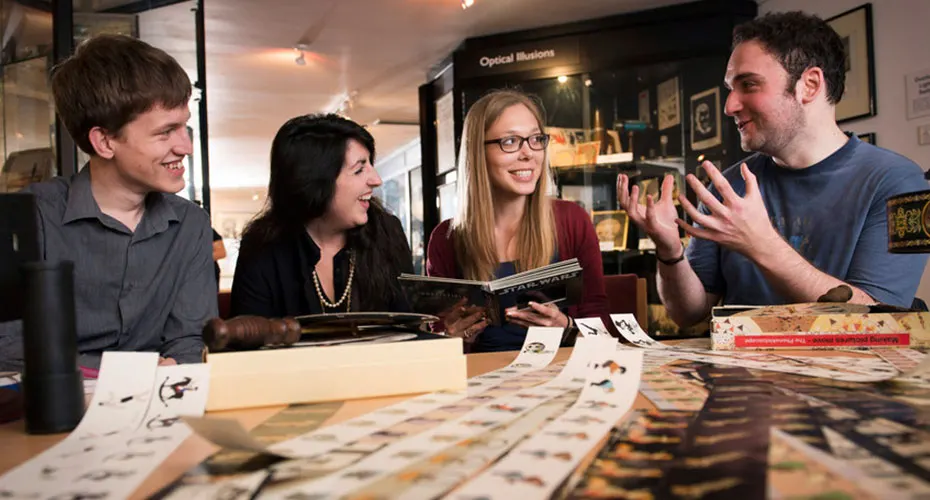
Students in the Bill Douglas Cinema Museum
We are exceptionally lucky to have some fantastic facilities and resources on the Streatham Campus.
Special Collections
We have Special Collections relating to writers such as Agatha Christie, Daphne du Maurier, and William Golding, and we integrate these into our teaching so students can share the excitement we have when discovering new insights from manuscripts, letters, and business papers.
The Bill Douglas Cinema Museum
Our unique film and popular culture resource, contains items going back hundreds of years. We regularly take students into its archives and think about the study of literature in relation to visual texts.
Digital Humanities Lab
Digital Humanities is increasingly important in all areas of humanities research, including history, archaeology, literatures and languages. This research space enables the examination, preservation and analysis of historical, literary and visual material. Facilities in the lab include:
- a flagship seminar room equipped with a 4.2-metre video wall, encouraging interactive engagement in a shared display space
- two state-of-the-art photography labs, including provision for the 2D digitisation of heritage material and primary sources
- an audio-visual lab with a recording studio and sound editing suite
- a MakerSpace equipped with 3D scanning and printing equipment
Your future with a Media and Communications degree
With practical modules on offer and opportunity to undertake professional placements, a degree in Media and Communications will give you plenty of opportunity to develop your professional portfolio which will give you the skills and experience needed to be successful in your chosen career.
Employer-valued skills this course develops
A Communications degree puts you in a great position to succeed in a range of careers. Oral and written communication is at the heart of our programme and you will learn to present your ideas in a variety of formats. You will also develop strong research and analytical skills and the ability to problem solve and make informed decisions. Through a balance of independent study and teamwork you will learn to manage your time and workload effectively.
Career paths
The programme will include module ‘Communications in the Workplace’, within which students will be encouraged to find work placements with providers in the communications and media sector, or projects which will enable them to carry out communication-related projects. In this module, students will undertake one or two work placements. The module will enable students to develop an understanding of how the skills and knowledge acquired as part of the degree apply to the workplace. Through reflexive practice, they will extend relevant work-based skills and knowledge. Students will have the opportunity to develop an understanding of a business or work environment through practical work and to gain experience in the use of technologies and applications commonly used in organisations.
Example careers
Graduates can expect to go on into roles in the following sectors:
- Advertising
- Digital Media
- Events Organisation
- Film-making
- International Relations
- Journalism
- Marketing
- Public Relations
- Research
- TV Production
Find out more about studying at Exeter








Sign-up for more information about studying with us
If you're thinking about studying BA Media and Communications with us, signing up to our emails is the best way to discover if we’re the right university for you.