BSc Business and Environment (Cornwall)
| UCAS code | N116 |
|---|---|
| Duration | 3 years |
| Entry year | 2027 |
| Campus | Penryn Campus |
| Typical offer | A-Level: ABB - BBB |
|---|---|
|
A-Level: BBC-BCC |
| UCAS code | N118 |
|---|---|
| Duration | 4 years |
| Entry year | 2027 |
| Campus | Penryn Campus |
| Typical offer | A-Level: ABB-BBB |
|---|---|
|
A-Level: BBC-BCC |
| UCAS code | N117 |
|---|---|
| Duration | 4 years |
| Entry year | 2027 |
| Campus | Penryn Campus |
| Typical offer | A-Level: ABB-BBB |
|---|---|
|
A-Level: BBC-BCC |
Why study Sustainable Business at Exeter?
Our mission: to prepare future leaders to drive sustainable business.
A pioneering programme: at the forefront of sustainable business and management education; part of a world leading centre for sustainability.
Interdisciplinary experience: equipping you with essential business skills, complemented by a deep understanding of the balance between business, society, and nature.
Flexible studies: 45 credits of optional modules in years 2 and 3, tailored to your interests and career aspirations.
Highly employable graduates: capable of confidently navigating the transition towards a more sustainable economy.
Beautiful location: study at our Penryn campus in Cornwall, a hub of environmental and social sustainability expertise, close to the sea and areas of outstanding natural beauty.

Top 10 in the UK for Business and Management

All Business School departments are top 10 for graduate prospects

Triple accredited Business School
AMBA, AACSB, EQUIS

90% of Management graduates in or due to start employment or further study 15 months after graduation
Based on full-time, first degree, UK domiciled graduates, HESA Graduate Outcomes survey 2022/23 data (published 2025)
Entry requirements for 2027 entry (typical offer)
| Qualification | Typical offer | Required subjects |
|---|---|---|
| A-Level | ABB - BBB | N/A |
| IB | 32/655 - 30/555 | N/A |
| BTEC | DDM | N/A |
| GCSE | C or 4 B or 5 |
Grade C or 4 in English Language, and Grade B or 5 in Mathematics (or: GCE A-level/AS Mathematics, Further Mathematics, Pure Mathematics or Core Mathematics) |
| Access to HE | 24 L3 Credits at Distinction Grade and 21 L3 credits at Merit Grade. | N/A |
| T-Level | Distinction | N/A |
| Contextual Offer | A-Level: BBC-BCC |
Specific subject requirements must still be achieved where stated above. Find out more about contextual offers. |
| Other accepted qualifications | ||
| English language requirements |
International students need to show they have the required level of English language to study this course. The required test scores for this course fall under Profile B1. Please visit our English language requirements page to view the required test scores and equivalencies from your country. |
|
NB General Studies is not included in any offer.
Grades advertised on each programme webpage are the typical level at which our offers are made and provide information on any specific subjects an applicant will need to have studied in order to be considered for a place on the programme. However, if we receive a large number of applications for the programme we may not be able to make an offer to all those who are predicted to achieve/have achieved grades which are in line with our typical offer. For more information on how applications are assessed and when decisions are released, please see: After you apply
The Business School in Cornwall is future facing which I think is needed for a Business degree in the 21st century. It is not just looking at ideologies and theories but actually putting it into practice.
Living in Cornwall is an absolute dream. You have outstanding beauty on your doorstep and some of the best beaches in the UK. There is also an amazing heritage and culture in Cornwall. At the Penryn Campus, you combine learning in a space of outstanding beauty with opportunities you wouldn’t get at other universities such as sailing and surfing. It is a match made in heaven.
Matt
BSc Business and Environment

Course content and modules
BSc Business and Environment focuses on the interdependence of business and the natural environment. It equips business leaders of tomorrow with the skills and insights to tackle the most pressing challenges facing society.
This course examines how business needs to change in order to address intensifying environmental issues and to achieve a sustainable economy. It is designed for anyone interested in becoming an adaptable and resilient leader, wishing to contribute to long-term ethical solutions. The programme is interdisciplinary, covering a range of topics including:
- Ecological economics and how business can contribute towards tackling the ecological crisis.
- Environmental science and how data helps us gain new insights into the eco-systems that support our lives.
- Climate justice and the role of environmental laws, regulation and policies in shaping our relationship with nature.
You’ll be part of a seminar-style international learning community, resulting in stronger peer networks with learning reinforced through one-to-one interaction with lecturers and researchers.
What do our students think?
“Being interdisciplinary, BSc Business and the Environment encompasses a diverse range of topics, from ecological economics to environmental science. This, combined with a high level of module flexibility, has opened up a wide range of career options for me, whilst enabling me to study what I'm most passionate about.” - Isaac
“I think that BSc Business and the Environment is so special because it provides us with such a variety of modules and allows us to build a wider and stronger range of knowledge. I have loved the experience and really enjoyed exploring topics I may not have explored if I didn't take this programme.” - Olivia
Modules
You may take option modules as long as any necessary prerequisites have been satisfied, where the timetable allows and if you have not already taken the module in question or an equivalent module.
You may notice changes to some of our modules over the coming months. This is because we are making space for the following:
- Minors: Future Skills Pathways - Alongside your main degree you may be eligible (depending on your course) to choose modules from another subject to broaden your skills and interests.
- Skills to Thrive built into every degree - Essential skills for your future, including communication, problem-solving, teamwork and digital confidence.
- Increased innovation and wellbeing - More room for creative learning, real-world projects and a healthier study rhythm.
The modules below provide examples of what you can expect to learn on this degree course based on recent academic teaching. The precise modules available to you in future years may vary depending on staff availability and research interests, new topics of study, timetabling and student demand.
Please note that the module information displayed here is subject to change.
105 credits of compulsory modules, 15 credits of optional modules
| Code | Module | Credits |
|---|---|---|
| Compulsory | ||
| Accounting | 15 | |
| Understanding Work and Organisations | 15 | |
| Environment, Society and Business | 30 | |
| Global Issues in Environmental Science | 15 | |
| Introduction to Data Science | 15 | |
| A Legal Foundation for Environmental Protection | 15 | |
BEP1070: Accounting
Financial literacy is an important skill in the business world. It helps you to understand how you can support the mission of any organisation and how you can add (or destroy) value. Whether you are an employee, a small business owner or in management of a larger business, understanding the principles of accounting helps you to understand the financial operations of the organisation.
The module incorporates the Colour Accounting Learning System™, an innovative way of presenting financial information using colour and diagrams. At the heart of the system is a diagram called the BaSIS Framework™ that is a holistic and graphical view of a balance sheet and income statement. It is highly creative and involves colour, movement, language, visualisation and breathtaking simplicity.
We examine the principles of accounting and financial statements and explore how to understand them.
The aim of this module is to provide you with a foundation in accounting literacy, which leads to financial literacy and ultimately to business acumen. You will be introduced to the recording of transactions, the content of financial statements, and the interpretation financial information.
The focus of the module is from the perspective of a user of financial information.
BEP1100: Understanding Work and Organisations
Organisations and organising refers to processes through which people are grouped in order to carry out and achieve common goals beyond the reach of individuals. In everyday life organisations are all around us and indeed, Peter Drucker who developed management as a discipline, stated that we live in a 'society of organisations'. We engage with organisations as customers, consumers, employees or through communities we live in or visit. Organisations and the wider labour market and environmental contexts in which they operate are therefore a fundamental part of the complex systems of society.
It is therefore important to develop some understanding and insight about how organisations interact with their environments, can be appropriately designed and effectively managed. This module does this through a combination of theoretical frameworks, practical, consultant-style activities with responsible AI use intergrated and part of the module's learning outcomes. It opens with an overview of the purpose and structure of organisations, activities within them - some ethical and some not - before mapping the relationship between organisations, their natural and labour market environments.
The module concludes with an attept to look into the future and discuss how changes in labour markers and organisational needs are likely to affect your career trajectories.
BEP1150: Environment, Society and Business
Business-as-usual is threatening the stability of the ecosystems that support our lives. We are exceeding planetary boundaries: most of the land surface and the ocean are impacted by human activities, forests continue to be cut down to make space for agriculture and animal husbandry, the poles are losing their ice, the depletion of natural resources such as drinking water is affecting local communities worldwide, overfishing and loss of biodiversity are increasing at a dramatic rate. Addressing challenges of this scale require an interdisciplinary response. It requires cooperation, long-sightedness and critical, creative and system thinking. This module brings different disciplines together to draw attention to the role our economy plays in exacerbating the ecological crisis, and what a sustainable economy might look like. The module offers an introductory insight into ecology, environmental science and different traditions of economic thought linking the economy and the environment. In so doing, it provides the theoretical basis for understanding, designing and implementing new purpose-driven business models, enabling business to make a positive contribution to the environment and society. No prior knowledge skills or experience is needed in order to able to take this module. This module is recommended for interdisciplinary pathways.
CGE1408B: Global Issues in Environmental Science
This module is designed to give you a clear, two-part journey through critical environmental issues we face today. We spend the first half of the term focused strictly on the science of "Planetary Boundaries"—specifically looking at the current state of our air, oceans, land use, and biodiversity. We zoom in on these areas because they have already crossed into risky, unhealthy territory.
In the second half, we widen the lens to include the human side of the equation further. We explore how those ecological lines we crossed earlier connect to real-world social issues like global health, mining, and natural hazards. The big takeaway is that these aren't separate problems; crashing through an environmental boundary often hurts human health, while trying to fix social problems can put more stress on the planet. Rather than just looking at "trade-offs," we aim to teach you how to navigate toward a "safe and just space" where humanity can thrive without breaking the Earth's life-support systems.
CGE1419: Introduction to Data Science
This module provides practical insights into how scientists use data to answer research questions in environmental, marine, and geographical sciences. The module is designed to build skills progressively: starting with foundational maths, moving on to programming in R, and culminating in the analysis of real environmental datasets using a range of statistical techniques.
Through a combination of lectures, practical workshops, and online resources, you will learn to:
- Handle, clean, and manipulate datasets
- Explore and visualise data effectively
- Apply descriptive and inferential statistics
- Conduct linear and non-linear analyses
- Integrate these skills to investigate applied environmental science questions
Weekly lectures introduce the theory behind the techniques covered in the practical classes. Practical sessions are supported by academic and teaching staff and focus on applying methods to real-world environmental data, including datasets from field studies, time series, and ecological measurements.
Assessment is through four online quizzes and associated practical exercises that give you hands-on experience of the full data analysis workflow, from messy data to interpreted results.
LAW1016C: A Legal Foundation for Environmental Protection
In this module you will be introduced to law in the context of the environment and how important the legal process is in its protection. The module seeks to provide you with an overview of all the different ways in which law can be used to protect the environment and give you the tools to choose which types of law are most suitable in different environmental contexts.
You will develop empathy for the different stakeholders in environmental issues. We will consider pathways to reconcile competing interests in an attempt to strike a balance between developmental or industrial progress and the need to protect our environment.
You are not expected to have any legal knowledge or experience and the module is therefore ideal for students on an interdisciplinary pathway, as well as being a compulsory element of the Environmental Science degree.
The module is designed as an essential foundation for those seeking employment following graduation in an environmental field where a working knowledge of law and policy will be assumed. It also provides an excellent foundation for further legal study.
| Code | Module | Credits |
|---|---|---|
| Optional | ||
| Earth System Science | 15 | |
| Biodiversity and its Conservation | 15 | |
| Power, Inequality and Global Justice | 15 | |
CGE1405B: Earth System Science
The Earth consists of a series of interacting natural systems (lithosphere, hydrosphere, cryosphere, biosphere, atmosphere). The interactions between these systems, called feedbacks, are central to analysing the functioning of major aspects of the Earth, such as climate, sea level and biotic evolution. This way of looking at our world is also critical in analysing the human impact on the Earth system and identifying management strategies to mitigate, remediate or predict geological and environmental hazards and impacts, and in identifying resources. This module is therefore about connectedness and the development of an approach to understanding the Earth that emphasises the connections between the components rather than the components themselves. This module requires no prior skills or experience and is particularly suitable for interdisciplinary pathways.
This module aims to:
- Explore our understanding of Earth origins, the evolution of the solar system, of the ocean, the biosphere and the atmosphere.
- Introduce natural systems theory.
- Identify the Earth’s component natural systems and the Earth’s climate system, its forcings and feedbacks.
- Describe plate tectonics and the role of the internal system in determining or controlling rock formation, the sedimentary cycle, the carbon cycle, Earth surface landforms (geomorphology), oceanic gateways and barriers, biotic evolution.
- Analyse orbital and gravitational controls on the Earth: tides, days, seasons, years.
- Explore the influence of tides on the timing and rate of Earth-moon separation.
- Describe solar variability and its impact on Earth climate.
- Describe the Earth’s radiation balance, atmospheric and oceanic circulation and their role in redistributing heat around the Earth.
- Analyse interactions between the hydrosphere and the cryosphere.
- Identify and describe major biogeochemical cycles, in particular the carbon cycle.
- Explore the causes of major climatic changes through geological time.
- Discuss the evolution of hominids and the interactions of humanity with the Earth system.t
The module will involve a fieldwork component involving an investigation of evidence for sea-level change on the Cornish coastline.
This module will help you to develop and extend your awareness of the importance of taught and learnt skills in strengthening employability potential, especially through the application of critical analytical skills (review of scientific literature, simple calculations) to a range of contemporary global challenges, notably climate change and geoengineering. More generally, through attending the fieldwork and weekly lectures, alongside your own independent learning, you will develop the following academic and professional skills:
- fundamental problem solving (linking theory to practice with academic guidance), collaboration (learning about the views and values of others), and audience awareness (presenting ideas effectively, persuading others of the importance and relevance of your views, responding positively and effectively to questions).
The teaching contributions on this module involve elements of research undertaken by staff, such as work on sea-level change (Scourse). Moreover, you are encouraged to undertake enquiry-led learning, specifically through the field component.
CGE1423: Biodiversity and its Conservation
Most people will be aware that the world is considered to be experiencing a biodiversity crisis. You’ll hear or read about it in the media all the time. But what do we actually mean by biodiversity? Where does it come from and how is it maintained in nature? Why is it important to humanity? How do human activities lead to its decline? What can be done to slow or even halt the decline? In this module, we will address all these questions to give students a solid foundation in the science of biodiversity and an understanding of the interdisciplinary nature of biodiversity conservation.
This module will introduce you to the theory and concepts of biodiversity and conservation science. It aims to provide you with a basis on which to build expertise in this area and grow your understanding of how conservation requires input from many disciplines beyond biology.
In addition, you will gain practical experience in some aspects of this field, such as conducting biodiversity surveys, carrying out an IUCN Red List assessment, and planning conservation action.
POC1026: Power, Inequality and Global Justice
This module will help you to ask critical questions about the assumptions behind contemporary practices of power in the contemporary international system.
You will understand what it means to ask critical questions by exposing and deconstructing a range of empirical practices in world politics. Through this critical questioning, we will explore the issues and possibilities for global justice in the contemporary international system. In this module we will examine a series of questions: How can we think critically? How do we find out what is going on in the world? Why do we obey? Why is the world divided territorially? Do colonialism and slavery belong in the past? Why are some people better off than others? What makes the world dangerous? What can we do to change the world? Who do we think we are? How can we end poverty? You will be exposed to a variety of approaches or 'framings' of world politics and encouraged to develop your own perspectives and reasoned arguments about them.
There are no pre-requisite or co-requisite modules required in order to take this module. This module is particularly recommended for students who intend to pursue modules in International Relations at levels 2 and 3.
The aims of this module are to:
Please note that the module information displayed here is subject to change.
90 credits of compulsory modules, 30 credits of optional modules
| Code | Module | Credits |
|---|---|---|
| Compulsory | ||
| Business Practice (Placement/Work Experience Project) | 15 | |
| Strategic Concepts for Business | 15 | |
| Research Inquiry for Practice | 15 | |
| Ecological Economics | 15 | |
| Circular Enterprise Economy | 15 | |
| Environmental Regulation and Redress | 15 | |
BEP2030: Business Practice (Placement/Work Experience Project)
Gaining work related experience of a variety of work place situations is invaluable to you as you apply for jobs post-graduation. Research into the graduate recruitment market suggests that lack of previous work experience is likely to detriment entry to graduate employment. . BEP2030 builds on your previous learning and development and expands your professional capability and entrepreneurial awareness through a range of opportunities to engage with organisational practice and the work environment.
This module aims to continue your career and personal development journey, integrating practice and digital capability at a business engagement level. You will link theory and practice through a variety of experiential learning activities. You will develop transferable skills such as communication, networking, self-awareness and team working by working with a number of external businesses as well as collaborating with your peers. You will complete a placement or project and as part of this, have the opportunity to personalise your career development journey.
BEP2040: Strategic Concepts for Business
Strategic thinking is important for all forms of organisation, and most managers are aware of the critical need to take a long-term view when developing strategy.
This module looks at how strategy is developed and enacted in practice across a variety of organisational contexts, from developing strategic business ideas, to strategy formulation and execution at multiple organisational levels, and with recognition of how a climate changing and digitally inter-linked economy demands decisions that will produce a value-creating strategy.
Students will engage with contemporary business strategy frameworks while critically examining their assumptions and limitations in complex and uncertain environments. Alongside established tools for analysing competitive positioning, capabilities and environments, the module introduces systems thinking, complexity and regenerative perspectives
The aim of the module is to equip students with the ability to strategise in complex, real-world conditions, integrating competitiveness, value creation, sustainability and systems awareness. Students will develop the capacity to analyse strategic issues from multiple perspectives and understand how strategic intent, vision and mission interact with wider economic, social and ecological systems. The module explicitly addresses the implications of the polycrisis for strategic management.
BEP2060: Research Inquiry for Practice
The Research Inquiry for Practice is a compulsory module on the BSc Business programme. Its core aim is to prepare you for making decisions based on evidence from quantitative (number-based) and qualitative (word-based) data. The module will equip you with core research skills which will allow you to manage your dissertation research project as well as offer research-based advice to businesses in the present, information-driven world.
On completing the module, you will be able to design an appropriate research strategy for data collection, analyse both qualitative and quantitative data, as well as present it in the most impactful way. Finally, you will be familiar with selected software packages to analyse data.
BEP2150: Ecological Economics
This module provides a comprehensive introduction to ecological economics in theory and practice. You will receive a thorough grounding in macroeconomics and microeconomics, alongside an in-depth knowledge of the economics and policy of environmental pollution, renewable and non-renewable resource use, as well as the connection between globalization and environmental degradation. With this basis, you will be able to identify possible solutions to environmental problems and assist in policy recommendation and decision-making.
This module aims to improve understanding of the link between ecological systems and economic activity. The module introduces core issues in ecological economics, related to micro and macro-economic theory, international trade and policy. Ecological economics is a transdisciplinary approach to economics that incorporates insights from the biological, physical and social sciences. In this module, you will apply ecological economic theory to a set of concrete environmental problems or challenges, in relation to the increasing scale of human impacts and the inequitable distribution of resources, in a way that encourages you to reflect on possible solutions and formulate policy recommendations. Seminars will complement lectures with more case studies and real-life examples.
BEP2210: Circular Enterprise Economy
There is a mounting interest in rethinking and redesigning business strategies in the context of ever-increasing social-ecological crises. What has become apparent is that the assumption of an ever-expanding economy is not compatible with operating within the planetary boundaries, in a safe and just space for humanity. This calls into question the inherently intertwined relationship between infinite economic growth, business operations, and ever-expanding markets, from raw material extraction to post-consumption disposal and waste. What it is openly questioned is the capacity to sustain endless economic growth on a planet with finite resources, which is not only harmful to the natural ecosystems that support human life but to human life itself. Most notably, expansion, extraction, and pollution/intoxication have been carried out at the expense of human communities, not just natural ecosystems, but also future generations, particularly in the Global South.
Given this background, in this module, we will engage in learning activities that enable students to investigate business strategy in relation to sustainability and circularity as a theme that crosses subject boundaries. The module intends to form and frame a learning path for developing knowledge and understanding of transitioning to more socially responsible, environmentally sustainable, and circular business models.
LAW2016C: Environmental Regulation and Redress
If you are concerned about environmental destruction and ensuring accountability on a global basis, then learning to articulate your argument and back it up with a sound grasp of the law might help you to make a real difference! The module will help you establish a working knowledge of how the law can be used as a mechanism to reconcile competing values in the protection of the environment and seeks to develop an understanding of the legal avenues available to mitigate environmental harm. As an environmentally aware individual, how can you use the law to prevent harm and what can you do if you feel that another individual or business has committed an environmental wrong? How can legal tools be used to redress and repair environmental harm? As you progress through the module, you will discover answers to these and other questions.
You will look at the role of national and international law in setting environmental standards. You will critically reflect on the extent to which the law across the world, including indigenous laws and cultural norms, might be used to embed pro-environmental and sustainable behaviour.
| Code | Module | Credits |
|---|---|---|
| Optional | ||
| Business Beyond Profit | 15 | |
| Project Management | 15 | |
| Finance for Business | 15 | |
| Workplace Wellbeing | 15 | |
| Digital Technologies and the Future of Work | 15 | |
| Understanding Financial Statements | 15 | |
| Introduction to Ecological Consultancy | 15 | |
| Geographical Information Science and Systems | 15 | |
| Remote Sensing for Environmental Management | 15 | |
| Landscape Evolution | 15 | |
| Biogeography | 15 | |
| Ice Sheets: Glaciology, Climate and the Oceans | 15 | |
| Waste and Society | 15 | |
| People and Nature | 15 | |
| Oceans and Human Health | 15 | |
Please note that the module information displayed here is subject to change.
This degree offers you the opportunity to spend a year working in a related industry or studying abroad.
If you choose one of these options your placement year will take place in your third year, before returning to complete your degree at Exeter in your fourth and final year of study.
You can apply directly to one of these options via UCAS, or you can apply to the standard 3 year course and transfer onto one of these options in the first term of your first year.
with Industrial Experience
120 credits of compulsory modules
| Code | Module | Credits |
|---|---|---|
| Compulsory | ||
| Business School Industrial Experience (Penryn) | 120 | |
BEP3002: Business School Industrial Experience (Penryn)
Summary:
This module allows you to undertake and to learn from an extended work placement during the third year of a four year With Industrial Experience 'WIE' programme. To progress to this module, you will have completed BEP2180 in your 2nd year and BEP1130 in 1st year (or be on BSc Business Studies With Industrial Experience programme), and will have secured a suitable placement which has been approved by the Business School.
Having developed the careers management skills necessary for a competitive graduate labour market, this is an invaluable opportunity to put the theory learned into practice in the workplace and to focus on your professional skills development.
Throughout your 'industry' year, you will receive guidance from an academic 'WIE tutor' and the Careers team, who will support and encourage you to fully maximise the developmental opportunities provided by your work experiences. Your personal development will also be supported through the completion of an assessed placement 'WIE PORTFOLIO', submitted in stages as you advance through your placement year.
Additional Information:
Internationalisation
You can undertake a work placement in the UK or elsewhere in the world. Overseas placements will be considered on a case-by case basis.
External Engagement
with Year Abroad
120 credits of compulsory modules
You must choose either BEP3100A, BEP3100B or BEP3100C
| Code | Module | Credits |
|---|---|---|
| Compulsory | ||
| Year Abroad (Study and Work Placement) | 120 | |
| Year Abroad (Study) | 120 | |
| Year Abroad (Work Placement) | 120 | |
BEP3100A: Year Abroad (Study and Work Placement)
This module is for undergraduate Business School students to study and work abroad in their 3rd of 4 years on the 'With Year Abroad' programme. With this module you can spend one semester studying at a European or non-European partner institution and 6 months' work placement abroad in a country of your choice.
An important element of international business is for you to understand the political, economic, and cultural differences between countries. By studying at another university and undergoing a work placement abroad as part of your degree programme, you will learn to think globally and come to understand how the world is interconnected through business. Adding an international component to your business degree, which may or not include learning of a foreign language, will make you more competitive in today's multicultural, global business environment. You will also have access to a range of modules, potentially in areas not offered at Exeter, taught in a different learning culture and therefore broadening your overall academic experience.
The module introduces you to the experience of academic study outside the UK, and, for some of you, a different language. It aims to challenge preconceptions and assumptions about higher education learning by exposing you to a different approach to academic study.
BEP3100B: Year Abroad (Study)
This module is for undergraduate Business School students to study abroad in their 3rd of 4 years on the 'With Year Abroad' programme. With this module you can spend an academic year at one of the Business School's European partner institutions, a partner institution outside of Europe, or combine one semester study at a European and one semester at a non-European partner institution.
An important element of international business is for you to understand the political, economic, and cultural differences between countries. By studying at another university as part of your degree programme, you will learn to think globally and come to understand how the world is interconnected through business. Adding an international component to your business degree, which may or may not include learning of a foreign language, will make you more competitive in today's multicultural, global business environment. You will also have access to a range of modules, potentially in areas not offered at Exeter, taught in a different learning culture and therefore broadening your overall academic experience.
The module introduces you to the experience of academic study outside the UK, and, for some of you, a different language. It aims to challenge preconceptions and assumptions about higher education learning by exposing you to a different approach to academic study.
BEP3100C: Year Abroad (Work Placement)
This module is for undergraduate Business School students to work abroad in their 3rd of 4 years on the 'With Year Abroad' programme. To progress to this module, you would have completed BSD2005 and would have found a suitable placement abroad for a minimum of 24 weeks and a maximum of 33 weeks.
An important element of international business is for you to understand the political, economic, and cultural differences between countries. By undergoing a work placement abroad as part of your degree programme, you will learn to think globally and come to understand how the world is interconnected through business. Adding an international component to your business degree, which may or may not include learning a foreign language, will make you more competitive in today's multicultural, global business environment.
The module assessment is designed to give you the opportunity to present and evaluate the knowledge and skills that you have developed and gained while on your year abroad work placement.
Please note that the module information displayed here is subject to change.
75 credits of compulsory modules, 45 credits of optional modules
| Code | Module | Credits |
|---|---|---|
| Compulsory | ||
| Business and Climate Change | 15 | |
| Practice-Based Consultancy Management | 15 | |
| Future-Facing Dissertation/Project | 30 | |
| Biomimicry | 15 | |
BEP3011: Business and Climate Change
This module is specifically designed for flexible learning and engagement with local communities . This module offers the opportunity for multidisciplinary study on a very wicked and complex topic that many businesses , policymakers and communiti es are very concerned about : Climate Change. In the lectures and classes, we will discuss the paradoxical role of business and climate change, addressing the following questions: How does climate change affect business? How can businesses develop climate change and net-zero strategies? How can business es potentially benefit from climate change? How do carbon markets work, and what are their limits and potential? Why do we find it so difficult to adopt less carbon - intensive lifestyles? What is the role of technology? What are the ethical issues that climate change raises? What are the responsibilities of business? How does business (and society at large) adapt to climate change? What does 'net-zero' mean? This module will address such questions, exploring the relationship between business and one of the, if not THE, most important question s of our time. As climate change requires immediate changes in behaviour and systems, w e will also apply our new-gained knowledge in practical settings . Students will form group s to work with local businesses, policymakers , and communities to bring about meaningful climate change action.
BEP3020: Practice-Based Consultancy Management
This module introduces you to the world of professional consultancy, with a particular focus on sustainability and contemporary business challenges. You’ll explore what consultants do, how the consulting profession works and why organisations increasingly turn to consultants to navigate complex issues.
Through real cases, research tasks, and a live or simulated consulting project, you will learn how to analyse business problems, work effectively with clients, and apply consultancy tools in practice. You’ll develop skills in problem‑solving, communication, professional relationship‑building, and project management—key capabilities for anyone considering consultancy or advisory roles.
You will also examine how consultancy theory translates into real‑world consulting work, gaining insight into client expectations, project protocols, risks and the barriers that affect implementation. Throughout the module, you’ll be encouraged to reflect on your experience, evaluate your impact, and learn how consultants adapt and make sound decisions when information is incomplete or situations are uncertain.
By the end of the module, you will have planned and delivered a consulting project to a defined brief and timeline, communicated your findings professionally and reflected critically on your development as an emerging consultant.
BEP3050: Future-Facing Dissertation/Project
You will undertake your own in-depth study into a relevant topic related to your degree subject which interests you. Studying independently will provide the benefit of having the opportunity to plan and manage an individual research project, investigating a topic at a level not covered in the taught modules, successfully concluding in an extended written dissertation.
The dissertation will reflect the interdisciplinary and future-focus nature of the BSc Business programme and could also be linked to a work placement experience. Developing either a thematic dissertation or work related dissertation, or a 'hybrid' of the two could advance your employability. You will also develop your research and comprehension skills, and be able to articulate your selected specialism.
BEP3130: Biomimicry
This module considers the tools and principles of biomimicry, a new discipline that emulates nature's best ideas and blueprints to solve human design challenges and to inspire innovative solutions. You will learn how nature inspired concepts can advance regenerative solutions to develop novel products, processes and organisations. In this module you will apply and adapt ecological concepts to develop innovative business strategies. In addition, you will have the opportunity to discover innovative examples of organisations worldwide who take inspiration from this approach.
This module aims to engage you on how to learn from nature. You will be inspired to create novel sustainable design, organizations and enterprises through accessing the wealth of ecological information available and applying it effectively to product and business design. This module introduces biomimicry, a new discipline that emulates nature's best ideas and blueprints to solve human and societal challenges.
| Code | Module | Credits |
|---|---|---|
| Optional | ||
| Sustainability Accounting and Reporting | 15 | |
| Advancing Sustainable Solutions | 30 | |
| Social and Technological Innovation | 15 | |
| Globalisation and Internationalisation | 15 | |
| Local - Global Innovation (Cornwall Research Seminar Series) | 15 | |
| Crisis: Change and Creativity in Organisations | 15 | |
| Business Field Trip | 15 | |
| Marketing Strategy | 15 | |
| Future 17: Sustainable Development Goals Challenge | 15 | |
| Science in Society | 15 | |
| Ecological Responses to Climate Change | 15 | |
| Marine Climate and Environmental Change | 15 | |
| Human-Animal Interactions | 15 | |
| Marine and Coastal Social-Ecological systems | 15 | |
| Sustainable Cities | 15 | |
| Corporate Law, Theory and Governance | 15 | |
Course variants
Overview
Our Business and the Environment degree offers you the opportunity to spend a year working in a related industry or studying abroad.
If you choose one of these options your placement year will take place in your third year, before returning to complete your degree at Exeter in your fourth and final year of study.
You can apply directly to one of these options using the UCAS codes below, or you can apply to the standard Business and the Environment course and transfer onto one of these options in the first term of your first year.
BSc Business and Environment with Industrial Experience
UCAS code: N118
Why choose a year in industry?
- Gain a proven work history that is excellent to discuss at job interviews and gives you a head start in the working world
- Get paid! Typical salaries range from £19,000 to £23,000 but can extend from £15,000 to £52,000
- Over 50% of students are offered graduate jobs from their placement employer
- 97% of With Industrial Experience graduates were in graduate employment or postgraduate study within 6 months of graduating, compared to 93.5% of non-WIE graduates (DLHE 2017)
- Increase your confidence and resilience, and make friends for life
What does a year in industry mean for me?
The ‘With Industrial Experience’ (WIE) pathway is a four-year version of your degree, in which your third year is spent in a professional placement before returning to university for your fourth and final year. The Business School Careers Team supports you every step of the way, helping you identify placement providers, create a strong application, practice interview techniques, and support you while you are in placement. The placement year assessment currently comprises:
- Progress reports provided by employers
- A reflective essay
- A business report
How do I secure a placement and where can I go?
You are responsible for sourcing and securing a work placement, but you will be supported throughout by the Business School Careers Team and assigned an academic tutor for the duration of your placement. Placements are available internationally. Previous placement providers include Adidas, Apple, ASOS, Bank of England, Deloitte, Disney, EY, GlaxoSmithKline, Goldman Sachs, PwC
Does it count towards my degree?
The placement year is assessed and contributes 1/7th of your final degree classification when you graduate.
Does it affect my tuition fee?
During your placement year you will pay a reduced tuition fee of approximately 20% of the maximum fee for that year. Find out more on our tuition fee webpages.
How do I apply?
‘With Industrial Experience’ is available on all Business School undergraduate programmes. You can apply through UCAS or ask to transfer onto WIE in the first term of your first year. Find out more on our Careers pages.
Other work experience options
If you choose not to undertake the four-year WIE pathway, there are other ways to gain work experience, from the Business Internships and Placements Module, to summer internships. Find out more on our careers pages.
BSc Business and Environment with Year Abroad
UCAS code: N117
Why choose a year abroad?
- In a complex and hyper-connected world, it is more important than ever to demonstrate a global outlook to employers
- A report by Universities UK International shows that graduates who are mobile during their degree are more likely to earn more than non-mobile peers
- Broaden your perspective in a way that benefits you for life: accelerating your resilience and flexibility, developing your ability to communicate across cultures, and demonstrating that you take the initiative
- We find students return from their year abroad with heightened self-confidence and an impressive work ethic.
What does a year abroad mean for me?
The ‘With Year Abroad’ (WYA) pathway is a four year version of your degree, in which your third year is spent studying at one of our 60 partner universities (spanning 26 countries), before returning to university for your fourth and final year. There is also the opportunity to combine study and work abroad, doing a semester of study at one of our partner universities followed by a semester of work in a placement that you secure anywhere in the world. The Business School Study Abroad Team supports you every step of the way, helping you to decide where to go, create a strong application, and supporting you while you are abroad.
Where can I go?
We have partners in: Canada, USA, Mexico, Peru, Norway, Sweden, Finland, Germany, Denmark, Netherlands, Switzerland, France, Spain, Portugal, Poland, Slovenia, Italy, Turkey, China, Hong Kong, Thailand, Japan, Taiwan, Singapore, Australia, New Zealand
Does it count towards my degree
The placement year is assessed and contributes 1/7th of your final degree classification when you graduate.
Does it affect my tuition fees?
If you spend a full academic year studying abroad you will pay a reduced fee of approximately 15% of the maximum fee for that year.
How do I apply?
Year abroad options are available on all Business School undergraduate programmes. You can apply for the four year ‘With Year Abroad’ variant of your degree through UCAS or ask to transfer onto the WYA programme in your first year. Acceptance is dependent on satisfactory academic performance and the level of research you have undertaken into your chosen institution. Find out more on our study abroad webpages.
Other study abroad options
If you choose not to undertake the full year studying abroad, there are other ways to gain a taste of the study abroad experience. You can spend two to six weeks at one of our international partner universities. Find out more on our study abroad webpages.
Fees
Tuition fees for 2027 entry
UK students: £10,050 per year
International students: £25,700 per year
Scholarships
The University of Exeter offers a wide range of scholarships to support your education, with £8 million available for international students applying to study with us in the 2027/28 academic year, including our prestigious Exeter Excellence Scholarships*. We also provide scholarships for sport, music and other achievements, alongside regional and partner awards such as The Beacon Trust. Financial support is available for students from disadvantaged backgrounds, lower income households and other under-represented groups to help them access, succeed and progress through higher education.
For more information on scholarships and other financial support, please visit our scholarships and bursaries page.
* Terms and conditions, including deadlines, apply. See our website for details.
I have loved living in Cornwall, I truly understand what attracts visitors to it during the holidays: the friendly locals, beautiful beaches, locally owned businesses and great food. Cornwall’s diverse geological landscape makes it an ideal terrain to study the many natural science and ecological degrees offered on campus.
My programme has an overarching Business and Environmental Science focus made up of relevant transdisciplinary modules, which I believe is not only crucially relevant and important within the challenge of climate change we are currently experiencing, but also allows for obtaining unique skills and perspectives which can be applied in any type of business setting.
Liné
BSc Business and Environment

Learning and teaching
How will I learn?
Although lectures are one of the main forms of teaching, you will also learn through participation in workshops, tutorials and seminars. As well as tackling case studies, discussing current issues in business and debating key theories, you will also develop presentation, team working, communication and problem solving skills. You’ll have a personal tutor who is available for advice and support throughout your studies.
Study hours
Timetabled contact hours, made up of lectures, seminars and tutorials, vary over the duration of programmes and between programmes and are on average between 11 and 14 hours. In addition, you will be expected to complete an average of 20-25 hours of independent or group study per week.
How will I be assessed?
Modules are assessed through a mixture of:
- Group work
- Coursework
- Project work
- Presentations
- Examinations
The weighting of these components varies according the module. Coursework is typically between 2,500 and 6,000 words in length, and exams are usually held at the end of the module in January and May/June.
First year assessments
You have to pass the assessments in your first year to proceed to the second year but they do not count towards your final degree classification.
Where will I study?
You will study on our beautiful Penryn Campus in Cornwall, the South of England.
Optional modules outside of this course
Each year, if you have optional modules available, you can take up to 30 credits in a subject outside of your course. This can increase your employability and widen your intellectual horizons.
Minors: Future Skills Pathways
You can study a Future Skills Pathway alongside your main degree by choosing up to 30 credits of modules from a different subject area in your second and final years.
Your future with a Business and Environment degree
The University of Exeter Business School provides a range of careers and employability support for Undergraduate students. Visit the Business School Career Zone web page for more information.
Global opportunities
The BSc Business and Environment degree adopts an international outlook meaning you will develop an understanding of the global business environment. Combined with the opportunity to study abroad or work a year in industry, you will be well-placed to work for local or international companies.
Careers
The wide range of business, management and environmental skills developed throughout the Programme will result in flexible employment options including roles such as project manager, marketing manager and sales manager. You will have employment advantages in private companies, public organisations, investment banks, NGOs, and third-sector industries, including key areas for Cornwall such as, water, renewables and food supply chain.
This combination of ethical, work-based, and global skills will create students who can compete at the highest levels and progress onto graduate Programmes to become CSR managers, change managers and environmental consultants.
Your degree demonstrates that you have the following professional skills
- Understanding of organisations and the environment they operate within, with an appreciation for the changing needs of modern business.
- Proven ability to work with modern data technologies and critically appraise challenges.
- Being able to identify and confidently communicate management strategies to provide sustainable solutions to complex business problems
- Excellent teamwork and communication skills including negotiation as well as sensitivity to the diversity of people and cultures.
- Project management, leadership and consultancy skills applicable to a range of fields.
Find out more about studying at Exeter






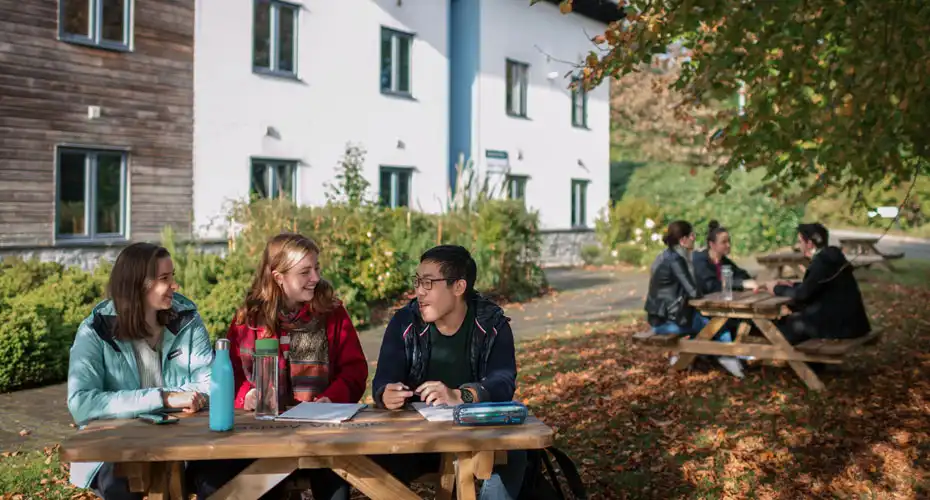

Sign-up for more information about studying with us
If you're thinking about studying BSc Business and Environment (Cornwall) with us, signing up to our emails is the best way to discover if we’re the right university for you.