BSc Medical Imaging (Diagnostic Radiography)
| UCAS code | B821 |
|---|---|
| Duration | 3 years |
| Entry year | 2027 |
| Campus | St Luke's Campus |
| Typical offer | A levels: ABB |
|---|---|
|
A-Level: BBC |
| UCAS code | N/A |
|---|---|
| Duration | 4 years |
| Entry year | 2027 |
| Campus | Streatham Campus |
| Typical offer | A levels: ABB |
|---|---|
|
A-Level: BBC |
Why study Diagnostic Radiography at Exeter?
- 95% of BSc Medical Imaging (Diagnostic Radiography) graduates in or due to start employment or further study fifteen months after graduation*
- You will become involve in learning about evidence-based practice and research approaches throughout the degree, which is led by our research-informed teaching.
- You’ll go on placements for 16 weeks each year, allowing you to fully integrate into your team and understand the full clinical experience
- Non-repayable maintenance grant between £5-8k per year
- Some students may be eligible to transfer to a four year Integrated Masters (MSci) programme at the end of year two. This offer will be made on the basis of academic performance in years one and two.
*based on full-time, first degree, UK domiciled graduates, HESA Graduate Outcomes survey 2022/23 data

Top 3 in the UK for Health Professions

Option to transfer to an Integrated Masters (MSci) programme at the end of Year 2*
*(depending on academic performance in years 1 and 2)

95% of graduates in or due to start employment or further study 15 months after graduation
Based on full-time, first degree, UK domiciled graduates, HESA Graduate Outcomes survey 2022/23 data (published 2025)

Top 10 in the Russell Group for student satisfaction in six out of seven themes
National Student Survey 2026: Medical Science
Approved by the HCPC and College of Radiographers

The BSc (Hons) Medical Imaging (Diagnostic Radiography) and MSci (Hons) Medical Imaging (Diagnostic Radiography) are approved by the Health & Care Professions Council.
The BSc (Hons) Medical Imaging (Diagnostic Radiography) and MSci (Hons) Medical Imaging (Diagnostic Radiography) are approved by the College of Radiographers for a period of five years, from 09/2024 to 08/2029 inclusive.
"I chose the University of Exeter as it is one of the top UK universities for Radiography. The course includes 16-week clinical placements each year, which allowed me to gain valuable hands-on opportunities and put my learnt theory into practice!"
"I thoroughly enjoyed all of my placements throughout my degree. They gave me the opportunity to fully engage in clinical experience, build my confidence, and develop my skills with the support of qualified radiographers. These placements have made me look forward to my future career as a Diagnostic Radiographer where I can continue to learn and develop my skills and knowledge.
Exeter has truly become a second home to me. It’s the ideal place to live, with the perfect mix between nature and city life, with places like Dartmoor, Exmouth, and the quay (some of my favourite places) right on your doorstep, giving you the perfect work-life balance! "
Kayla
MSci Medical Imaging (Diagnostic Radiography)

Entry requirements for 2027 entry (typical offer)
| Qualification | Typical offer | Required subjects |
|---|---|---|
| A-Level | ABB |
GCE A Level science grade B
GCE A Level science includes: Biology/Human Biology*; Chemistry; Computing; Design and Technology; Electronics; Environmental Science; Environmental Studies; Geography; Geology; Maths/Pure Maths/Further Maths*; Life and Health Sciences; Physical Education; Physics; Psychology; Science (applied); Statistics. *If more than one of these is taken they would only count as one 'science' but could count as two A-levels towards our general requirements. |
| IB | 32/655 | HL 5 in a Science subject |
| BTEC | DDM |
Applicants studying a BTEC Level 3 Extended Diploma in Health and Social Care (Health Studies) will be accepted without an additional A-Level science subject.
Applicants studying a BTEC Level 3 Extended Diploma in Health and Social Care will be accepted without an additional A-Level science subject, if at least two of the following modules are taken: Infection Prevention and Control, Psychological Perspectives, Nutritional Health, Biochemistry for Health. All other BTEC applicants will require grade B in an acceptable A-Level Science subject (listed in 'A-Level required subjects') |
| GCSE | C or 4 |
Grade C or 4 in both Maths and English Language Applicants who have achieved GCSE Maths one grade below the specified requirement will be considered. These applicants may be invited to complete the Maths Transition Course and receive a conditional offer on the basis of successful course completion. |
| Access to HE | 24 L3 credits at Distinction Grade and 21 L3 credits at Merit Grade. |
Applicants with Access to HE Diploma in Radiography, Health Science or Science: at least 12 Level 3 credits at Merit Grade in a relevant science subject area.
Other Access to HE Diploma programmes will be considered but applicants will likely be required to have grade B in an acceptable A’ Level Science subject. |
| T-Level | Distinction |
T-Level in Health Care Sciences or T-Level in Science, where laboratory science is taken as the specialism.
T-Level in Health will be referred to the Admissions tutor for consideration. |
| Contextual Offer | A-Level: BBC |
Specific subject requirements must still be achieved where stated above. Find out more about contextual offers. |
| Other accepted qualifications | ||
| English language requirements |
International students need to show they have the required level of English language to study this course. The required test scores for this course fall under Profile F. Please visit our English language requirements page to view the required test scores and equivalencies from your country. |
|
NB General Studies is not included in any offer.
Grades advertised on each programme webpage are the typical level at which our offers are made and provide information on any specific subjects an applicant will need to have studied in order to be considered for a place on the programme. However, if we receive a large number of applications for the programme we may not be able to make an offer to all those who are predicted to achieve/have achieved grades which are in line with our typical offer. For more information on how applications are assessed and when decisions are released, please see: After you apply
Admissions policy
Please see the Medical Imaging Admissions Policy 2027 (.pdf) for full details on our Medical Imaging admissions selection process.
Contextual offer
We are committed to identifying the best possible applicants, regardless of personal circumstances or background. Please refer to our Applications policy
Completing your application form
Each application cycle starts in September. Your application should normally reach UCAS between 1 September and the UCAS equal consideration deadline.
Do I need work experience?
While work experience is not a mandatory entry requirement for our programme, you are encouraged to undertake work experience in a Radiography department to gain an insight in to your desired profession.
Will there be an interview?
If successful at the application stage, you will be invited to an interview during January to March, where you’ll undergo a small multiple mini interview (MMI), which consists of a series of short, structured interview stations used to assess your suitability for the programme.
During the interview day, we will be assessing your personal qualities, such as your communication skills, empathy, insight in to your own strengths and weaknesses, motivation to study radiography, etc.
What happens next?
All successful applicants after interview will be required to complete a health questionnaire and those accepting an offer will be screened by our Occupational Health Department.
You may be required to attend a medical examination as part of the admissions process. You will be required to have up to date vaccination records for relevant innoculations in line with University requirements and those of your placement providers.
We require all radiography students to be immunised against certain infectious diseases to meet health and safety standards required to work with patients. We will require students to provide evidence of two MMR jabs, and in addition undergo tests to determine their Hepatitis B surface antigen, TB and HIV status.
Enrolled radiography students will be unable to undertake their studies without evidence of completion of the vaccination process.
As you may be working with vulnerable people in a variety of clinical settings throughout the degree programme, all offers are conditional upon a Criminal Conviction Self Declaration and an enhanced disclosure check via the Disclosure & Barring Service (formerly the Criminal Records Bureau). We will review all significant reports of convictions, cautions and verbal warnings and decide on a candidate’s suitability to enter the programme.
International students
International students should check details of our English language requirements.
If your academic qualifications or English language skills do not meet our entry requirements our INTO University of Exeter centre offers a range of courses to help you reach the required language and academic standards.
International Foundation programmes
Preparation for entry to Year 1 of an undergraduate degree:
Foundation programme for Biomedical, Life and Environmental Sciences.
Further information
Please read the important information about our Typical offer.
For full and up-to-date information on applying to Exeter and entry requirements, including requirements for other types of qualification, please see the Applying section.
Course content and modules
Our BSc (Hons) in Medical Imaging (Diagnostic Radiography) aims to ensure that, on graduation, you have the skills required to successfully embark on a career as a Diagnostic Radiographer and to be eligible to apply for registration with the Health and Care Professions Council (HCPC).
This full-time three-year programme includes clinical placements in hospitals across Cornwall, Devon, Dorset and Somerset, which stretch into the summer vacation and, as such, this programme is longer than those in other subjects. You will have three clinical placements as part of the degree programme, where you will attend a different placement site for four months during each year.
Placements
Around fifty percent of your time will be spent in clinical practice. Each clinical block is about 4 months in length. You go to a different placement site for each of your years of study. Our key NHS practice partners across the South West are:
- Royal Devon and Exeter
- Torbay
- Plymouth (Major Trauma Centre)
- Truro
- Barnstaple
- Taunton
- Yeovil
- Dorchester
In addition to these three core placements, students who transfer to the MSci will undertake a 10-week specialist placement during year 4.
Course structure
Your first year provides a foundation in the theoretical knowledge and practical skills required for radiography. Academic study provides theoretical knowledge of patient care, anatomy, imaging techniques, professional practice and the science that underpins medical imaging. This is then complemented with a clinical placement that provides practical experience in the safe and effective practice of general and fluoroscopic radiography.
Year two develops further understanding of anatomical and physiological concepts in contemporary clinical imaging practice. You will develop your knowledge of radiation science and gain an appreciation of safe and optimal use of radiation-based imaging techniques, alongside a clinical placement.
In the final year, you will integrate theory with practice by drawing on your prior experience of imaging modalities, and reinterpreting your knowledge of imaging within a scientific framework. During your final clinical placement you will become an integral member of the multi-professional healthcare team, having responsibility for organising your working day and liaising with staff in other departments, and will gain experience of managing an inter-professional team.
You may notice changes to some of our modules over the coming months. This is because we are making space for the following:
- Minors: Future Skills Pathways - Alongside your main degree you may be eligible (depending on your course) to choose modules from another subject to broaden your skills and interests.
- Skills to Thrive built into every degree - Essential skills for your future, including communication, problem-solving, teamwork and digital confidence.
- Increased innovation and wellbeing - More room for creative learning, real-world projects and a healthier study rhythm.
The modules below provide examples of what you can expect to learn on this degree course based on recent academic teaching. The precise modules available to you in future years may vary depending on staff availability and research interests, new topics of study, timetabling and student demand.
Please note that the module information displayed here is subject to change.
120 credits of compulsory, non-condonable modules.
| Code | Module | Credits |
|---|---|---|
| Compulsory 1 | ||
| Practical Placement 1 | 30 | |
| Research and Evidence Based Practice | 15 | |
| Foundations of Patient Care | 15 | |
| Anatomy and Physiology for Radiographers | 30 | |
| Fundamentals of Radiographic Practice | 30 | |
PAM1007: Practical Placement 1
Professional radiographers must be able to apply their theoretical knowledge and practical skills within an inter-professional clinical context. This module provides practical experience of the safe and effective practice of general and fluoroscopic radiography. You will develop patient-care skills and learn to identify 'professional' and 'management' issues and understand how these are inter-related. Mandatory training is an integral part of this module and must be completed at the required time to avoid module failure.
The University defines academic credit in terms of workload, with one credit being equal to a notional 10 hours of learning. However, due to the amount of time required for a clinical placement, and the fact that the placement necessarily runs outside of standard university terms, this approach cannot be followed for placement modules in radiography. Therefore, the hours given are a closer reflection of the amount of time spent on placement, although they should still be considered indicative.
This module will equip you with clinical skills with focus on common examinations and imaging in able bodied, compliant patients to deliver compassionate, holistic patient care. Through successful completion of this module, you will gain an understanding of legal, ethical and professional aspects of radiographic practice as they relate to these areas of medical imaging practice.
PAM1016: Research and Evidence Based Practice
This module introduces you to the principles of evidence-based practice and research methodologies that underpin patient/client care. Students will be introduced to the principles of professional practice within health and social care. In the context of evidence-based professional practice, students will develop basic problem solving and reasoning skills. Alongside this they will develop an understanding of professional practice.
Through undertaking this module, you will develop skills and understanding in order to critically evaluate research literature relating to diagnostic radiography. You will begin to understand the importance of becoming an evidence-based practitioner. This module underpins PAM2007 Project Studies 1 and PAM3004 Project Studies 2 as well as providing core academic skills for completion of coursework across the medical imaging programme.
PAM1018: Foundations of Patient Care
During this module you will participate in a variety of lectures, seminars, workshops and simulated activities to explore the fundamentals of patient care sociological, psychological and inter-professional clinical context.
Within this module you will hear and learn from individuals with lived experience of accessing medical imaging and wider healthcare services for a range of conditions. Our aim is to provide you with understanding, empathy, knowledge and compassion to support families and patients accessing healthcare services.
The role of a professional radiographer is to give high-quality patient care. As a radiographer, you must not just know what professional conduct is, you must behave in this way both instinctively and at all times. This module aims to develop appropriate inter-personal skills, and an understanding of aspects of sociology and psychology as they apply to the inter-professional clinical context.
PAM1019: Anatomy and Physiology for Radiographers
In this module, you will develop knowledge, understanding and application of human anatomy and physiology. The module draws on established knowledge from the scientific disciplines of anatomy and physiology that underpin sound practice in healthcare. The module introduces two and three dimensional radiographic images which you will learn to recognise and understand.
The aim of the module is to provide you with the knowledge of human anatomy and physiology needed for subsequent modules in the programme. You will apply this anatomical knowledge in the context of radiographic images. You will learn to recognise key anatomical features on projection radiographs, computed tomography and magnetic resonance images.
The core knowledge acquired from this module underpins, PAM2012 Pathology for Radiographers and PAM3006 Skeletal Image Interpretation as well as all practical imaging techniques.
PAM1020: Fundamentals of Radiographic Practice
This module will introduce physical and technical (including Artificial Intelligence) concepts relating to Medical Imaging. You will develop knowledge and understanding of physical principles, equipment and technical aspects involved in general and fluoroscopic radiography. You will undertake supervised practical sessions demonstrating the principles taught. You will also learn about and undertake supervised practice of patient positioning for projection radiographs of various parts of the human body. This training includes the important clinical and radiation safety measures required for clinical practice.
You will develop essential skills and gain knowledge of the essential science underpinning the various radiation imaging modalities. The module further aims to provide introductory knowledge of radiation biology, physics and techniques sufficient for you to subsequently appreciate the legislative framework which is fundamental to clinical practice.
This module prepares you for your first-year clinical placement using academic and practical experiences that will be directly relevant to your clinical experiences.
Please note that the module information displayed here is subject to change.
120 credits of compulsory, non-condonable modules.
| Code | Module | Credits |
|---|---|---|
| Compulsory 1 | ||
| Practical Placement 2 | 30 | |
| Project Studies 1 | 15 | |
| Science for Medical Imaging | 15 | |
| Medical Imaging Applications | 30 | |
| Pathology and Image Interpretation 1 | 30 | |
PAM2006: Practical Placement 2
Building on PAM1007 Practice Placement 1, this module provides further practical experience of the safe and effective practice of general and fluoroscopic imaging. It introduces you to interventional radiography and other imaging modalities. You will develop your patient-care skills and learn to handle more complex situations. You will develop your role within the imaging department and learn to identify 'professional' and 'management' issues and understand how these are inter-related within the inter-professional context.
The University defines academic credit in terms of workload, with one credit being equal to a notional 10 hours of learning. However, due to the amount of time required for a clinical placement, and the fact that the placement necessarily runs outside of standard university terms, this approach cannot be followed for placement modules in radiography. Therefore, the hours given are a closer reflection of the amount of time spent on placement, although they should still be considered indicative.
PAM2007: Project Studies 1
To enable you to develop a sound understanding of research terminology, methods, and principles. This module builds on the foundation of the stage 1 module PAM1016 Research and Evidence Based Practice. It is designed to enable you to understand different research designs, to evaluate the research literature and to prepare you to undertake research at undergraduate level.
By undertaking this module, you will gain an understanding and appreciation of a variety of research methods to improve your ability to critically evaluate current research. These skills will contribute to the appropriate and effective planning of your PAM3004 Project Studies 2 research project.
PAM2011: Science for Medical Imaging
This module builds on PAM1020 Fundamentals of Radiographic Practice to include the scientific principles behind the imaging modalities of ultrasound, nuclear medicine and magnetic resonance imaging. This module underpins PAM2013 Medical Imaging Applications and will offer an insight into the scientific enquiry and writing skills, needed for PAM3004 Project Studies 2.
This module aims to develop a range of basic mathematical skills and knowledge of the essential science which underpins the various imaging modalities. The module also aims to provide you with sufficient knowledge of introductory radiation biology and physics to allow you an appreciation of safe and optimal use of radiation imaging techniques.
PAM2013: Medical Imaging Applications
This module aims to develop knowledge of the science and technology underpinning 2-D and 3-D imaging techniques; Computed Tomography (CT), Mammography, Nuclear Medicine, Ultrasound, Magnetic Resonance Imaging (MRI), Dual X-ray absorptiometry (DXA), interventional and dental radiography. It addresses the principles of safe practice in using these various modalities and quality assurance in medical imaging. The module further aims to provide 1) practical experience in interpretation of the images that arise from these modalities and 2) awareness of Artificial Intelligence and deep learning technology.
This module aims to equip you with a fundamental understanding of the roles and scope of Computed Tomography (CT), Mammography, Nuclear Medicine, Ultrasound, Magnetic Resonance Imaging (MRI), Dual X-ray absorptiometry (DXA), interventional and dental radiography within the field of medical imaging to underpin appropriate decision-making when justifying imaging requests. The module also aims to develop safe practice within these modalities so that you have appropriate awareness of restrictions, ethics, legislation and professionalism to be able to maintain the safety of yourself and others present in the imaging environment.
PAM2014: Pathology and Image Interpretation 1
This module builds on PAM1019 Anatomy and Physiology for Radiographers and PAM1007 Practice Placement 1. A variety of learning methods are used to provide you with the opportunity to learn about common pathology encountered in the multi-disciplinary clinical environment and develop musculoskeletal image interpretation skills. This module supports preparation for Stage 3 PAM3019 Pathology and Image Interpretation 2 as well as future practice placement modules.
This module aims to develop knowledge and understanding of common pathological processes encountered in the contemporary radiology department, together with the radiographic appearances of some pathological processes and injuries. The Society and College of Radiographers 2013 policy for Image Interpretation and Reporting expects graduates to possess the skills to make reliable and accurate decisions on images they acquire and communicate those findings via written preliminary clinical evaluation. You will develop the fundamental skills of decision making and preliminary clinical evaluation required for musculoskeletal image interpretation.
Please note that the module information displayed here is subject to change.
120 credits of compulsory, non-condonable modules.
| Code | Module | Credits |
|---|---|---|
| Compulsory 1 | ||
| Project Studies 2 | 30 | |
| Practice Placement 3 | 30 | |
| Pathology and Image Interpretation 2 | 30 | |
| Professional Skills and Leadership for Radiographers | 30 | |
PAM3004: Project Studies 2
This module forms the research project component of the BSc Honours Medical Imaging (Diagnostic Radiography) degree.
To enable you to engage in self-directed and group study. To plan, undertake and evaluate a research project and to write up this project suitable for publication. This module builds on the foundation of the level 1 module PAM1016 (Evidence-based Professional Practice) and the level 2 module PAM2007 (Project Studies 1). During this module you will investigate systematically and in-depth an area of particular interest and direct relevance to the field of study.
PAM3018: Practice Placement 3
This module builds upon PAM2006 Practice Placement 2 to develop the full range of professional and technical skills required to meet the proficiency standards of HCPC registration requirements. Mandatory training is an integral part of this module and must be completed at the required time to avoid module failure.
During this third and final placement you will become an integral member of the multi-professional healthcare team: proficient to deal with a full range of patients using a wide range of modalities. You will have responsibility for organising your working day and liaising with staff in other departments and will gain experience of managing an inter-professional team.
Whilst the module's precise content may vary from year to year, an example of an overall structure is as follows:
Pre-clinical Preparation (June/July preceding placement)
Mandatory training in compliance with NHS requirements, including:
Basic Life Support.
Mandatory e-learning modules.
Moving and Handling
Clinical Education.
General and Mobile Radiography (including Dental) [5 weeks]
Perform a range of general radiography procedures based on departmental protocol, including practice in A&E, mobile, and dental settings.
Assessment of radiographs, modification of exposure factors and technique.
PAM3019: Pathology and Image Interpretation 2
This module builds on PAM1019 Anatomy and Physiology for Radiographers and PAM2014 Pathology and Image Interpretation 1. A variety of learning methods are used to provide you with the opportunity to extend your knowledge of pathology and further develop your image interpretation skills to include the axial skeleton.
This module aims to further develop your knowledge and understanding of pathological processes and image interpretation. You will learn to research diseases, which you may be unfamiliar with and gain understanding of the role of imaging in diagnosis. In preparation for your first clinical role as a qualified radiographer, you will consolidate your decision making and preliminary clinical evaluation (PCE) skills in line with The Society and College of Radiographers 2013 policy for Image Interpretation and Reporting.
PAM3022: Professional Skills and Leadership for Radiographers
In this module, you will develop your knowledge of the legislative and professional framework that governs radiographers together with associated managerial, professional and inter-professional issues encountered in clinical practice. The resulting framework of knowledge and skills supports safe and equitable practice.
This module aims to equip you with the knowledge to fulfil the non-clinical aspects of your role as a diagnostic radiographer such as compliance with governance and professional responsibilities.
Integrated Masters: MSci Medical Imaging
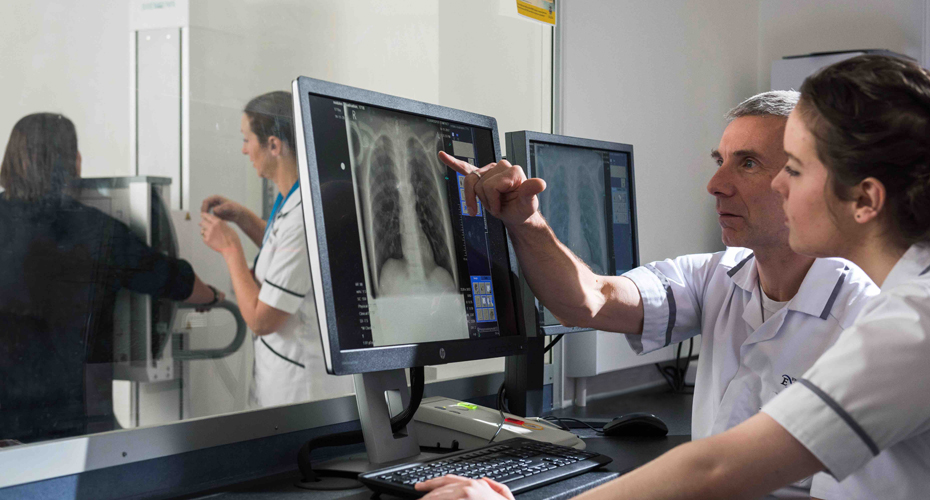
You can potentially transfer to our four-year MSci Medical Imaging course at the end of your second year (subject to performance).
The MSci Masters-level course is designed to offer improved preparation for working in cross-sectional imaging. It will broaden your understanding of medical imaging technologies, allowing greater specialisation and career advancement in the future.
If you transfer to the MSci, you will study the 3 years of BSc modules, plus an additional fourth year which includes a 10-week specialist placement.
MSci Medical Imaging (Diagnostic Radiography) modules
120 credits of compulsory, non-condonable modules.
| Code | Module | Credits |
|---|---|---|
| Compulsory 1 | ||
| Practical Placement 1 | 30 | |
| Research and Evidence Based Practice | 15 | |
| Foundations of Patient Care | 15 | |
| Anatomy and Physiology for Radiographers | 30 | |
| Fundamentals of Radiographic Practice | 30 | |
120 credits of compulsory, non-condonable modules.
| Code | Module | Credits |
|---|---|---|
| Compulsory 1 | ||
| Practical Placement 2 | 30 | |
| Project Studies 1 | 15 | |
| Science for Medical Imaging | 15 | |
| Medical Imaging Applications | 30 | |
| Pathology and Image Interpretation 1 | 30 | |
120 credits of compulsory, non-condonable modules.
| Code | Module | Credits |
|---|---|---|
| Compulsory 1 | ||
| Project Studies 2 | 30 | |
| Practice Placement 3 | 30 | |
| Pathology and Image Interpretation 2 | 30 | |
| Professional Skills and Leadership for Radiographers | 30 | |
90 credits of compulsory, non-condonable modules, 30 credits of optional modules.
| Code | Module | Credits |
|---|---|---|
| Compulsory 1 | ||
| Scientific Principles of CT | 15 | |
| Scientific Principles of MRI | 15 | |
| CT: Theory, Applications and Practice | 30 | |
| MRI: Theory, Applications and Practice | 30 | |
PAMM115: Scientific Principles of CT
This module will introduce more scientific and technical depth around concepts relating specifically to Computed Tomography (CT). You will develop further knowledge and understanding of the underlying theoretical principles behind the equipment and technical aspects involved in CT as well as further understanding of key parameters that influence image quality and examination type.
You will gain essential knowledge of the science and technology underpinning CT as used in current clinical practice. This module aims to give you sufficient grounding in the scientific and technological aspects of CT as a way of preparing you for further study relating to clinical aspects of CT, thereby providing an underpinning knowledge base for Enhanced Practice (Core Pathway Clinical Pillar 13, 15) . Elements of this module may map against aspects of Enhanced or Advanced Practice as defined by the relevant AHP frameworks (NHSE) and / or as defined by the College of Radiographers' Education and Career Framework 2023 .
PAMM116: Scientific Principles of MRI
This module will introduce more scientific and technical depth around concepts relating specifically to Magnetic Resonance Imaging (MRI). You will develop further knowledge and understanding of the underlying theoretical principles behind the equipment and technical aspects involved in MRI as well as further understanding of key parameters that influence image quality and examination type.
You will gain essential knowledge of the science and technology underpinning MRI as used in current clinical practice. This module aims to give you sufficient grounding in the scientific and technological aspects of MRI as a way of preparing you for further study relating to clinical aspects of MRI. Elements of this module may map against aspects of Enhanced or Advanced Practice as defined by the relevant AHP frameworks (NHSE) and/or as defined by the College of Radiographers' Education and Career Framework 2023.
PAMM122: CT: Theory, Applications and Practice
This module will enhance your understanding of the role Computed Tomography (CT) plays in the clinical setting. It will build in the knowledge gained in the Scientific Principles of CT module and will consider how CT is tailored to meet the needs of individual patients whilst investigating a range of different conditions as well as the role it plays in the patient pathway.
You will learn how to apply your scientific understanding of CT to a range of clinical applications, learning how CT protocols are designed and adapted for a range of common clinical indications. You will learn about anatomy and common pathologies as demonstrated on CT images and gain understanding of the relative role CT plays in the patient pathway. You will learn about quality assurance in CT, how to identify common artefacts and the steps taken to either eliminate or minimise them. You will also discover, drawing on the evidence base, how to provide person centred care when practicing within this modality. You will also undertake a practice placement that will further enable you to understand how to apply theory to practice.
PAMM123: MRI: Theory, Applications and Practice
This module will enhance your understanding of the role Magnetic Resonance Imaging (MRI) plays in the clinical setting. It will build in the knowledge gained in the Scientific Principles of MRI module and will consider how MRI is tailored to meet the needs of individual patients whilst investigating a range of different conditions as well as the role it plays in the patient pathway.
You will learn how to apply your scientific understanding of MRI to a range of clinical applications, learning how MRI protocols are designed and adapted for a range of common clinical indications. You will learn about anatomy and common pathologies as demonstrated on MRI images and gain understanding of the relative role MRI plays in the patient pathway. You will learn about quality assurance in MRI, how to identify common artefacts and the steps taken to either eliminate or minimise them. You will also discover, drawing on the evidence base, how to provide person-centred care when practising within this modality. You will also undertake a practice placement that will further enable you to understand how to apply theory to practice.
| Code | Module | Credits |
|---|---|---|
| Optional 1 | ||
| Fundamentals of Research Design | 15 | |
| Education Essentials | 15 | |
| Principles of Advanced Clinical Practice | 30 | |
| Principles of Supervision, Mentoring and Coaching | 15 | |
| Management and Leadership in Global Healthcare | 30 | |
HPDM092: Fundamentals of Research Design
In this compulsory introductory module, you will critically examine and apply the core concepts and perspectives at the heart of applied health and care research, and the main methods and elements of study design that underpin this multidisciplinary and highly applied area of social science. It seeks balanced coverage of: quantitative, qualitative and mixed methods; a wide range of disciplinary perspectives; appreciation of the full range of health service and health policy goals (e.g. effectiveness, safety, cost-effectiveness, feasibility, acceptability, accessibility, equity, and understanding the perspectives of different stakeholders); and is based around the key study design choices which all applied social science studies face. It will also cover fundamental considerations in all high quality applied health research, such as: the role of theory; patient and public involvement; data processing and management, and research ethics.
HPDM105: Education Essentials
In this module we introduce you to the essential knowledge, skills and attitudes required of all healthcare professionals who educate - both in the workplace and in more formal situations such as lectures, tutorials and small groups. Through critical appraisal of learning theories and models of delivery, the module explores the practicalities of delivering high quality education in busy healthcare environments.
Teaching is a practical skill that uses complex ideas about how people learn. As a clinical educator, you will increasingly need to demonstrate appropriate knowledge and application of learning and skills in teaching.
In the module, you will explore how to apply educational theory and teaching models to develop your teaching and support learners in the workplace. Through observed teaching, and evaluation of a session that you deliver in your workplace, you will design an evidence-based action plan for improving your practice as a clinical educator.
Teaching observations, peer review, and other activities such as the microteaching you'll be expected to undertake as part of this module, provide evidence to draw upon should you decide to apply for professional recognition with Advance HE, the Academy of Medical Educators, or other relevant organisations.
HPDM128: Principles of Advanced Clinical Practice
This module will develop your knowledge base and your understanding and appreciation of the impact of advanced practice on your own professional development and within the wider community. You will be able to critically evaluate your own practice and to reflect on the extended role of the advanced practitioner in the wider context of healthcare policy and provision. You will explore the four pillars of advanced practice, which in addition to your own clinical specialty will also encompass leadership and management, education and research and how these elements blend with your own profession and clinical role.
This module will allow you to gain an introduction to the 4 pillars of advanced practice. The learning and teaching will support you in the consideration of current legislation and in your understanding of relevant research and theory in the context of advanced practice. There will be opportunity for collaborative learning and engagement with other allied and health care professionals in a multidisciplinary setting.
HPDM142: Principles of Supervision, Mentoring and Coaching
In this module you will explore the important part supervision, mentoring and coaching plays in the learning process. You will learn about Pendleton's Rules, Agenda Led, Outcomes-based Analysis (ALOBA), Set-Go and have the opportunity to put your feedback skills into practice.
Educators need to encourage all learners to improve and to identify those who need particular support and guidance. They also need feedback and opportunities to reflect on their own performance. This module will equip you with the necessary knowledge and skills to give effective feedback, supervise learners, identify learners in difficulty and explore this important aspect of your role as an educator based in a clinical/healthcare education setting. In a similar manner to other modules, there is an emphasis on developing both in-depth knowledge and practical experience.
HPDM194: Management and Leadership in Global Healthcare
In this module, you will explore the theoretical knowledge and practical skills that contribute to effective management and leadership in complex healthcare settings. Through a comparative approach to analysing global healthcare systems, you will reach into the available evidence base and reflect on multi-disciplinary perspectives on areas such as integrated governance, communication, project management, self-management and decision-making in healthcare. You will critically appraise principles of leadership and followership to understand how you may most effectively lead.
You will examine how to understand and engage with human behaviour in a changing healthcare environment, and through understanding decision making theory, critically appraise the conditions needed to make a collaborative decision. By the end of the module, you will be equipped with a series of practical tools that will assist you in offering safe, effective and sustainable system of healthcare for your patients.
The aim of the module is to provide you with the necessary skills and knowledge, behaviours and attitudes to enable you to manage and lead multi-professional teams within a complex system of care.
Fees
Tuition fees for 2027 entry
UK students: £10,050 per year
International students: £31,500 per year
NHS Learning Support Fund
Through the NHS Learning Support Fund, students starting or continuing study on a range of Nursing and Allied Health degrees at undergraduate or postgraduate level can apply for a Training Grant of £5,000 per academic year.
Potential extra payments worth up to £3,000 per academic year will be available for eligible students. This includes £1000 for those studying in an area of shortage specialism, including radiography (diagnostic and therapeutic) and mental health nursing. Find out more and how to apply on the NHS Learning Support Fund website.
Scholarships
The University of Exeter offers a wide range of scholarships to support your education, with £8 million available for international students applying to study with us in the 2027/28 academic year, including our prestigious Exeter Excellence Scholarships*. We also provide scholarships for sport, music and other achievements, alongside regional and partner awards such as The Beacon Trust. Financial support is available for students from disadvantaged backgrounds, lower income households and other under-represented groups to help them access, succeed and progress through higher education.
For more information on scholarships and other financial support, please visit our scholarships and bursaries page.
* Terms and conditions, including deadlines, apply. See our website for details.
Learning and teaching
Your learning is through lectures, tutorials and seminars with clinical placements in the Radiology Department of one of our placement hospitals across the South West. We are strongly committed to offering high levels of student support. You will have a Personal Tutor at the University and during your clinical placements you will be visited fortnightly by a Clinical Tutor who will offer both personal and academic support.
Research-led teaching
We believe every student benefits from being part of a research-led culture and being taught by experts – you will discuss the very latest ideas in seminars and tutorials and become actively involved in research yourself. Research plays an important part in developing patient care and radiography as a whole for the future. You will be taught by staff who are at the cutting edge of their research areas which ensures you receive the most up-to-date knowledge. During your third year you will undertake a research project in which you will investigate a particular aspect of radiography in detail and may have the opportunity to work alongside research staff on current clinical projects.
Assessment
You will be assessed by a combination of continuous assessment (both academic and clinical) and exams. The ratio of continuous assessment to exams is approximately 5:4. You will have to pass the assessments in your first year to proceed to the second year but they do not count towards your degree classification. The assessments in the second and third year will each contribute to your final degree classification.
Clinical Placements
The clinical placements are within Radiology Departments in one of our 8 placement hospitals: Barnstaple, Plymouth, Dorchester, Exeter, Taunton, Torbay, Truro and Yeovil. You will spend time at a different placement site each year in order to ensure you get a wide range of clinical experience whilst exploring all that the South West has to offer; be prepared that at least once in the three years it is likely that you will be allocated to a placement site which will require you to move to onsite accommodation. The cost of this accommodation can be reimbursed, dependent on your personal circumstances. In addition this process can take a few weeks, so will need to be considered when budgeting for this course.
During your first placement, you will be working for four and a half days a week, between the hours of 9am and 5pm. In the second and third years you will undertake some weekend and out-of-hours duties. You will always be supervised by a qualified member of staff.
The placements last for four months each and the first year placement will end in mid-August, so the holiday times for this degree do not fall in line with other university courses.
These placement sites will be allocated at least a term in advance of the placement occurring, with the majority of students being given one of their top three preferred choices. Please note you will not be able to return to a placement site that you have previously been to.
20 years of Medical Imaging excellence
Medical Imaging at the University of Exeter is celebrating 20 years of teaching and research excellence, training much-needed radiographers for the NHS and beyond.
Since the programme was launched in 2004 to help address a national shortage of radiographers, Medical Imaging has trained more than 1,000 radiographers, with active student placements in ten NHS trusts across Devon, Cornwall, Dorset and Somerset.
.
Optional modules outside of this course
Each year, if you have optional modules available, you can take up to 30 credits in a subject outside of your course. This can increase your employability and widen your intellectual horizons.
Minors: Future Skills Pathways
You can study a Future Skills Pathway alongside your main degree by choosing up to 30 credits of modules from a different subject area in your second and final years.
Your future with a Diagnostic Radiography degree
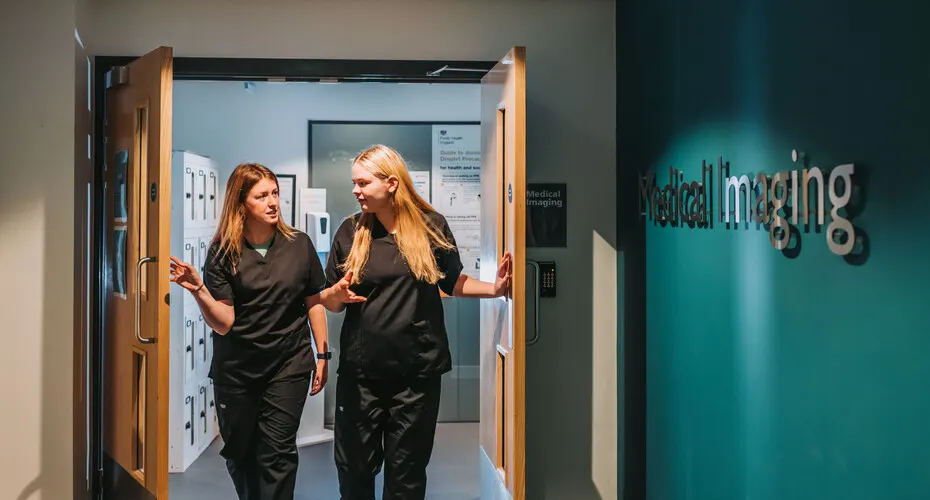
A Medical Imaging degree is a passport to an interesting job and a fulfilling career. There is a grading structure that sees an individual’s salary increase as they move up the profession. There are also management opportunities and consultant radiography posts are planned.
Radiographers trained in the UK are recognised as being among the best in the world and the health providers of many countries recruit in the UK. On graduation you will be eligible to apply for registration as a diagnostic radiographer with the Health and Care Professions Council (HCPC) and for membership of the Society and College of Radiographers. Preparing students for employment is an essential part of our programme.
Many graduates also go on to further study in the field of Diagnostic Radiography through MSc Medical Imaging.
In addition to the assessed academic and personal skills integrated within the programme, there is a schedule of additional activities designed to enhance the employability of our graduates. 88% of our Medical Imaging students are in or due to start employment or further study fifteen months after graduation.*
Further information on Diagnostic Radiography can be found at:
*based on full-time, first degree, UK domiciled graduates, HESA Graduate Outcomes survey 2018/19
Find out more about studying at Exeter








Sign-up for more information about studying with us
If you're thinking about studying BSc Medical Imaging (Diagnostic Radiography) with us, signing up to our emails is the best way to discover if we’re the right university for you.