BSc Sport Business Management
| UCAS code | C607 |
|---|---|
| Duration | 3 years |
| Entry year | 2027 |
| Campus |
Streatham Campus and St Luke's Campus, Exeter |
| Typical offer | A-Level: ABB |
|---|---|
|
A-Level: BBC |
| UCAS code | N/A |
|---|---|
| Duration | 4 years |
| Entry year | 2027 |
| Campus |
Streatham Campus and St Luke's Campus, Exeter |
| Typical offer | A-Level: ABB |
|---|---|
|
A-Level: BBC |
| UCAS code | N/A |
|---|---|
| Duration | 4 years |
| Entry year | 2027 |
| Campus |
Streatham Campus and St Luke's Campus, Exeter |
| Typical offer | A-Level: ABB |
|---|---|
|
A-Level: BBC |
Why study BSc Sport Business Management at Exeter?
- Explore the commercial and management foundations of the contemporary sports industry, through core modules in business, enterprise, e-sports, technology and the digital age, event organisation, and global issues.
- Gain insight into how the sports industry operates behind the scenes, from facilities, equipment and people management, to sponsorship, merchandising and digital innovation across public, private and third sectors.
- Tailor your studies to your interests and career goals, from grassroots to elite performance sport environments. Whether it’s working in sport, health and physical activity, events, entrepreneurship or retail through to digital media and marketing.
- Delivered jointly by the Department of Public Health and Sport Sciences and the University of Exeter Business School, the programme brings together interdisciplinary teaching and academic expertise.
- Learn alongside a diverse community of students, leading researchers and industry professionals, building leadership and management skills for careers across the global sports industry.

Top 20 in the world for Sports-related subjects
QS World University Subject Rankings 2026

Top 5 in the UK for Sports Science
5th in The Times and Sunday Times Good University Guide 2026 and the Complete University Guide 2026

Top 10 in the Russell Group for student satisfaction in four out of seven themes
Sport and Health Sciences: National Student Survey 2025

Top 10 for Business and Management
9th in The Times and The Sunday Times Good University Guide 2025 and The Complete University Guide 2026
Entry requirements (typical offer)
| Qualification | Typical offer | Required subjects |
|---|---|---|
| A-Level | ABB | n/a |
| IB | 32/655 | n/a |
| BTEC | DDM | n/a |
| GCSE | C or 4 |
English Language and Mathematics Applicants who have achieved GCSE Maths one grade below the specified requirement will be considered. These applicants may be invited to complete the Maths Transition Course and receive a conditional offer on the basis of successful course completion. |
| Access to HE | 24 L3 credits at Distinction Grade and 21 L3 credits at Merit Grade | N/A |
| T-Level | T-Levels not accepted | N/A |
| Contextual Offer | A-Level: BBC |
Specific subject requirements must still be achieved where stated above. Find out more about contextual offers. |
| Other accepted qualifications | ||
| English language requirements |
International students need to show they have the required level of English language to study this course. The required test scores for this course fall under Profile B2. Please visit our English language requirements page to view the required test scores and equivalencies from your country. |
|
NB General Studies is not included in any offer.
Grades advertised on each programme webpage are the typical level at which our offers are made and provide information on any specific subjects an applicant will need to have studied in order to be considered for a place on the programme. However, if we receive a large number of applications for the programme we may not be able to make an offer to all those who are predicted to achieve/have achieved grades which are in line with our typical offer. For more information on how applications are assessed and when decisions are released, please see: After you apply
Course content
Your studies will introduce the foundations of the global sports business industry, exploring how sport operates across commercial, public and third sectors. Core modules cover areas such as sport business, enterprise and innovation, event planning and organisation, digital technology and e-sport, and contemporary global issues including governance, sustainability and ethics.
A strong focus on employability runs throughout the programme. You will develop career planning skills, complete consultancy and project-based learning, and gain practical experience through work placements, volunteering or industry-led activities.
Optional modules across sport science and business allow you to tailor your degree to your interests, whether in entrepreneurship, health and physical activity, events or elite sport.
By graduation, you will have developed leadership, management and professional skills that prepare you for a wide range of careers or progression to postgraduate study.
Indicative module list
You may notice changes to some of our modules over the coming months. This is because we are making space for the following:
- Minors: Future Skills Pathways - Alongside your main degree you may be eligible (depending on your course) to choose modules from another subject to broaden your skills and interests.
- Skills to Thrive built into every degree - Essential skills for your future, including communication, problem-solving, teamwork and digital confidence.
- Increased innovation and wellbeing - More room for creative learning, real-world projects and a healthier study rhythm.
The modules below provide examples of what you can expect to learn on this degree course based on recent academic teaching. The precise modules available to you in future years may vary depending on staff availability and research interests, new topics of study, timetabling and student demand.
Please note that the module information displayed here is from a previous year and is subject to change.
This programme is currently in development. Below you can view provisional module information - please note this is subject to change.
Year 1
120 credits of compulsory modules
Compulsory modules
| Module code | Module Title | Description | Credits |
|---|---|---|---|
| SHS1001 | Foundations for Employability and Career Success | Build the foundations for a successful career in sport and beyond, focusing on the key principles of employability and career planning. Supported by guest speakers, alumni insights, and mini projects, you will learn to build your personal brand, create a strong CV, and prepare for networking and work experience opportunities. | 15 |
| SHS1002 | Introduction to the Sport Business Industry | Explore the foundation of the global sports business industry and how it operates for commercial gain. You will examine key commercial areas such as media, technology, sponsorship, sporting goods, merchandise and events, while also learning how commercial organisations collaborate with the public and third (charity) sectors to create value in society. | 15 |
| BEM1023 | Discovering Management | This module provides an introduction to organisations and their management. It introduces you to major elements of management theory, both historic and contemporary in nature. | 30 |
| BEM1019 | Fundamentals of Marketing | This module is designed to introduce you to a marketing process. You will learn about the basic concepts, practices, and analytical methods of marketing and study how successful organizations conduct marketing strategy to build sustainable competitive advantage over their competitors. | 15 |
| BEA1013 | Introduction to Accounting | This module gives an introduction to the role of accounting from the perspective of the modern manager. | 15 |
| SHS1003 | Sports Enterprise and Innovation | Learn to identify entrepreneurial opportunities, develop creative solutions, and apply business model thinking to real-world sport contexts. Through case studies and collaborative projects, you will gain hands-on experience in start-up development and design thinking. | 15 |
| BEM1024 | Statistics for Business | This module will familiarise you with the principles and practice of performing statistical analyses within a range of management, marketing and business analytics settings. | 15 |
Please note that the module information displayed here is from a previous year and is subject to change.
This programme is currently in development. Below you can view provisional module information - please note this is subject to change.
Year 2
105 credits of compulsory modules; 15 credits of optional modules
Compulsory modules
| Module code | Module Title | Description | Credits |
|---|---|---|---|
| SHS2001 | Work Experience to Enhance Career Potential | In this module, you will develop career-enhancing skills through work experience, including practical workshops, projects, employer-led activities, placements, volunteering, and virtual internships. The module builds your employability through application preparation, covering commercial awareness, interview skills, assessment centres, and presentations. | 15 |
| SHS2002 | Event Planning and Organisation | In this module, you will learn to plan, organise, and deliver successful sports events. You will recognise the event lifecycle, from feasibility (concept development) and budgeting to logistics, marketing, and evaluation. You will examine how events contribute to sport, business, and community goals. | 15 |
| SHS2003 | Sports Consultancy Project | Take on the role of a sports consultant, working with a real or simulated client to solve a current industry challenge. You will apply your knowledge of sport management to research, analyse, and present strategic recommendations tailored to the client’s needs. | 15 |
| BEM2047 | Organisational Behaviour | This module builds your knowledge of organisations, and your ability to analyse organisational life. It develops a critical mindset, built from a strong understanding of organisational theory, to enable you to operate as an effective future organisational leader. | 30 |
| BEM2021 | Human Resource Management | Acquire an understanding of human resource management and how to operate as a line manager with people management responsibilities. | 15 |
Optional modules
| Module code | Module Title | Description | Credits |
|---|---|---|---|
| BEM2033 | Brands and Brand Marketing | You will learn different approaches, theories, and concepts for creating and managing brands, managing brand portfolios and insights on drivers of successful brand strategies. | 15 |
| BEM2061 | Research Methods for Marketing | The knowledge and skills gained from this module will provide you with a grounding in research design and analytical techniques (quantitative and qualitative) that can be used to underpin either industry-based marketing research or further studies. | 15 |
| BEM2039 | Business Analysis in Practice | This module introduces the key concepts and ideas about how business analytics is used in practice. It highlights the importance of data to organisations and how it can be used to improve firm performance in relation to competitors, customers, employees and processes. | 15 |
| BEM2016 | Consumer Behaviour | This module examines the development of consumer behaviour in the marketplace from different disciplinary perspectives spanning the social sciences. | 30 |
| BEM2037 | Leadership: Challenges and Practice | This module addresses the more practical, active and vocational aspects of leadership. You will be encouraged to draw on your own experience of leadership in practice, and to engage in activities which enable you to develop your own leadership capacity. | 15 |
Please note that the module information displayed here is from a previous year and is subject to change.
Professional Placement
On a Professional Placement year you will learn to apply the knowledge learnt during your first and second years, improve personal and transferable skills, make new contacts and enhance your employability.
Study abroad
The Study Abroad option allows you to study at an overseas university in your third year, earning credits towards your final degree while also gaining vital experience and employability skills.
Please note that the module information displayed here is from a previous year and is subject to change.
This programme is currently in development. Below you can view provisional module information - please note this is subject to change.
Year 3
60 credits of compulsory modules; 60 credits of optional modules
Compulsory modules
| Module code | Module Title | Description | Credits |
|---|---|---|---|
| BEM3065 | Strategy | Building upon foundational knowledge developed in earlier parts of your degree programme, the Strategy module offers a deeper perspective on the multifaceted nature of strategy implementation processes. | 15 |
| SHS3001 | Career-readiness: Preparing to Graduate | Reflect on knowledge and experiences gained, identify strengths, and update your career plan in readiness for graduation. You will learn how to present yourself confidently to employers while maximising the university career service for tailored support. | 15 |
| SHS3002 | E-Sport and Technology in the Digital Age | In this module, you will explore the rapidly evolving world of e-sport and digital technology in sport. You will examine gaming, virtual environments and emerging tech, and how streaming platforms, and data analytics are re-shaping competition and transforming fan engagement, athlete performance and other commercial opportunities. | 15 |
| SHS3003 | Contemporary and Global Issues in Sport | In this module, you will critically examine key social, political, cultural, and economic issues shaping sport in today’s globalised world. Through discussion and research, you will develop skills to analyse complex challenges and propose informed solutions, preparing you to engage with sport as a socially responsible and globally aware professional. | 15 |
Optional modules
| Module code | Module Title | Description | Credits |
|---|---|---|---|
| BUS3001 | Dissertation | The Dissertation is an opportunity to plan and manage an individual piece of research on a topic of your interest, which may not have been covered in depth during regular modules, supported with classes that explain the principles of management research. | 30 |
| BEM3055 | Ethics and Responsible Innovation | In recent years, pressure has mounted for technology to be ethically responsible - shifting technological innovation from a focus on delivering economic value to addressing societal challenges such as those outlined in the UN Sustainable Development Goals. This module will explore what ‘responsible innovation’ might look like, through research-led case studies. | 15 |
| BEM3052 | Managing Change and Crisis in Organisations | This module examines how organisations manage change and cope with crisis. The complex cultural, political and ethical issues faced by leaders, managers and change agents will be examined in detail. | 15 |
| BEM3067 | Innovation for Urgent Global Challenges | Now more than ever, it is clear that the world is facing catastrophic shocks and urgent grand challenges that cross social, economic and environmental spheres. Businesses and innovators need to work in increasingly collaborative ways which move beyond traditional boundaries and research silos. | 15 |
| BEM3092 | Business for Social and Environmental Good | As every business engages with various stakeholders and the natural environment, it should also contribute to social and environmental good. The module then explores multiple business forms, some of which might be better suited to delivering such good. | 15 |
| BEM3091 | Contemporary Challenges in HRM | This module builds on learning achieved through studying the introductory human resource management (BEM2021) module in Year 2. It prepares you for some of the HR-related challenges you are likely to face when leading teams and taking up management roles in organisations on graduation. | 15 |
| BEM3046 | Managing Human Resources: Advanced Issues | In this module you will learn more about the connection between human resource practices and the delivery of organisation objectives through a number of topics that are at the leading edge of people management practice. | 15 |
| BEM3047 | Contemporary Leadership Issues | The aim of this module is to provide you with the opportunity to actively participate in a series of discussions which focus on three key contemporary leadership issues. In doing so, the module looks to challenge your implicit conceptions of leadership and to develop a more sophisticated understanding of real-world leadership. | 15 |
| BEM3057 | Employment Law for Managers | In this module you will learn about the various ways in which the employment relationship is regulated in the UK. We will also draw on examples from other countries (particularly EU countries). The module is very practical in its orientation, focusing primarily on what managers need to do to avoid breaching employment law and having to defend their organisations in the courts. | 15 |
Course variants
BSc Sport Business Management with Professional Placement
This course offers the opportunity to take a professional placement year (through a competitive entry process). You will spend your third year on a self-organised work placement with an organisation relevant to your degree, which we support you to secure.
Why choose a professional placement year?
In your professional placement year you will learn to apply the knowledge learnt during your first and second years, improve personal and transferable skills, make new contacts and enhance your employability. Work placements allow you to gain experience of a professional workplace prior to graduating and develop your career focus, and are extremely valued by employers.
What support is available during my placement?
You will be supported through your professional placement by a programme director who will provide high-quality advice to ensure you get the most from your placement.
Does it count towards my degree?
The professional placement year counts towards your degree through the completion of your placement and associated coursework. It contributes to your final degree classification, and the words ‘with Professional Placement’ will appear in your degree title.
During your first, second and final years of study, you will follow the same programme of study as the BSc Sport Business Management (see Course content).
How does it affect my tuition fee?
If you spend a full year on a work placement, you will pay a reduced fee. Find out more in the fees section.
How do I apply?
There is no need to apply directly to this programme: apply via UCAS for BSc Sport Business Management, and you can apply to transfer onto the four-year programme with a Professional Placement once you are at Exeter.
BSc Sport Business Management with Study Abroad
Why study abroad?
Students who have studied abroad demonstrate initiative, independence, motivation and, depending on where they stay, may also have gained a working knowledge of another language – all qualities employers are looking for.
Where can I study abroad?
We have links with major universities in Australia, Hong Kong, Japan, Canada, the Netherlands, Portugal, Spain and Switzerland. You can find a complete list of International Exchange partner universities on the Study Abroad website.
What will I study whilst I am abroad?
The Study Abroad option allows you to study at an overseas university in your third year, earning credits towards your final degree while also gaining vital experience and employability skills.
Does it count towards my degree?
Yes: all assessments during the year abroad are undertaken at the host university and count towards your final degree.
Upon return to the University of Exeter, you will then complete the final year of your degree in a fourth year.
How does it affect my tuition fee?
If you spend a full academic year studying abroad you will pay a reduced fee for that year. You can find out more information in the fees section.
How do I apply?
There is no need to apply directly to this programme: apply via UCAS for BSc Sport Business Management, and you can apply to transfer onto the four-year programme with Study Abroad once you are at Exeter.
Further information
For further information on where you can go and all the issues surrounding study abroad, see the Study Abroad website.
My time at university was instrumental in shaping my career. While studying, I was also University Tennis Coordinator, overseeing the student programme and increasing participation, which taught me critical time management and practical skills that directly transferred to my current role.
I now work at the Lawn Tennis Association as Wheelchair Pathway Manager, leading regional and national programmes, talent selection and player development, and collaborating with UK Sport and Sport England.
Matthew
Sport and Health Science graduate
Fees
Tuition fees for 2026 entry
UK students: £9,790 per year
International students: £29,900 per year
Year abroad
If you transfer onto the four-year version of this degree programme and spend a full academic year studying abroad, you will pay a reduced fee of 15 per cent of the maximum fee for that year.
Professional placement year
If you choose the four-year version of this degree programme and spend a full year on a work placement (in the UK or abroad) you will pay a reduced fee of 20 per cent of the maximum fee for that year.
Scholarships
The University of Exeter offers a wide range of scholarships to support your education, with £7 million available for international students applying to study with us in the 2026/27 academic year, including our prestigious Exeter Excellence Scholarships*. We also provide scholarships for sport, music and other achievements, alongside regional and partner awards such as Chevening, The Beacon Trust and the British Council. Financial support is available for students from disadvantaged backgrounds, lower income households and other under-represented groups to help them access, succeed and progress through higher education.
* Terms and conditions, including deadlines, apply. See our website for details.
Learning and teaching
How will I learn?
You will learn through lectures, seminars, workshops and practical projects, combining sport science and business.
Case studies, consultancy projects, event planning, digital sport modules and placements give hands-on experience. Learning is supported by academics and industry professionals, developing leadership, innovation, and strategic skills for sports management careers.
How will I be assessed?
Assessment includes:
- essays,
- reports,
- presentations,
- reflective tasks,
- practical project outputs,
- and employer evaluations.
These assess knowledge, applied skills, critical thinking, and professional competence, preparing you for graduate roles or postgraduate study in the sports sector.
Where will I study?
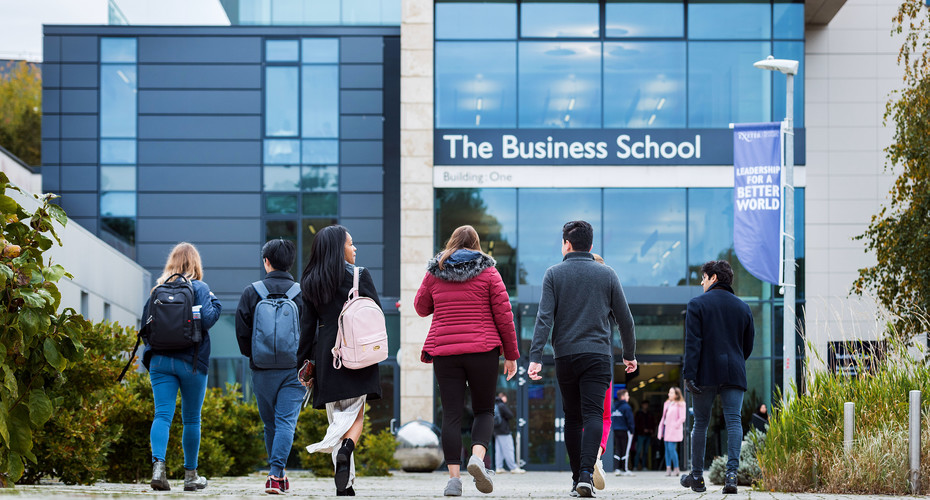
Study across Public Health and Sport Sciences at our St Luke’s Campus and the University of Exeter Business School on our Streatham Campus. Access campus teaching, digital resources, and industry-standard facilities, plus guest lectures, workshops, and placements that connect learning to real-world sports management.
Work experience and placements
Gain practical experience through consultancy projects, industry placements, volunteering, or virtual internships. Develop professional networks, hands-on skills, and applied knowledge, enhancing employability in sports management and related industries.
Research and industry insight
Learn from leading academics and industry experts. Case studies, guest speakers, and mini projects provide insight into current and emerging trends in the sports industry, including sponsorship, merchandising, fan engagement, and digital innovation.
Skills development
Build leadership, management, and professional skills. Workshops and reflective tasks develop communication, project planning, entrepreneurship, and career-readiness skills, equipping you for roles across the global sports sector.
Optional modules outside of this course
Each year, if you have optional modules available, you can take up to 30 credits in a subject outside of your course. This can increase your employability and widen your intellectual horizons.
Minors: Future Skills Pathways
You can study a Future Skills Pathway alongside your main degree by choosing up to 30 credits of modules from a different subject area in your second and final years.
Your future
Develop employer-valued skills
This degree equips you with leadership, management, and professional skills valued across the global sports industry. You’ll gain expertise in strategy, event planning, digital sport, innovation, and entrepreneurship.
Practical projects, consultancy tasks, and reflective workshops build communication, problem-solving, teamwork, and career-readiness skills that employers seek in community sport, elite performance, fitness brands, and global sports organisations.
Employer visits
Engage directly with the sports industry through guest lectures, employer talks, and site visits. You’ll gain insight into real-world operations, current trends, and career opportunities in sponsorship, merchandising, sports technology, digital innovation, and events, connecting classroom learning to professional practice.
Work experience and placements
Enhance employability with industry placements, consultancy projects, volunteering, or virtual internships. Apply academic knowledge in real-world settings, develop professional networks, and gain hands-on experience in sports management, events, public health, or elite sport environments.
Research and industry insight
Learn from leading academics and industry professionals. Case studies, mini projects, and interactive workshops provide insights into emerging trends, governance, sustainability, fan engagement, and business strategy, preparing you to respond to evolving challenges in the sports sector.
Career paths
Graduates may pursue careers across community sport, elite performance, global brands, health promotion, events management, digital sport, sponsorship, and fitness entrepreneurship. The degree equips you with versatile skills and industry connections that give a competitive edge in the global sports market.
Further study
This programme provides a strong foundation for postgraduate study, including MSc Sports Management. Optional modules and practical experience prepare you to progress to advanced study in leadership, strategy, sports science, or business management.
Employability support
Benefit from our tailored Careers Service offering workshops, and guidance on CVs, interviews, networking, and job applications. The course integrates employability from day one, giving you confidence, industry insight, and a clear pathway to graduate roles or entrepreneurial ventures.