ESI Challenge of the Month
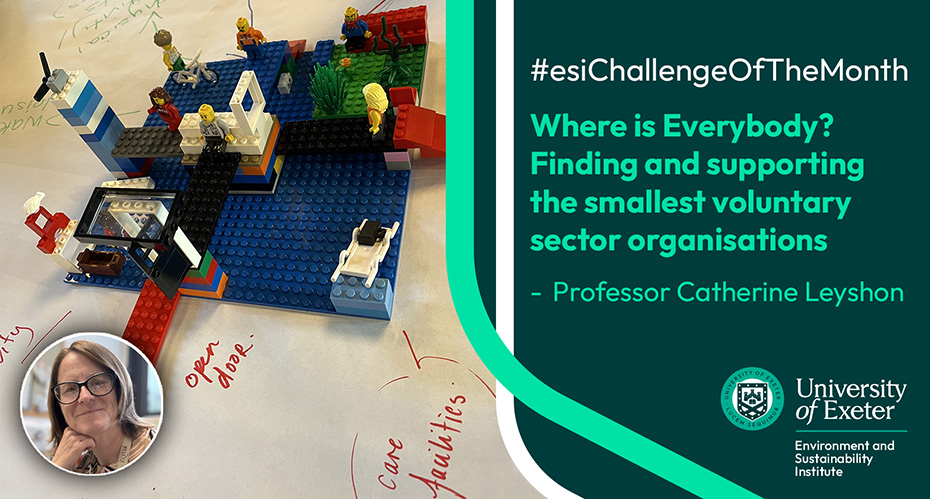
Professor Catherine Leyshon (from the Department of Earth and Environmental Science), has taken up the ESI Challenge of the Month for January 2026.
Professor Catherine Leyshon delivered the #esiChallengeOfTheMonth (hybrid) talk "Where is Everybody? Finding and supporting the smallest voluntary sector organisations" in the ESI Trevithick Room on Monday 26 January 1 - 2pm.
This talk examines the challenges and opportunities facing small voluntary and community organisations in England. Using the metaphor of the "microbiome," it highlights how the smallest voluntary sector organisations—comprising an estimated 335,000 unregistered groups alongside 132,000 registered ones—are essential components of public service delivery, community support, and care for the environment. And yet we have no true idea of how many of these organisations there are, where they are, or how they help. The current estimates of the size and shape of the voluntary sector are based on extrapolation. This has implications at the local and national level: it is currently not possible to understand the range of and gaps in provision across Cornwall or advocate powerfully for the value of the voluntary sector at a national level. This talk covers what might be done about this, and how the question of finding the microbiome leads into a wider national conversation about the quality and consistency of the data we have on the voluntary sector.
The full video recording of this talk can be viewed below:
Previous challenges

Dr Jamie Hampson, Associate Professor in the History department, Humanities and Social Sciences, Cornwall, took up the ESI Challenge of the Month for November 2024.
Click here to view his profile page.
Relevant research:
An internationally known scholar of Indigenous heritage, rock art, and symbolism, Dr Hampson has documented and analysed more than 1600 rock art sites in southern Africa, Australia, the Americas, India, and Europe. He has published the following books on Rock Art:
- Hampson, J., Goldhahn, J., & Challis, S. (2022). Powerful pictures: Rock art research histories around the world. Archaeopress.
- Hampson, J., & Rozwadowski, A. (2021). Visual Culture, Heritage and Identity: Using Rock Art to Reconnect Past and Present. Archaeopress.
- Hampson, J. (2016). Rock art and regional identity: a comparative perspective. Routledge. [First edition published in 2015; paperback published in 2021.]
Since 1999, Jamie has delivered more than one hundred conference papers, and organised three major conferences that span history, heritage studies, environmental humanities, archaeology, and anthropology. Some of his recent papers:
- Hampson, J., Iriarte, J., & Aceituno, F. J. (2024). 'A World of Knowledge': Rock Art, Ritual, and Indigenous Belief at Serranía De La Lindosa in the Colombian Amazon. Arts, 13(4), 135.
Read the University press release here. This was also featured in the Newsweek. - Robinson, M., Hampson, J., Osborn, J., Aceituno, F. J., Morcote-Ríos, G., Ziegler, M. J., & Iriarte, J. (2024). Animals of the Serranía de la Lindosa: Exploring representation and categorisation in the rock art and zooarchaeological remains of the Colombian Amazon. Journal of Anthropological Archaeology, 75, 101613.
- Hampson, J. & Challis, S. Cultures of appropriation: rock art ownership, Indigenous intellectual property, and decolonisation. In: Moro Abadia, Conkey, & McDonald (eds), Deep-Time Images in the Age of Globalization: Understanding Rock Art in the 21st Century, 275–288. New York: Springer.
Dr Hampson's three large interdisciplinary research grants (£1.3 million in total) were and are supported by Indigenous groups and government bodies, and they continue to have international impact. Here is a recent grant award:
- Dr Jamie Hampson has been awarded £225,000 as a Co-PI with physicist Dr Tessa Charles (University of Liverpool/ Australian Synchrotron) and archaeologist Dr Courtney Nimura (Ashmolean Museum, Oxford) on a UKRI Biotechnology and Biological Sciences Research Council interdisciplinary project.
NoMAD (Non-destructive Mobile Analysis and imaging Device) draws on technology developed for particle accelerators to bring scientific analysis techniques to Indigenous rock art and other remote heritage sites. The project focuses on rock art – a crucial part of our shared global cultural heritage – and the design and development of a portable particle accelerator. This project is a world-first, revolutionary in the fields of physics and cultural heritage management.
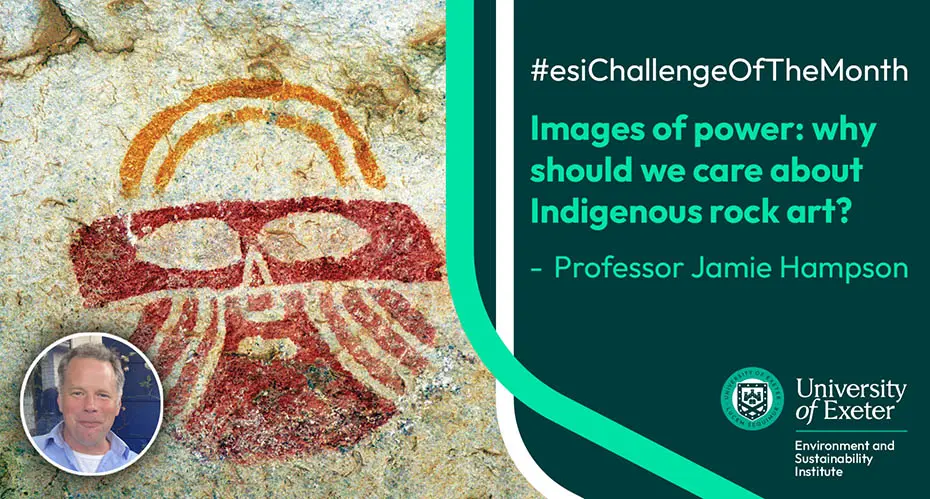
Dr Jamie Hampson delivered the ESI Challenge of the Month talk "Images of power: why should we care about Indigenous rock art?" on Monday 25 November 1 - 2pm in the ESI Trevithick Room.
Sacred Indigenous rock paintings and engravings are found in different landscapes in almost every country around the world. Some motifs are at least 75,000 years old; some were painted yesterday.
We do not always know exactly what the rock imagery means, but thanks to intertwining strands of evidence we do know a great deal – especially in regions where the descendants of the original artists still survive. Indeed, rock art motifs were – and often still are – ‘powerful things in themselves’, and an integral part of sacred Indigenous heritage. Tragically, however, rock art in some parts of the world is threatened by industrial development and climate change.
In this talk, I draw from 25 years of archaeological and anthropological fieldwork in southern Africa, the Americas, and Australia.
#esiChallengeOfTheMonth