| UCAS code | A100 |
|---|---|
| Duration | 5 years |
| Entry year | 2026 |
| Campus |
St Luke’s and Truro |
| Discipline | Medicine |
| Contact | Web: Enquire online |
| Typical offer | A-Level: A*AA |
|---|---|
|
A-Level: AAB |
Overview
- You will have clinical experience from the first month of the programme in a variety of locations; hospitals, General Practice and the wider health community
- Learn in small groups using real-life clinical examples
- Gain an excellent understanding of the basic and clinical sciences necessary to be a doctor
- Study in a world-leading, internationally-recognised, research-rich environment
- You will have the opportunity to obtain an intercalated degree at either Bachelors or Masters level

Joint 1st in the UK for Medicine by Graduate Prospects
The Complete University Guide 2026

12th for Medicine in The Guardian University Guide 2026

Top 20 in the UK for Medicine
17th in The Times and The Sunday Times Good University Guide 2026

Major capital investment in new buildings and state-of-the-art facilities
Accreditations
Accredited by the General Medical Council
Entry requirements (typical offer)
| Qualification | Typical offer | Required subjects |
|---|---|---|
| A-Level | A*AA | A in Chemistry and A in Biology |
| IB | 38/766 | HL 6 in Chemistry and HL 6 in Biology |
| BTEC | D*DD | Applicants studying a BTEC Extended Diploma will also require GCE A-Level Biology and Chemistry grade A. |
| GCSE | B or 6 | English Language |
| Access to HE | Pass the QAA-approved Access to HE Diploma with 30 L3 credits at Distinction and 15 L3 credits at Merit | 15 L3 credits at Distinction in a Biology-related subject and 15 L3 credits at Distinction in a Chemistry-related subject |
| T-Level | T-Levels not accepted | N/A |
| Contextual Offer | A-Level: AAB |
Specific subject requirements must still be achieved where stated above. Find out more about contextual offers. |
| Other accepted qualifications | ||
| English language requirements |
International students need to show they have the required level of English language to study this course. The required test scores for this course fall under Profile G. Please visit our English language requirements page to view the required test scores and equivalencies from your country. |
|
NB General Studies is not included in any offer.
Grades advertised on each programme webpage are the typical level at which our offers are made and provide information on any specific subjects an applicant will need to have studied in order to be considered for a place on the programme. However, if we receive a large number of applications for the programme we may not be able to make an offer to all those who are predicted to achieve/have achieved grades which are in line with our typical offer. For more information on how applications are assessed and when decisions are released, please see: After you apply
All applicants are required to have taken either the UCAT Test or the GAMSAT Test.
All applications are considered on an individual basis and offers will be made by the end of March. Please see the BMBS Admissions Process Policy 2026 (.pdf) for full details on our admissions selection process.
Completing your application form
All applications for full-time study must be made through UCAS. The deadline for applications to UCAS is 15 October. No more than four choices should be used for clinical programmes. Please note meeting the typical offer range does not guarantee being shortlisted for an interview. Shortlisted applicants will be invited for interview between December and March.
Additional entry requirements
UCAT - Candidates applying with predicted or achieved A levels will also be required to sit the University Clinical Aptitude Test (UCAT). Applications will then be sorted according to academic profile and UCAT overall score in order to determine which applicants will receive an offer of an interview. Watch the UCAT Preparation plan video.
GAMSAT - Candidates applying with an existing degree, or if it will be more than two full academic years (September to August) since you completed your A levels or equivalent qualifications when you enter the BMBS programme, will be required to sit the Graduate Medical School Admissions Test (GAMSAT). Applications will be sorted according to the GAMSAT overall score.
Offers/interviews
The interview style will be Multiple Mini Interview (MMI). The interview may take place either in person or online.
Assistance for travel is available to those who meet certain eligibility criteria.
Health assessments and DBS
All successful applicants after interview will be required to complete a health questionnaire and those accepting an offer will be screened by our Occupational Health Department. You may be required to attend a medical examination as part of the admissions process. You will be required to have up to date vaccination records for relevant innoculations in line with University requirements and those of your placement providers.
We require all medical students to be immunised against certain infectious diseases to meet health and safety standards required to work with patients. We will require students to provide evidence of two MMR jabs, and in addition undergo tests to determine their Hepatitis B surface antigen, TB and HIV status.
Enrolled medical students will be unable to undertake their studies without evidence of completion of the vaccination process.
Offers for this programme will be conditional on a completed Enhanced Disclosure and Barring Service (DBS) check.
All successful applicants will be required to sign the appropriate student agreement.
Selection process
If you have any questions relating to submitting an application for the BMBS programme we recommend that you review our BMBS FAQs page prior to contacting us via telephone or e-mail.
Course content
The five-year Bachelor of Medicine, Bachelor of Surgery (BMBS) programme draws on the strength of our partnership with the NHS in Devon and Cornwall to provide a unique learning experience in healthcare. It develops skills for lifelong learning and the professional attitudes that you will need throughout your medical career. The importance of a multi-professional perspective is a key component.
The curriculum provides a clinical focus that is patient-centred, forward-thinking and meets the needs of students who want to work as doctors in an increasingly integrated health environment. It also includes the whole health community, not just hospitals. This recognises the community role in chronic illness and prevention and provides the social context, giving you a wider perspective and understanding.
Clinical placements
You will gain placement experience throughout your studies. In the later years of the programme you will be immersed in the clinical environment with extensive opportunities for learning from patients as you move through the pathways of the patient care programme.
The community placements provide experience of the multi-professional nature of medicine and the importance of the healthcare team.
Peer physical examinations
When able, students are encouraged to take part in peer physical examinations, where students perform non-intimate examinations on one another to gain better understanding and knowledge of anatomy and physiology.
Intercalation between years 3 and 4
An intercalated degree provides the opportunity to explore another discipline at degree level, bringing added breadth and depth to your study. You may have the opportunity to choose to intercalate and study 120 credits from another Bachelor’s degree (usually the final year) or a one-year Masters degree from a wide range of options available at the University of Exeter.
Although intercalation means an extra year of study, it can enhance the undergraduate experience by providing additional specialist knowledge and transferable skills which can be a real asset in your future professional life.
Electives
The electives form a very important part of the curriculum, enabling you to experience medicine in an entirely new environment, both socially and culturally. Electives may involve clinical or research placements, or a combination of both. Many students take this opportunity to see the practice of medicine in another part of the world, for example, by exploring the delivery of clinical care in low- and middle-income countries, through placements in mission or government hospitals. Other students arrange elective placements within the South West or other parts of the UK. There are few restrictions on what you might wish to do, provided this is clearly set out in the context of agreed learning objectives and meets clinical and health and safety risk assessment requirements.
UK Foundation Programme (UKFP)
At the end of the undergraduate programme you will receive your BMBS degree, which is a primary medical qualification (PMQ). This entitles you to provisional registration with the General Medical Council (GMC). Provisionally registered doctors can only practise in approved UKFP Foundation Year 1 posts: the law does not allow provisionally registered doctors to undertake any other type of medical work. To obtain a Foundation Year 1 post you will need to apply during the final year of your undergraduate degree through the UK Foundation Programme Office selection scheme, which allocates these posts to graduates on a competitive basis.
In your first year, you will learn core biomedical and psychosocial concepts within clinical context. You will be based predominantly at St Luke’s Campus in Exeter, alongside clinical placement experiences and clinical skills training.
In the second year you will further develop your core biomedical, psychological, sociological and population health knowledge (also predominantly on St Luke’s Campus), in a more integrated and further contextualised manner, increasing your range of clinical skills and contextualising your learning with placement experience.
Compulsory modules
| Code | Module | Credits |
|---|---|---|
| MDC2001 | BMBS Medicine Year 2 | 120 |
In the third year, you will commence Clinical Pathways 1 at one of our secondary care NHS Trust sites. Your learning will be patient-centred and you will rotate through a series of hospital and community placements across either Devon or Cornwall.
Compulsory modules
| Code | Module | Credits |
|---|---|---|
| MDC3001 | Clinical Pathways 1 | 120 |
Clinical Pathways 2 is undertaken in your fourth year and will provide extensive experience of a wide range of clinical settings throughout either Devon or Cornwall, further increasing your clinical knowledge and skills particularly through an increasing range of clinical specialities.
Compulsory modules
| Code | Module | Credits |
|---|---|---|
| MDC4001 | Clinical Pathways 2 | 120 |
In your final year, you will consolidate your skills and refine your practice in preparation for graduation as a doctor. You will undertake a series of apprenticeship attachments in NHS hospitals and in primary care across the South West.
At this stage you will have developed the personal and learning skills required to analyse and evaluate patients’ conditions and to suggest forms of clinical management. You’ll also take a Student-Selected Elective which may involve clinical or research placements, or a combination of both. Many students take this opportunity to see the practice of medicine in another part of the world.
Compulsory modules
| Code | Module | Credits |
|---|---|---|
| MDC5001 | Preparation for Medical Practice | 145 |
Fees
Tuition fees for 2026 entry
UK students: £9,790 per year
International students: £48,900 per year
Scholarships
The University of Exeter offers a wide range of scholarships to support your education, with £7 million available for international students applying to study with us in the 2026/27 academic year, including our prestigious Exeter Excellence Scholarships*. We also provide scholarships for sport, music and other achievements, alongside regional and partner awards such as Chevening, The Beacon Trust and the British Council. Financial support is available for students from disadvantaged backgrounds, lower income households and other under-represented groups to help them access, succeed and progress through higher education.
* Terms and conditions, including deadlines, apply. See our website for details.
Learning and teaching
Our learning and teaching are based around a patient-centred education and a culture that is sensitive to the needs of our students. A patient-centred education means that you will become a clinically skilled graduate with a strong knowledge of contemporary science, an awareness of research and excellent professional behaviour. You will benefit from structured small group learning and an intensively supported learning environment and be taught to challenge, stretch, reward and empower yourself.
On graduation you will be able to approach clinical problems holistically, have excellent communication skills, be empathetic and a good listener. You will be confident working in multi-professional teams, be able to seek and appraise the best evidence to inform your practice and be capable of meeting the health care needs of society.
Campus allocations
The BMBS programme at the University of Exeter offers an extensive array of clinical placement experiences, having access to placement providers ranging across coastal, rural and urban environments. This equips our graduates well for any Foundation doctor job after graduation. Therefore whilst studying for the BMBS at Exeter, you will be expected to spend a portion of your degree studying in different locations across Devon and Cornwall.
As well as placements across Devon, this will include a minimum of one year being based in the Knowledge Spa at the Royal Cornwall Hospital Trust (Truro), which is a modern, multi-disciplinary building with specialist teaching facilities. You will be required to relocate to Cornwall to undertake this portion of your education. Find out more about Student Life in Cornwall, where some medical students choose to live on Penryn Campus, and others live in Truro.
Time for independent study is built into the timetable, enabling you to take advantage of the wide array of resources available to support your learning. You will have access to excellent amenities; at the University and NHS sites there are extensive library and learning facilities. State-of-the-art IT and e-learning resources are a key tool to help support your learning.
In the later years of the programme your learning occurs predominantly within the clinical environment with extensive opportunities for learning from patients as you move through the pathways of the patient care programme.
Small group learning
The first two years of the curriculum are centred around small group learning. In small groups, you’ll work through a series of clinical cases to build your knowledge base. You will be guided to prepare for timetabled sessions. Between these sessions, you will undertake research and independent study on all aspects of the case from the biomedical, public health, human science and professional points of view, then share your findings with others in subsequent sessions.
Lectures
You will come together with other students for large group teaching sessions in lecture theatres. These lectures focus on specific subjects relevant to the cases you are studying and often involve external experts.
The Life Sciences Resource Centre
The Life Sciences Resource Centre (LSRC) develops your knowledge of the structure and function of the human body. Your understanding of anatomy develops through using medical imaging, including x-rays, magnetic resonance imaging and ultrasound, coupled with the study of plastinates, models, living anatomy and virtual multimedia methods. Relevant clinical anatomy is taught using the knowledge and experience of clinicians.
The Clinical Skills Resource Centre
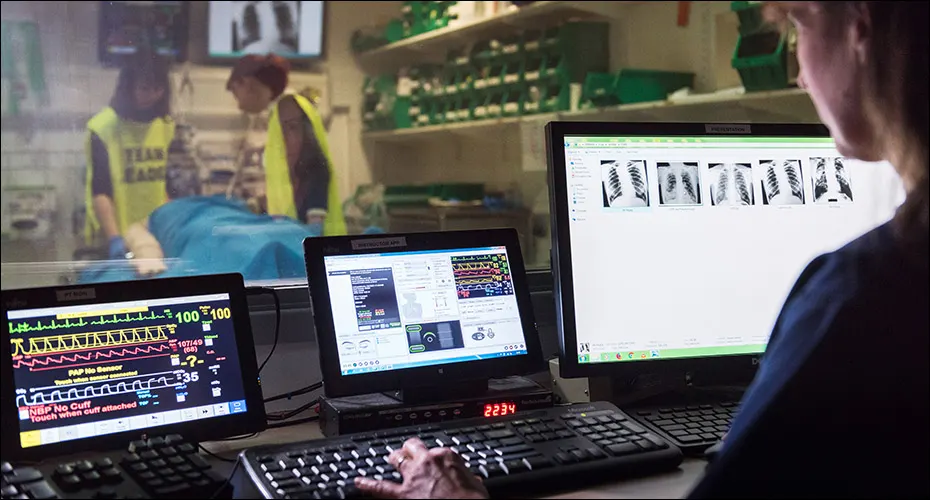
You’ll learn clinical and communication skills in a safe environment within the Clinical Skills Resource Centre (CSRC), before using them in a real clinical setting. The CSRC contains state-of-the-art electronic patient simulators, mock NHS wards and emergency departments. You will learn to gather information, carry out physical examinations, conduct patient and family interviews, develop your diagnostic skills and perform a variety of practical procedures including injections, venepuncture and basic life support. You will also develop the ability to interact with patients in a variety of situations. Learning and improving communication skills enables you to understand the needs of individual patients, physically and psychologically.
Clinical placements
Extensive exposure to real patients in clinical settings underpins the development of your clinical skills. This experience will help you become an expert in the clinical environment. In your clinical placements during the first two years, you’ll experience how healthcare is delivered in both the community and hospital. You will normally meet your first patient early in the first term of your first year.
During your placements, you will also learn from patients about the breadth of diseases and health problems in a community and the effect of social and environmental factors on disease. This will help you to understand the multi-professional nature of medicine and the importance of the wider healthcare team.
Integrated clinical learning
In years 3 and 4, the programme is divided into ‘pathways of care’. In your third year you will study pathways in medicine, surgery, general practice, mental health and other hospital specialities. In year four, these continue with a focus on acute care, the complexities of chronic care, child health and palliative care/oncology. These pathways emphasise the importance of continuing to acquire knowledge in biomedical science, psychology, sociology and population health, while also refining and building on the clinical and communication skills you developed in your first two years.
Integrated science learning
Your knowledge of biomedical, clinical and human science is developed during placements, through meeting patients at home, in general practice, in acute and community hospitals and through interaction with healthcare professionals in their working environment. You will experience how the NHS works as a team to deliver patient care.
Your learning during each pathway is supported by an academic programme, which develops your knowledge of common medical conditions and professional issues. You will experience a consolidated programme of scheduled small group activities: complementing your clinical experiential learning and helping to integrate your scientific and clinical knowledge. The continuing emphasis on teaching and learning in small groups continues helping you understand the key concepts and knowledge that relate to each pathway.
Special study units
Special study units involve working with staff from the NHS, the University and the community in a wide range of disciplines to study areas of particular interest to you. With a wide range of topic areas, the units provide a challenging and stimulating way to develop your critical thinking, scientific and analytical skills.
During the first two years, SSUs focus on developing your academic, scholarship and research skills. In your third and fourth years, you’ll continue to develop your research and scholarship skills in the clinical environment; for example, developing your own learning and teaching skills to support your education role as a future doctor.
Academic tutor
All students are allocated a tutor who oversees academic progress and personal and professional development. Your tutor is the first point of contact for academic support for the duration of the programme. You will change tutors each year.
Assessment
Assessment is an important part of the learning process: it demonstrates the standard you are achieving as well as that to which you are working.
Your progress is assessed in relation to your knowledge and your work in clinical practice and you will be provided with continuous feedback, enabling you to identify strengths as well as areas for improvement.
Academic review
Your performance in assessment is formally reviewed each term to ensure that any problems that you may be experiencing with your learning can be identified early. We seek to support students whose performance may be a cause for concern. If you need support you will be referred to trained staff and receive a confidential report containing recommendations on how changes to individual learning styles, techniques, assessment strategies and attitude to work may improve performance.
In addition, at the end of the academic year all aspects of your performance are reviewed to ensure you are ready to move onto the next year of study or receive your primary medical qualification at the end of year five. If you are not ready to progress, you might be asked to repeat a year, but we never ask students to leave the programme on academic grounds without giving them plenty of opportunity to reflect on, review and remediate their performance.
Your future
Provisional registration with the GMC
The General Medical Council (GMC) is the regulatory body for all doctors and medical students in the UK. Like all the medical schools in the UK, we have to demonstrate that our course and assessments reach the standard that the GMC expects, so they are able to reassure the public that our graduates are safe to practice medicine.
With this in mind, the GMC has introduced the Medical Licensing Assessment (MLA) which all students in UK medical schools will have to take and pass to enable them to graduate and practice as doctors from the academic year 2024-25. The MLA is an assessment framework designed to test the core knowledge, skills and behaviours of doctors new to medical practice in the UK.
It is a two-part assessment made up of an applied knowledge test (AKT) and a clinical and professional skills assessment (CPSA). You will take both parts as part of your BMBS programme at Exeter, on dates chosen by the programme to fit with our course. Our BMBS programme has been carefully mapped to the MLA Content Map so that engagement with our programme prepares you well for success in that assessment.
When you successfully complete the undergraduate programme, which is subject to General Medical Council (GMC) quality assurance, you will receive your BMBS degree, which is a primary medical qualification (PMQ). Holding a PMQ entitles you to provisional registration with the GMC. Provisionally registered doctors can only practise in approved Foundation Year 1 posts: the law does not allow provisionally registered doctors to undertake any other type of work.
To obtain a Foundation Year 1 post you will need to apply during the final year of your undergraduate degree through the UK Foundation Programme Office selection scheme, which allocates these posts to graduates on a competitive basis. So far, all suitably qualified UK graduates have found a place on the Foundation Year 1 programme, but this cannot be guaranteed.
Successful completion of the Foundation Year 1 programme is normally achieved within 12 months and is marked by the award of a Certificate of Experience. You will then be eligible to apply for full registration with the General Medical Council. You need full registration with a licence to practise for unsupervised medical practice in the NHS or private practice in the UK.
To find out about registration information for the General Medical Council (GMC), please read our Information regarding registration with the GMC document.
International students and GMC recognition
GMC-accredited Medical degrees are recognised in many countries around the world. International students are encouraged to check with their local Medical Councils on the recognition of our BMBS programme as different legislation may apply. The Faculty doesn't guarantee registration in other countries that we are not currently registered in.
Postgraduate foundation training and beyond
Holding a PMQ entitles you to provisional registration with the General Medical Council, subject only to its acceptance that there are no Fitness to Practise concerns that need consideration. Provisional registration is time limited to a maximum of three years and 30 days (1125 days in total). After this time period your provisional registration will normally expire. Please note: students need to be aware that regulations in this area may be subject to change.
There is a broad spectrum of careers within clinical practice across medical, surgical and other specialities. Whilst many of these have historically been hospital-based, healthcare is moving towards a more community-centred model of delivery and consequently doctors will be increasingly expected to deliver healthcare in a range of settings.
The range of placement opportunities throughout the programme will help to develop your skills and experience of working in different healthcare settings and enable you to understand how organisations operate.
This, alongside tailored careers advisory sessions and events provided in partnership with the Health Education South West (formerly the South West Peninsula Deanery) will also help you to make informed career choices.
The highlights for me have been the fantastic placements which I have been able to experience from the first week at Exeter. It has allowed me to grow and develop into a future doctor, not just a medical student.
Kayleigh
BMBS Medicine
Intercalation
During an intercalated year students take a one-year interlude in the Medicine programme to study a subject of their choice at either Bachelor’s or Master’s degree level. This optional opportunity enables selected students to pursue a subject of their choice in depth supplementing the vigorous education that they receive as part of the Medicine programme. An intercalated degree may be particularly beneficial to those considering a career in research or academic medicine.
When can students undertake an intercalated degree?
Currently, the University of Exeter offers students the opportunity to undertake an intercalated degree between years 3 and 4 of the Medicine programme.
Can external students apply to intercalate at the University of Exeter?
Yes - The University of Exeter welcomes applications from medical, veterinary and dental students from across the UK who have completed at least two years of their course (or three years for applications to Master’s level programmes), who have permission to undertake an intercalated degree from their home institution and will return to their home institution upon completion of the course.
If you are an external student interested in pursuing an intercalated degree at the University of Exeter, please visit the External Intercalation Applicants page or contact: ICD@exeter.ac.uk.
What intercalated programmes are available at the University of Exeter?
Bachelor’s Degree programmes
The University of Exeter offers a number of different intercalated Bachelor’s degree programmes. Unless stated otherwise these courses are taught at the Exeter-based campuses.
Intercalated BSc:
- Biological Sciences
- Conservation Biology (Cornwall Campus)
- Evolutionary Biology (Cornwall Campus)
- Exercise & Sports Science
- Infectious Disease
- Biomedical Sciences
- Molecular & Cellular Science
- Neuroscience
- Psychological Studies
- Zoology (Cornwall Campus)
All programmes listed are subject to availability.
Master’s Degree programmes
The University of Exeter offers numerous different Master’s degree programmes:
- MSc Bioarchaeology
- MSc Clinical Education
- MSc Environment & Human Health
- MSc Genomic Medicine
- MSc Global Healthcare Management
- MSc Health Data Science
- MSc Health Research Methods
- MSc Sports and Exercise Medicine
- Master of Public Health (MPH)
- MSc Extreme Medicine
All programmes listed are subject to availability.
For further information, or if you are an external student interested in pursuing an intercalated degree at the University of Exeter, please contact: ICD@exeter.ac.uk
Joint 1st in the UK for Medicine by Graduate Prospects
The Complete University Guide 2026
12th for Medicine in The Guardian University Guide 2026
Top 20 in the UK for Medicine
17th in The Times and The Sunday Times Good University Guide 2026
Major capital investment in new buildings and state-of-the-art facilities